

Pirazzoli, P. A., Montaggioni, L. F., Salvat, B., and Faure, G., 1988.
Late Holocene sea level indicators from twelve atolls in the
central and eastern Tuamotus (Pacific Ocean). Coral reefs,
7(2), 57–68.
Tracey, J. I., Ladd, J. S., and Hoffmeister, J. E., 1948. Reefs of
Bikini, Marshall Islands. Bulletin of the Geological Society of
America, 59, 861–878.
Cross-references
Algae, Coralline
Forereef/Reef Front
Reef Front Wave Energy
Spurs and Grooves
ANTECEDENT PLATFORMS
Peter J. Davies
University of Sydney, Sydney, NSW, Australia
Definition
Antecedent Platforms are the surfaces, usually older reefs
which have been exposed to the atmosphere, and which
form the foundation for later reef growth.
Introduction
In the study of coral reefs, the term “antecedent platform”
has a special place for three reasons. First, in various guises,
it stood as a challenge to Darwin’s championing of subsidence as the principle factor in coral reef growth; second,
it stood against the need for glacial eustacy as a factor in reef
growth; and third, as a special case (limestone platforms),
and at a later time, it co-defined a new paradigm for the evolution of the foundations of modern reefs. The thinking on
antecedent platforms moved therefore from the broad to
the specific, from “the alternative” to “center-stage,” albeit
coupled with other processes. This contribution traces these
views accenting more the later process-related views but
placed within the context of the earlier history.
In the beginning!!
In the middle and early nineteenth century, ideas on reef
evolution and growth were dominated by Darwin’s theory
that subsidence played a critical role in the evolution of
coral reefs from fringing to barrier to atolls (1842)
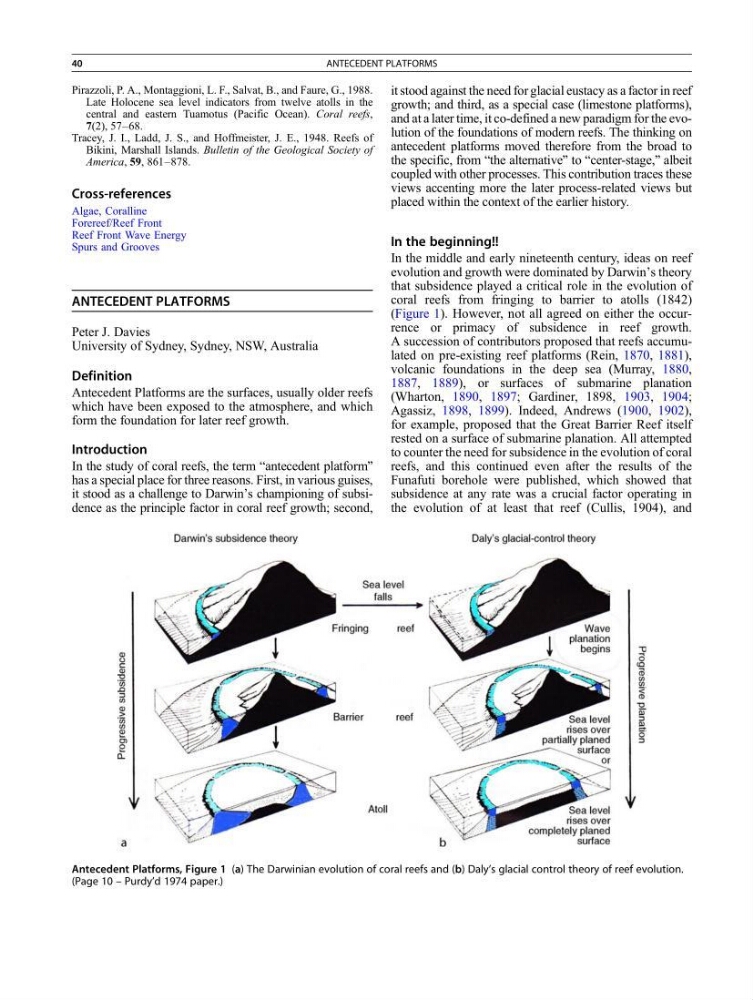
(Figure 1). However, not all agreed on either the occurrence or primacy of subsidence in reef growth.
A succession of contributors proposed that reefs accumulated on pre-existing reef platforms (Rein, 1870, 1881),
volcanic foundations in the deep sea (Murray, 1880,
1887, 1889), or surfaces of submarine planation
(Wharton, 1890, 1897; Gardiner, 1898, 1903, 1904;
Agassiz, 1898, 1899). Indeed, Andrews (1900, 1902),
for example, proposed that the Great Barrier Reef itself
rested on a surface of submarine planation. All attempted
to counter the need for subsidence in the evolution of coral
reefs, and this continued even after the results of the
Funafuti borehole were published, which showed that
subsidence at any rate was a crucial factor operating in
the evolution of at least that reef (Cullis, 1904), and
Antecedent Platforms, Figure 1 (a) The Darwinian evolution of coral reefs and (b) Daly’s glacial control theory of reef evolution.
(Page 10 – Purdy’d 1974 paper.)
40
ANTECEDENT PLATFORMS
Late Holocene sea level indicators from twelve atolls in the
central and eastern Tuamotus (Pacific Ocean). Coral reefs,
7(2), 57–68.
Tracey, J. I., Ladd, J. S., and Hoffmeister, J. E., 1948. Reefs of
Bikini, Marshall Islands. Bulletin of the Geological Society of
America, 59, 861–878.
Cross-references
Algae, Coralline
Forereef/Reef Front
Reef Front Wave Energy
Spurs and Grooves
ANTECEDENT PLATFORMS
Peter J. Davies
University of Sydney, Sydney, NSW, Australia
Definition
Antecedent Platforms are the surfaces, usually older reefs
which have been exposed to the atmosphere, and which
form the foundation for later reef growth.
Introduction
In the study of coral reefs, the term “antecedent platform”
has a special place for three reasons. First, in various guises,
it stood as a challenge to Darwin’s championing of subsidence as the principle factor in coral reef growth; second,
it stood against the need for glacial eustacy as a factor in reef
growth; and third, as a special case (limestone platforms),
and at a later time, it co-defined a new paradigm for the evolution of the foundations of modern reefs. The thinking on
antecedent platforms moved therefore from the broad to
the specific, from “the alternative” to “center-stage,” albeit
coupled with other processes. This contribution traces these
views accenting more the later process-related views but
placed within the context of the earlier history.
In the beginning!!
In the middle and early nineteenth century, ideas on reef
evolution and growth were dominated by Darwin’s theory
that subsidence played a critical role in the evolution of
coral reefs from fringing to barrier to atolls (1842)
(Figure 1). However, not all agreed on either the occurrence or primacy of subsidence in reef growth.
A succession of contributors proposed that reefs accumulated on pre-existing reef platforms (Rein, 1870, 1881),
volcanic foundations in the deep sea (Murray, 1880,
1887, 1889), or surfaces of submarine planation
(Wharton, 1890, 1897; Gardiner, 1898, 1903, 1904;
Agassiz, 1898, 1899). Indeed, Andrews (1900, 1902),
for example, proposed that the Great Barrier Reef itself
rested on a surface of submarine planation. All attempted
to counter the need for subsidence in the evolution of coral
reefs, and this continued even after the results of the
Funafuti borehole were published, which showed that
subsidence at any rate was a crucial factor operating in
the evolution of at least that reef (Cullis, 1904), and
Antecedent Platforms, Figure 1 (a) The Darwinian evolution of coral reefs and (b) Daly’s glacial control theory of reef evolution.
(Page 10 – Purdy’d 1974 paper.)
40
ANTECEDENT PLATFORMS