

shallow, relatively high-energy facies, that can still be
found in the same area today. Between 4,700 and 2,900
yr B.P. sea level fell, exposing the buttresses, and by
2,850 year B.P. corals settled on the present reef flat and
the algal ridge began to develop (Figure 4). A total of 45
species, which still occur in the area, are recorded in the
Merizo Limestone (Siegrist et al., 1984a; Randall et al.,
1984). The dominant corals were corymbose Acropora
which fueled the rapid growth and aggradation of the
reefs. Similar facies were also described from Rota (Bell
and Siegrist, 1988): (1) coral framestone facies of corymbose Acropora (primarily A. humilis; Kayanne et al.,
1993) and in leeward settings of Porites mounds, considered to be the catch-up phase of reef growth; (2) algal
bindstone facies, which are interpreted as the keep-up
algal ridge; and (3) detrital facies at the leeward margin
of the reef. High-magnesium cements were common
besides aragonite cements.
On Guam and Rota, the early Holocene fringing reef
(Merizo Limestone on Guam and Milancatan Limestone
on Rota) displaced later Holocene reef growth seaward
(Kayanne et al., 1993). Early Holocene limestones are well
eroded, in particular, in the softer landward, detrital facies
behind the corymbose coral facies (Siegrist et al., 1984a),
in which deep lagoons can develop. The present-day reef
frequently grows in form of well-developed groove-andspur buttresses. Also the Merizo and Milencatan reefs had
well-developed buttresses and it is unclear whether these
reflect forcing by antecedent topography and/or wave
energy. Morphology in deeper water frequently is also
highly convoluted and in many areas it is evident that the
modern reef is forced into its shape.
There are not only similarities in morphology between
the early and late Holocene reefs, but also in the distribution and composition of the primary calcareous reefbuilders. The same coral species, as listed by Siegrist
and Randall (1985) and Randall et al. (1984), for the early
Holocene occur today. Modern buttresses on the reef slope
are primarily built by corymbose Acropora and deeper on
the reef slope or in more sheltered areas, large Porites- or
Goniastrea-built buttresses occur. Shallowest and highest
energy parts of the reef edge, when not occupied by calcareous algae, show local dominance by Pocillopora. The
shallowest reef environments in the Merizo and the present-day reefs are covered by a densely calcified algal
ridge. Landward of this algal ridge, another zone of corymbose Acropora can be found. In lagoons that are eroded
into the Merizo or Milancatan Limestone, typically good
growth of Heliopora coerulea is found in well-drained
areas, large stands of open-arborescent Acropora occur
alongside Porites micro-atolls.
A similar zonation is found across the lagoons of
Saipan and Guam. The biotic zonation described by Cloud
(1959) at Tanapag lagoon is still recognizable despite
significant reduction in space covered by corals and sea
grasses (Houk and van Woesik, 2008). A reef slope
with variable coral cover and groove-and-spurs abuts
a well-cemented reef crest that slopes lagoonward and is
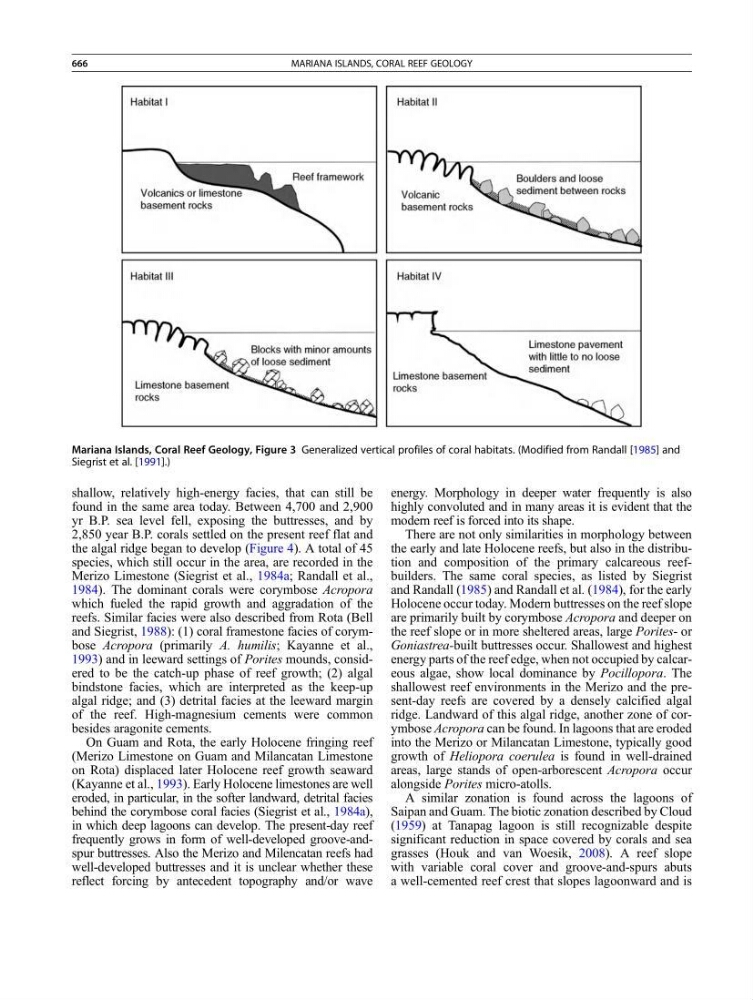
Mariana Islands, Coral Reef Geology, Figure 3 Generalized vertical profiles of coral habitats. (Modified from Randall [1985] and
Siegrist et al. [1991].)
666
MARIANA ISLANDS, CORAL REEF GEOLOGY