

existing Milencatan Limestone and corals settled on
preexisting highs about 80 m behind today’s reef margin.
Between 5,500 and 4,700 year B.P. corals accreted primarily under rising sea-level conditions and produced high
buttresses dominated by corymbose Acropora and thick
algal crusts. Large Porites mounds occurred in protected
areas. Around 4,700 year B.P. sea-level rise slowed and
the reefs caught up to the surface (then around þ2.5 to
3 m above present sea level; Bell and Siegrist, 1988).
Maximum sea level was at $4,200 year B.P. on Rota
and Guam (Kayanne et al., 1993; Pirazzoli and
Montaggioni, 1988; Dickinson, 2000). Coral frameworks
were then encrusted by digitate coralline algae, which Bell
and Siegrist (1988) and Kayanne et al. (1993) interpret as
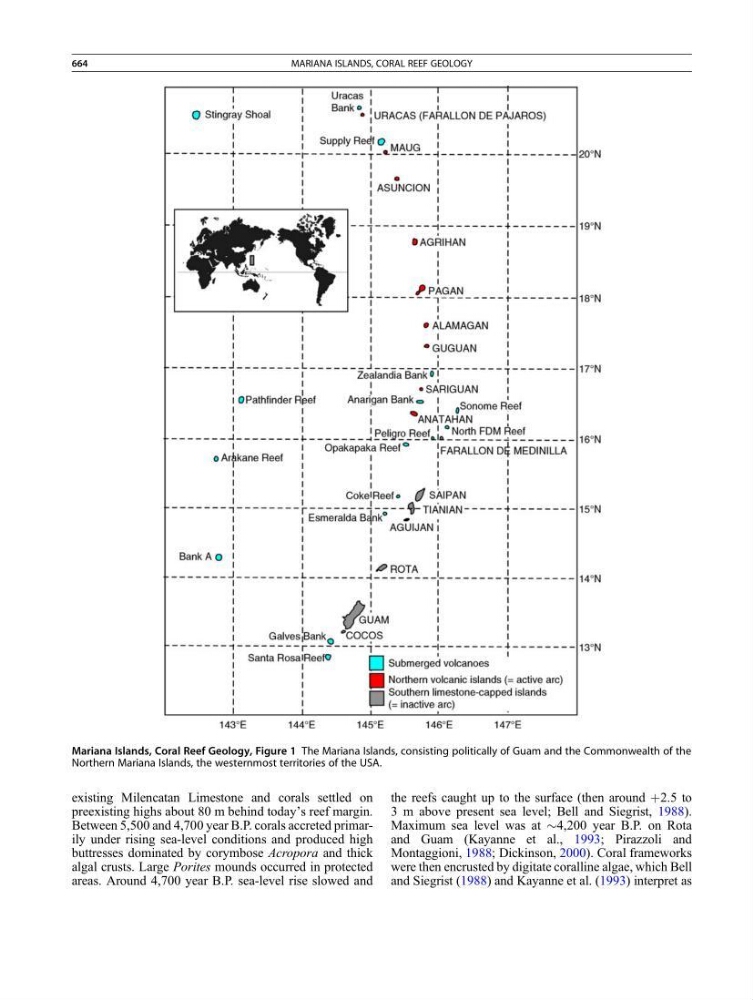
Mariana Islands, Coral Reef Geology, Figure 1 The Mariana Islands, consisting politically of Guam and the Commonwealth of the
Northern Mariana Islands, the westernmost territories of the USA.
664
MARIANA ISLANDS, CORAL REEF GEOLOGY