

Cross-references
Algae, Blue-Green Boring
Algae, Coralline
Algae, Turf
Algal Rims
Fossil Coralline Algae
Halimeda
Halimeda Bioherms
Nutrient Pollution/Eutrophication
Rhodoliths
Seagrasses
Stromatolites
ALGAE, TURF
Mark M. Littler, Diane S. Littler
Smithsonian Institution, Washington, DC, USA
Synonyms
Algae turfs; Algal mats; Low-growing algae; Prostrate
algae
Definition
Algae turfs are sparse to thick mats of diminutive and
juvenile algae less than 2 cm high.
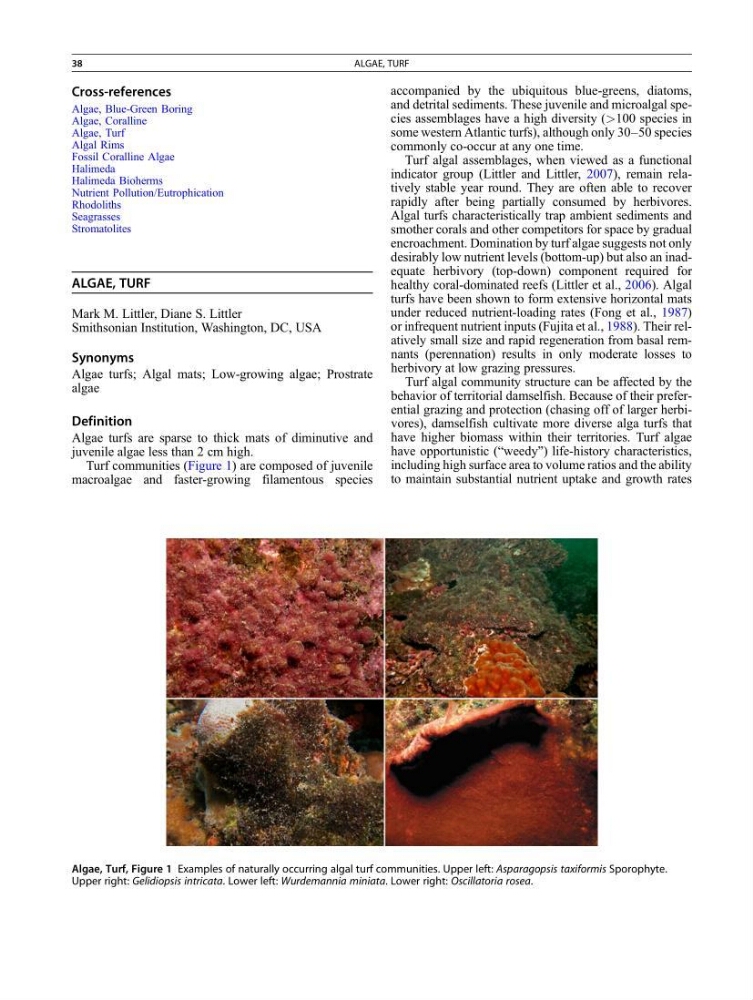
Turf communities (Figure 1) are composed of juvenile
macroalgae and faster-growing filamentous species
accompanied by the ubiquitous blue-greens, diatoms,
and detrital sediments. These juvenile and microalgal species assemblages have a high diversity (>100 species in
some western Atlantic turfs), although only 30–50 species
commonly co-occur at any one time.
Turf algal assemblages, when viewed as a functional
indicator group (Littler and Littler, 2007), remain relatively stable year round. They are often able to recover
rapidly after being partially consumed by herbivores.
Algal turfs characteristically trap ambient sediments and
smother corals and other competitors for space by gradual
encroachment. Domination by turf algae suggests not only
desirably low nutrient levels (bottom-up) but also an inadequate herbivory (top-down) component required for
healthy coral-dominated reefs (Littler et al., 2006). Algal
turfs have been shown to form extensive horizontal mats
under reduced nutrient-loading rates (Fong et al., 1987)
or infrequent nutrient inputs (Fujita et al., 1988). Their relatively small size and rapid regeneration from basal remnants (perennation) results in only moderate losses to
herbivory at low grazing pressures.
Turf algal community structure can be affected by the
behavior of territorial damselfish. Because of their preferential grazing and protection (chasing off of larger herbivores), damselfish cultivate more diverse alga turfs that
have higher biomass within their territories. Turf algae
have opportunistic (“weedy”) life-history characteristics,
including high surface area to volume ratios and the ability
to maintain substantial nutrient uptake and growth rates
Algae, Turf, Figure 1 Examples of naturally occurring algal turf communities. Upper left: Asparagopsis taxiformis Sporophyte.
Upper right: Gelidiopsis intricata. Lower left: Wurdemannia miniata. Lower right: Oscillatoria rosea.
38
ALGAE, TURF
Algae, Blue-Green Boring
Algae, Coralline
Algae, Turf
Algal Rims
Fossil Coralline Algae
Halimeda
Halimeda Bioherms
Nutrient Pollution/Eutrophication
Rhodoliths
Seagrasses
Stromatolites
ALGAE, TURF
Mark M. Littler, Diane S. Littler
Smithsonian Institution, Washington, DC, USA
Synonyms
Algae turfs; Algal mats; Low-growing algae; Prostrate
algae
Definition
Algae turfs are sparse to thick mats of diminutive and
juvenile algae less than 2 cm high.
Turf communities (Figure 1) are composed of juvenile
macroalgae and faster-growing filamentous species
accompanied by the ubiquitous blue-greens, diatoms,
and detrital sediments. These juvenile and microalgal species assemblages have a high diversity (>100 species in
some western Atlantic turfs), although only 30–50 species
commonly co-occur at any one time.
Turf algal assemblages, when viewed as a functional
indicator group (Littler and Littler, 2007), remain relatively stable year round. They are often able to recover
rapidly after being partially consumed by herbivores.
Algal turfs characteristically trap ambient sediments and
smother corals and other competitors for space by gradual
encroachment. Domination by turf algae suggests not only
desirably low nutrient levels (bottom-up) but also an inadequate herbivory (top-down) component required for
healthy coral-dominated reefs (Littler et al., 2006). Algal
turfs have been shown to form extensive horizontal mats
under reduced nutrient-loading rates (Fong et al., 1987)
or infrequent nutrient inputs (Fujita et al., 1988). Their relatively small size and rapid regeneration from basal remnants (perennation) results in only moderate losses to
herbivory at low grazing pressures.
Turf algal community structure can be affected by the
behavior of territorial damselfish. Because of their preferential grazing and protection (chasing off of larger herbivores), damselfish cultivate more diverse alga turfs that
have higher biomass within their territories. Turf algae
have opportunistic (“weedy”) life-history characteristics,
including high surface area to volume ratios and the ability
to maintain substantial nutrient uptake and growth rates
Algae, Turf, Figure 1 Examples of naturally occurring algal turf communities. Upper left: Asparagopsis taxiformis Sporophyte.
Upper right: Gelidiopsis intricata. Lower left: Wurdemannia miniata. Lower right: Oscillatoria rosea.
38
ALGAE, TURF