

location and elevation of conglomerate and reef topography. In particular, shingle islands and ramparts afford shelter from wave and current energy providing a suitable low
energy depositional environment for mangrove colonisation (Stoddart, 1965; Stoddart et al. 1978a).
The substrate underlying mangrove communities varies
considerably and includes: sequences of organic mud that
reach up to 2 m thick, sandy reef flat sediments, and emergent fields of fossil microatolls (Figure 1g).
Leeward sand cay
Supra-tidal sand accumulations occur on the leeward sides
of low wooded islands and exhibit greater morphological
diversity than ordinary sand cays (Stoddart et al.,
1978a). These islands can be grouped according to their
location with respect to other reef top geomorphic units,
stability and degree of vegetation. In one group, sand cays
can occur as discrete and separate features and possess
similar characteristics to other reef flat sand cays (e.g.,
Figure 1a and b). These cays may occur as small,
unvegetated and ephemeral features. Others are larger, stable vegetated islands (Stoddart et al., 1978a). These larger
islands are commonly covered with woodland or scrub but
have a higher diversity of vascular plants than simple sand
cays. A second group consists of discrete vegetated cays,
which are surrounded entirely or partially by mangrove
(e.g., Figure 1d–f ). These islands form contiguous land
units with the mangrove and shingle islands and collectively occupy large areas of the reef platform.
A notable feature of the vegetated sand cays of the
Great Barrier Reef is the presence of an extensive high terrace surrounded by a lower elevation terrace (Figure 1g).
The higher terrace is also distinct from the lower elevation
counterpart due to greater soil development, different sedimentary characteristics (McLean and Stoddart, 1978),
and more mature and dense vegetation communities. The
different terrace levels are indicative of distinct phases of
island development.
Stoddart et al. (1978a) note that sand cays have higher
numbers of vascular plants than other vegetated cays in
the Great Barrier Reef. Typically the higher terrace contains woodland comprising a mix of trees such as Casuarina equisetifolia, Pisonia grandis, Pandanus, Cordia,
and Coconuts. Common at the fringes of woodland and
on lower terraces are shrub species that include
Tournefortia, Pemphis, Scaevola, and Euphorbia sp.
that give islands a bushy appearance (Hopley, 1982).
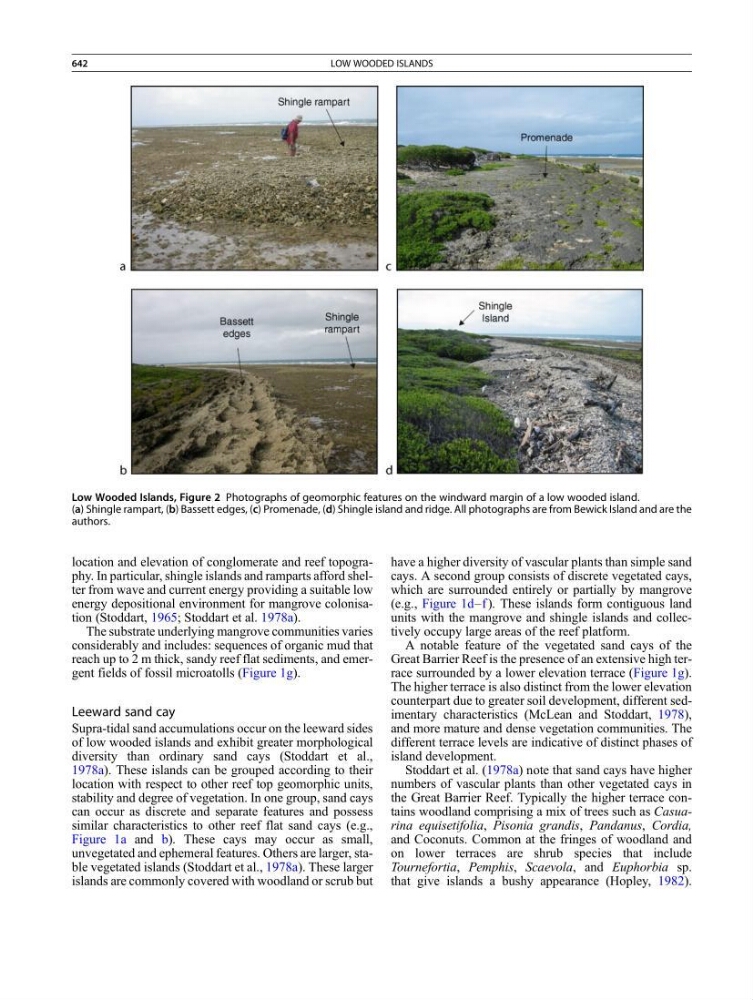
Low Wooded Islands, Figure 2 Photographs of geomorphic features on the windward margin of a low wooded island.
(a) Shingle rampart, (b) Bassett edges, (c) Promenade, (d) Shingle island and ridge. All photographs are from Bewick Island and are the
authors.
642
LOW WOODED ISLANDS