

adopting the more conservative ratio of 149 Æ 4 per mil
which is considered by others to be “strictly-reliable”
(Gallup et al., 1994; Stirling et al., 1998). Also, only two
exposures of in-place coral framework were dated, and
both returned a large spread of ages that are inconsistent
with limited stratigraphic interval of reef accretion. The
other ages reported by Muhs et al. (2002) are from coral
storm-gravel deposits and their stratigraphic consistency
cannot therefore be assessed. But of the 16 ages in the
entire data set with strictly reliable initial ratios, 11 fall
within the more restricted interval of 123–118 ka,
suggesting a much narrower time window for highstand
reef development than claimed by Muhs et al. (2002).
These more reliable data are fully consistent with the
orbital forcing of climate during the LIG (Muhs, 2002).
Summary and conclusions
The age, elevation, and architecture of fossil reefs from
both uplifted and stable terrains provide key insight into
the timing, duration, and nature of the LIG. Uplifted areas
provide an assessment of the timing of postglacial SL rise
(or glacial termination) and the duration of the interglacial
but, due to the tectonic overprint and the possibility of
coseismic displacement, it is difficult to infer anything
about the detailed SL behavior or the absolute elevation
reached during the highstand. By contrast, stable sites
can provide a detailed look into the timing and duration
of peak interglacial conditions during the highstand, as
well as the absolute elevation and SL behavior during that
highstand.
Without doubt, the best studied uplifted reefs of LIG
age occur on Barbados and the Huon Peninsula of Papua
New Guinea. Reef development on Barbados is well
understood largely due to the fact that the relatively simple
coral zonation on modern Caribbean reefs is well
represented in its fossil counterparts (Jackson, 1992).
The uplift of the LIG terrace on the south and west coasts
of the island has exposed only the upper $20 m of reefcrest development and, although earlier workers claimed
that reefs were absent until later in the postglacial rise, this
is difficult to substantiate now that reefs of late-glacial age
have been encountered in submerged cores off the south
coast (Fairbanks, 1989). It is much more likely that this
20 m thick reef-crest sequence represents the final backstepping stage of reef development during the penultimate
deglacial SL rise, and that earlier stages are buried beneath
subsequent development of interstadial reef terraces
(Blanchon and Eisenhauer, 2001). Aside from the incomplete record of reef development, the 20 m-thick reef-crest
units display a clear keep-up architecture as demonstrated
by their over-thickened facies which retrograde upslope
on the west coast and aggrade vertically or prograde on
the south coast. The timing and duration of this keep-up
reef development, however, has been difficult to substantiate due to subtle diagenetic exchange of U-series
nuclides in the fossil corals. This process has produced
a 20 ka range of “strictly reliable” coral ages from
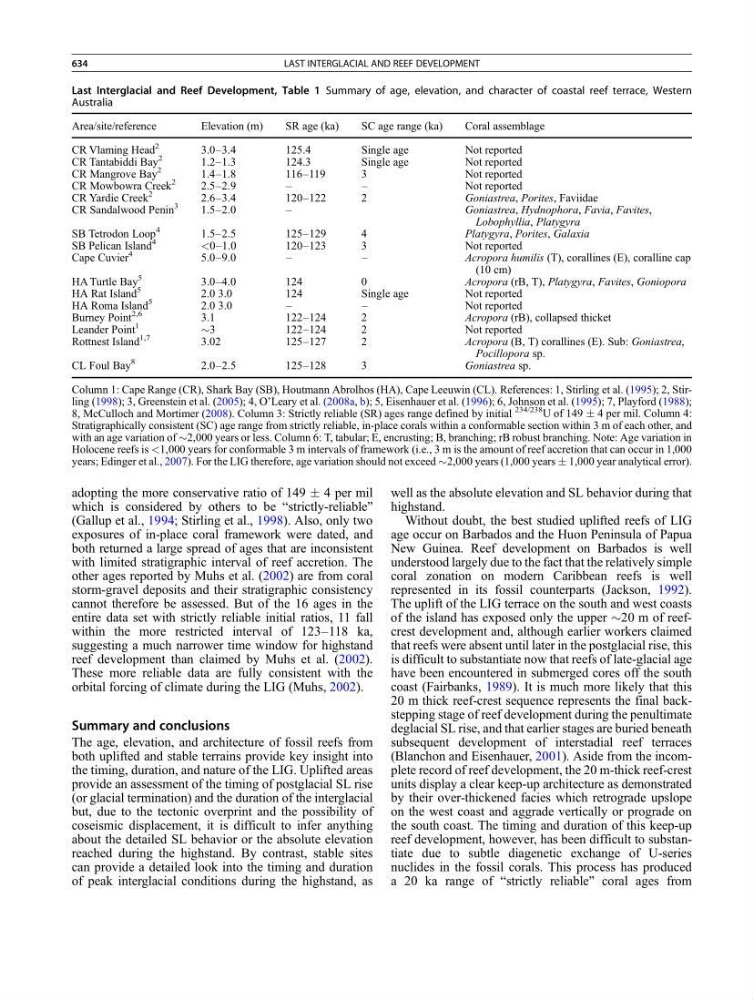
Last Interglacial and Reef Development, Table 1 Summary of age, elevation, and character of coastal reef terrace, Western
Australia
Area/site/reference
Elevation (m)
SR age (ka)
SC age range (ka)
Coral assemblage
CR Vlaming Head
2
3.0–3.4
125.4
Single age
Not reported
CR Tantabiddi Bay
2
1.2–1.3
124.3
Single age
Not reported
CR Mangrove Bay
2
1.4–1.8
116–119
3
Not reported
CR Mowbowra Creek
2
2.5–2.9
–
–
Not reported
CR Yardie Creek
2
2.6–3.4
120–122
2
Goniastrea, Porites, Faviidae
CR Sandalwood Penin
3
1.5–2.0
–
Goniastrea, Hydnophora, Favia, Favites,
Lobophyllia, Platygyra
SB Tetrodon Loop
4
1.5–2.5
125–129
4
Platygyra, Porites, Galaxia
SB Pelican Island
4
<0–1.0
120–123
3
Not reported
Cape Cuvier
4
5.0–9.0
–
–
Acropora humilis (T), corallines (E), coralline cap
(10 cm)
HA Turtle Bay
5
3.0–4.0
124
0
Acropora (rB, T), Platygyra, Favites, Goniopora
HA Rat Island
5
2.0 3.0
124
Single age
Not reported
HA Roma Island
5
2.0 3.0
–
–
Not reported
Burney Point
2,6
3.1
122–124
2
Acropora (rB), collapsed thicket
Leander Point
1
$3
122–124
2
Not reported
Rottnest Island
1,7
3.02
125–127
2
Acropora (B, T) corallines (E). Sub: Goniastrea,
Pocillopora sp.
CL Foul Bay
8
2.0–2.5
125–128
3
Goniastrea sp.
Column 1: Cape Range (CR), Shark Bay (SB), Houtmann Abrolhos (HA), Cape Leeuwin (CL). References: 1, Stirling et al. (1995); 2, Stirling (1998); 3, Greenstein et al. (2005); 4, O’Leary et al. (2008a, b); 5, Eisenhauer et al. (1996); 6, Johnson et al. (1995); 7, Playford (1988);
8, McCulloch and Mortimer (2008). Column 3: Strictly reliable (SR) ages range defined by initial
234/238 U of 149 Æ 4 per mil. Column 4:
Stratigraphically consistent (SC) age range from strictly reliable, in-place corals within a conformable section within 3 m of each other, and
with an age variation of $2,000 years or less. Column 6: T, tabular; E, encrusting; B, branching; rB robust branching. Note: Age variation in
Holocene reefs is <1,000 years for conformable 3 m intervals of framework (i.e., 3 m is the amount of reef accretion that can occur in 1,000
years; Edinger et al., 2007). For the LIG therefore, age variation should not exceed $2,000 years (1,000 years Æ 1,000 year analytical error).
634
LAST INTERGLACIAL AND REEF DEVELOPMENT