

development is vertically restricted to less than þ3 m. As
on San Salvador, however, intertidal beach units and
notches clearly indicate that the highstand reached þ6
m. Neumann and Hearty (1996) claimed that the general
absence of reefal units above þ3 m indicated that there
must have been a rapid jump in SL toward the end of the
highstand with a duration that was too short for reefs to
keep up or even to catch up. In fact, they claimed that there
was only sufficient time for notch cutting, which was estimated at 600 years. To account for the well-preserved
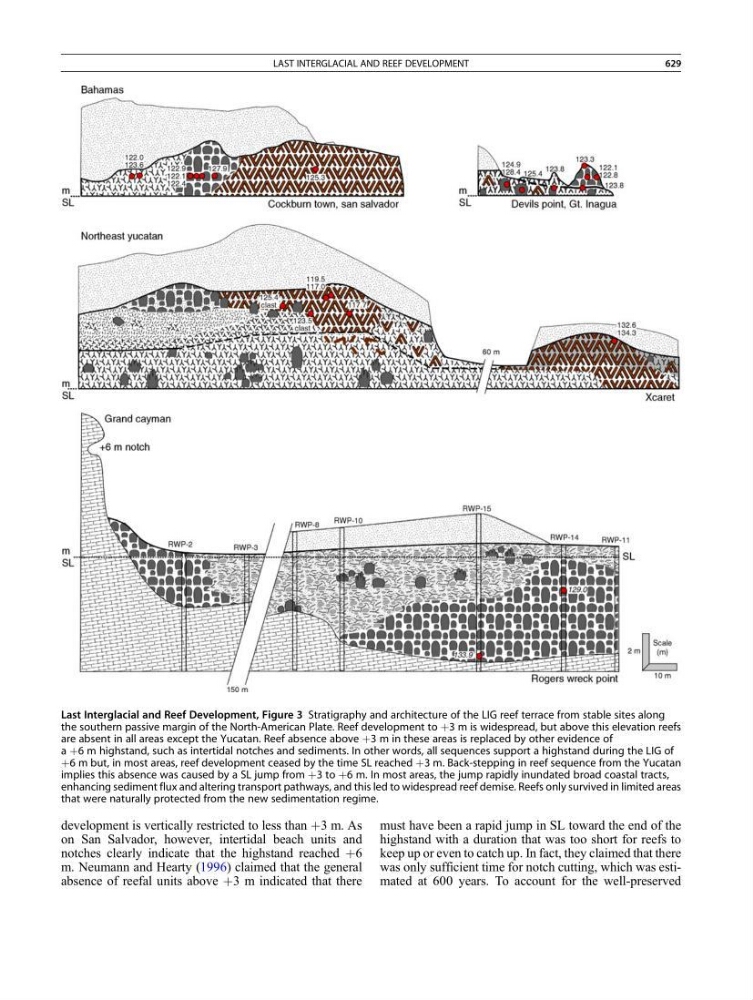
Last Interglacial and Reef Development, Figure 3 Stratigraphy and architecture of the LIG reef terrace from stable sites along
the southern passive margin of the North-American Plate. Reef development to þ3 m is widespread, but above this elevation reefs
are absent in all areas except the Yucatan. Reef absence above þ3 m in these areas is replaced by other evidence of
a þ6 m highstand, such as intertidal notches and sediments. In other words, all sequences support a highstand during the LIG of
þ6 m but, in most areas, reef development ceased by the time SL reached þ3 m. Back-stepping in reef sequence from the Yucatan
implies this absence was caused by a SL jump from þ3 to þ6 m. In most areas, the jump rapidly inundated broad coastal tracts,
enhancing sediment flux and altering transport pathways, and this led to widespread reef demise. Reefs only survived in limited areas
that were naturally protected from the new sedimentation regime.
LAST INTERGLACIAL AND REEF DEVELOPMENT
629