

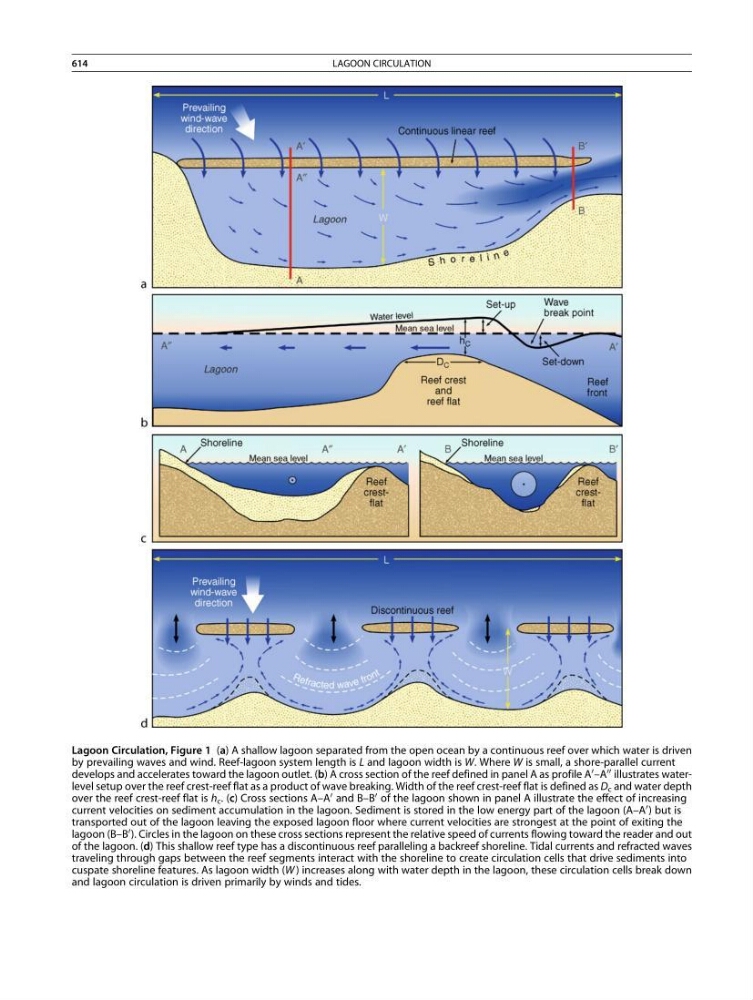
Lagoon Circulation, Figure 1 (a) A shallow lagoon separated from the open ocean by a continuous reef over which water is driven
by prevailing waves and wind. Reef-lagoon system length is L and lagoon width is W. Where W is small, a shore-parallel current
develops and accelerates toward the lagoon outlet. (b) A cross section of the reef defined in panel A as profile A
0
–A
00
illustrates waterlevel setup over the reef crest-reef flat as a product of wave breaking. Width of the reef crest-reef flat is defined as D c and water depth
over the reef crest-reef flat is h c . (c) Cross sections A–A
0
and B–B
0
of the lagoon shown in panel A illustrate the effect of increasing
current velocities on sediment accumulation in the lagoon. Sediment is stored in the low energy part of the lagoon (A–A
0
) but is
transported out of the lagoon leaving the exposed lagoon floor where current velocities are strongest at the point of exiting the
lagoon (B–B
0
). Circles in the lagoon on these cross sections represent the relative speed of currents flowing toward the reader and out
of the lagoon. (d) This shallow reef type has a discontinuous reef paralleling a backreef shoreline. Tidal currents and refracted waves
traveling through gaps between the reef segments interact with the shoreline to create circulation cells that drive sediments into
cuspate shoreline features. As lagoon width (W ) increases along with water depth in the lagoon, these circulation cells break down
and lagoon circulation is driven primarily by winds and tides.
614
LAGOON CIRCULATION