

affected by sediments. Among reefs impacted by combined
sedimentation and eutrophication, only one of five reefs
showed a decrease in average coral linear extension
rates through time. Coral skeletal density in nearshore,
polluted environments, however, was significantly lower.
Low density, high-extension skeletal growth may be
a sclerochronological signal of combined sedimentation
and eutrophication effects on corals. One of the key conclusions of Edinger et al. (2000b) was that coral growth rates
may be a poor indicator of whole-reef health, given the
conflicting effects of covarying sediments and nutrients.
Partial or total mortality
Death of all or a part of coral colonies has been associated
with purported sediment stress. Marszalek (1981) reported
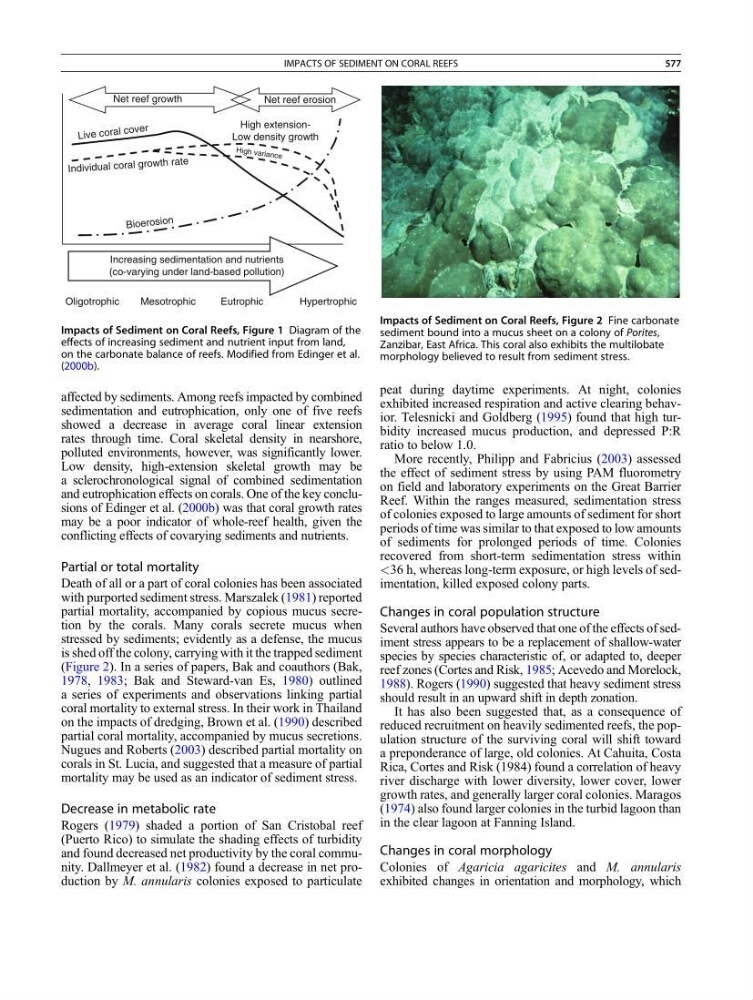
partial mortality, accompanied by copious mucus secretion by the corals. Many corals secrete mucus when
stressed by sediments; evidently as a defense, the mucus
is shed off the colony, carrying with it the trapped sediment
(Figure 2). In a series of papers, Bak and coauthors (Bak,
1978, 1983; Bak and Steward-van Es, 1980) outlined
a series of experiments and observations linking partial
coral mortality to external stress. In their work in Thailand
on the impacts of dredging, Brown et al. (1990) described
partial coral mortality, accompanied by mucus secretions.
Nugues and Roberts (2003) described partial mortality on
corals in St. Lucia, and suggested that a measure of partial
mortality may be used as an indicator of sediment stress.
Decrease in metabolic rate
Rogers (1979) shaded a portion of San Cristobal reef
(Puerto Rico) to simulate the shading effects of turbidity
and found decreased net productivity by the coral community. Dallmeyer et al. (1982) found a decrease in net production by M. annularis colonies exposed to particulate
peat during daytime experiments. At night, colonies
exhibited increased respiration and active clearing behavior. Telesnicki and Goldberg (1995) found that high turbidity increased mucus production, and depressed P:R
ratio to below 1.0.
More recently, Philipp and Fabricius (2003) assessed
the effect of sediment stress by using PAM fluorometry
on field and laboratory experiments on the Great Barrier
Reef. Within the ranges measured, sedimentation stress
of colonies exposed to large amounts of sediment for short
periods of time was similar to that exposed to low amounts
of sediments for prolonged periods of time. Colonies
recovered from short-term sedimentation stress within
<36 h, whereas long-term exposure, or high levels of sedimentation, killed exposed colony parts.
Changes in coral population structure
Several authors have observed that one of the effects of sediment stress appears to be a replacement of shallow-water
species by species characteristic of, or adapted to, deeper
reef zones (Cortes and Risk, 1985; Acevedo and Morelock,
1988). Rogers (1990) suggested that heavy sediment stress
should result in an upward shift in depth zonation.
It has also been suggested that, as a consequence of
reduced recruitment on heavily sedimented reefs, the population structure of the surviving coral will shift toward
a preponderance of large, old colonies. At Cahuita, Costa
Rica, Cortes and Risk (1984) found a correlation of heavy
river discharge with lower diversity, lower cover, lower
growth rates, and generally larger coral colonies. Maragos
(1974) also found larger colonies in the turbid lagoon than
in the clear lagoon at Fanning Island.
Changes in coral morphology
Colonies of Agaricia agaricites and M. annularis
exhibited changes in orientation and morphology, which
Net reef growth
Net reef erosion
Liv e cor al cov er
Indiv idua l cora l grow th rate
Bio ero sio n
High extensionLow density growth
Increasing sedimentation and nutrients
(co-varying under land-based pollution)
Oligotrophic
Mesotrophic
Eutrophic
Hypertrophic
Hig h var ian ce
Impacts of Sediment on Coral Reefs, Figure 1 Diagram of the
effects of increasing sediment and nutrient input from land,
on the carbonate balance of reefs. Modified from Edinger et al.
(2000b).
Impacts of Sediment on Coral Reefs, Figure 2 Fine carbonate
sediment bound into a mucus sheet on a colony of Porites,
Zanzibar, East Africa. This coral also exhibits the multilobate
morphology believed to result from sediment stress.
IMPACTS OF SEDIMENT ON CORAL REEFS
577