

Both solid, and porous, reef models use roughness as
part of the structural form of the model and require the
model to incorporate some skin friction, i.e., conventional
surface friction, and so retain a nominal separation of
scales between form and skin friction. An example of this
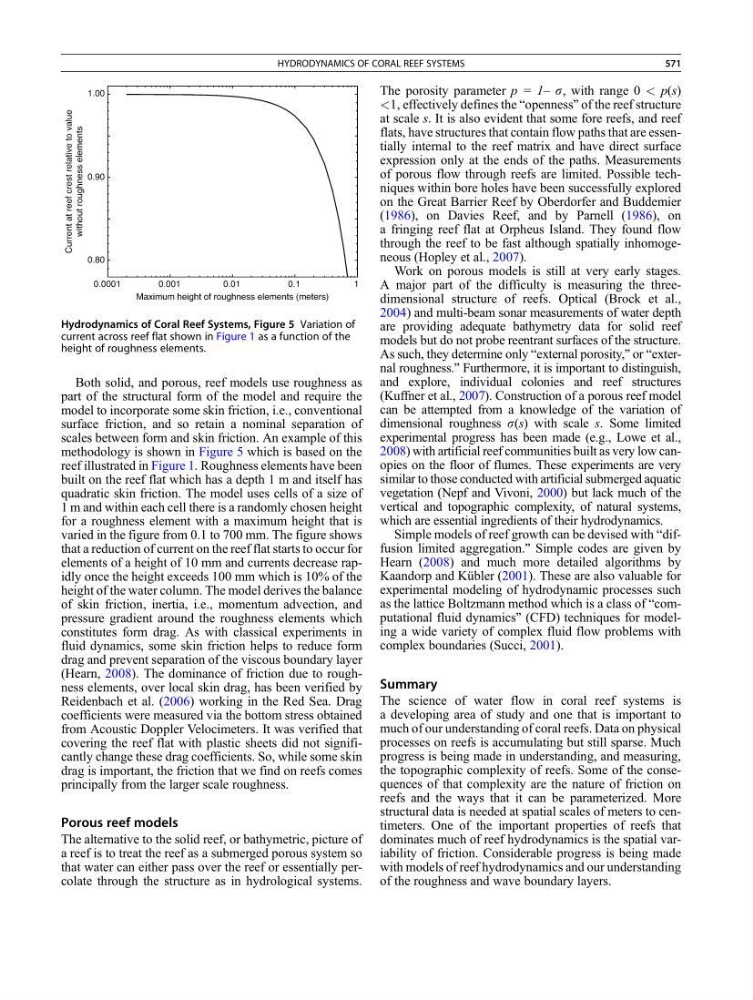
methodology is shown in Figure 5 which is based on the
reef illustrated in Figure 1. Roughness elements have been
built on the reef flat which has a depth 1 m and itself has
quadratic skin friction. The model uses cells of a size of
1 m and within each cell there is a randomly chosen height
for a roughness element with a maximum height that is
varied in the figure from 0.1 to 700 mm. The figure shows
that a reduction of current on the reef flat starts to occur for
elements of a height of 10 mm and currents decrease rapidly once the height exceeds 100 mm which is 10% of the
height of the water column. The model derives the balance
of skin friction, inertia, i.e., momentum advection, and
pressure gradient around the roughness elements which
constitutes form drag. As with classical experiments in
fluid dynamics, some skin friction helps to reduce form
drag and prevent separation of the viscous boundary layer
(Hearn, 2008). The dominance of friction due to roughness elements, over local skin drag, has been verified by
Reidenbach et al. (2006) working in the Red Sea. Drag
coefficients were measured via the bottom stress obtained
from Acoustic Doppler Velocimeters. It was verified that
covering the reef flat with plastic sheets did not significantly change these drag coefficients. So, while some skin
drag is important, the friction that we find on reefs comes
principally from the larger scale roughness.
Porous reef models
The alternative to the solid reef, or bathymetric, picture of
a reef is to treat the reef as a submerged porous system so
that water can either pass over the reef or essentially percolate through the structure as in hydrological systems.
The porosity parameter p = 1– s, with range 0 < p(s)
<1, effectively defines the “openness” of the reef structure
at scale s. It is also evident that some fore reefs, and reef
flats, have structures that contain flow paths that are essentially internal to the reef matrix and have direct surface
expression only at the ends of the paths. Measurements
of porous flow through reefs are limited. Possible techniques within bore holes have been successfully explored
on the Great Barrier Reef by Oberdorfer and Buddemier
(1986), on Davies Reef, and by Parnell (1986), on
a fringing reef flat at Orpheus Island. They found flow
through the reef to be fast although spatially inhomogeneous (Hopley et al., 2007).
Work on porous models is still at very early stages.
A major part of the difficulty is measuring the threedimensional structure of reefs. Optical (Brock et al.,
2004) and multi-beam sonar measurements of water depth
are providing adequate bathymetry data for solid reef
models but do not probe reentrant surfaces of the structure.
As such, they determine only “external porosity,” or “external roughness.” Furthermore, it is important to distinguish,
and explore, individual colonies and reef structures
(Kuffner et al., 2007). Construction of a porous reef model
can be attempted from a knowledge of the variation of
dimensional roughness s(s) with scale s. Some limited
experimental progress has been made (e.g., Lowe et al.,
2008) with artificial reef communities built as very low canopies on the floor of flumes. These experiments are very
similar to those conducted with artificial submerged aquatic
vegetation (Nepf and Vivoni, 2000) but lack much of the
vertical and topographic complexity, of natural systems,
which are essential ingredients of their hydrodynamics.
Simple models of reef growth can be devised with “diffusion limited aggregation.” Simple codes are given by
Hearn (2008) and much more detailed algorithms by
Kaandorp and Kübler (2001). These are also valuable for
experimental modeling of hydrodynamic processes such
as the lattice Boltzmann method which is a class of “computational fluid dynamics” (CFD) techniques for modeling a wide variety of complex fluid flow problems with
complex boundaries (Succi, 2001).
Summary
The science of water flow in coral reef systems is
a developing area of study and one that is important to
much of our understanding of coral reefs. Data on physical
processes on reefs is accumulating but still sparse. Much
progress is being made in understanding, and measuring,
the topographic complexity of reefs. Some of the consequences of that complexity are the nature of friction on
reefs and the ways that it can be parameterized. More
structural data is needed at spatial scales of meters to centimeters. One of the important properties of reefs that
dominates much of reef hydrodynamics is the spatial variability of friction. Considerable progress is being made
with models of reef hydrodynamics and our understanding
of the roughness and wave boundary layers.
Hydrodynamics of Coral Reef Systems, Figure 5 Variation of
current across reef flat shown in Figure 1 as a function of the
height of roughness elements.
HYDRODYNAMICS OF CORAL REEF SYSTEMS
571