

In eastern Australia, for example, where Hopley (1984)
discussed the potential for the development of periods of
high energy conditions during shelf flooding, sea-levels during the early-mid Holocene are estimated to have been rising
at $10 mm year
À1 from about 9,000 to 7,500 years BP, and
then at $2–2.5 mm year
À1 through to $6,000 years BP
when sea levels slightly exceeded their present day position.
Since this, highstand sea-level has fallen to its present level.
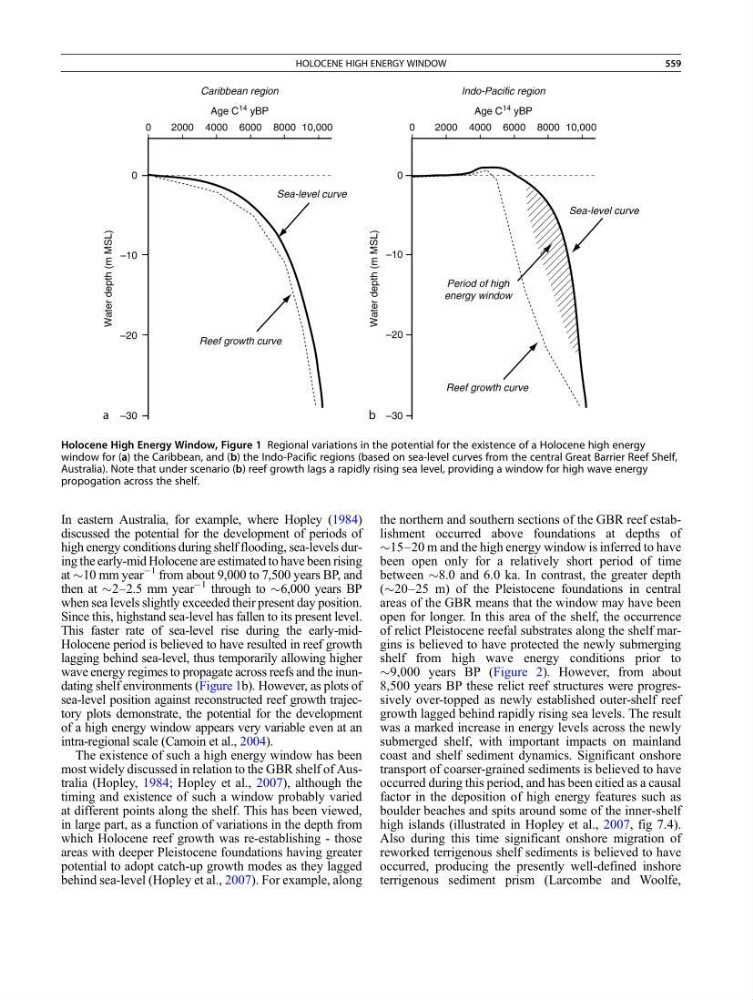
This faster rate of sea-level rise during the early-midHolocene period is believed to have resulted in reef growth
lagging behind sea-level, thus temporarily allowing higher
wave energy regimes to propagate across reefs and the inundating shelf environments (Figure 1b). However, as plots of
sea-level position against reconstructed reef growth trajectory plots demonstrate, the potential for the development
of a high energy window appears very variable even at an
intra-regional scale (Camoin et al., 2004).
The existence of such a high energy window has been
most widely discussed in relation to the GBR shelf of Australia (Hopley, 1984; Hopley et al., 2007), although the
timing and existence of such a window probably varied
at different points along the shelf. This has been viewed,
in large part, as a function of variations in the depth from
which Holocene reef growth was re-establishing - those
areas with deeper Pleistocene foundations having greater
potential to adopt catch-up growth modes as they lagged
behind sea-level (Hopley et al., 2007). For example, along
the northern and southern sections of the GBR reef establishment occurred above foundations at depths of
$15–20 m and the high energy window is inferred to have
been open only for a relatively short period of time
between $8.0 and 6.0 ka. In contrast, the greater depth
($20–25 m) of the Pleistocene foundations in central
areas of the GBR means that the window may have been
open for longer. In this area of the shelf, the occurrence
of relict Pleistocene reefal substrates along the shelf margins is believed to have protected the newly submerging
shelf from high wave energy conditions prior to
$9,000 years BP (Figure 2). However, from about
8,500 years BP these relict reef structures were progressively over-topped as newly established outer-shelf reef
growth lagged behind rapidly rising sea levels. The result
was a marked increase in energy levels across the newly
submerged shelf, with important impacts on mainland
coast and shelf sediment dynamics. Significant onshore
transport of coarser-grained sediments is believed to have
occurred during this period, and has been citied as a causal
factor in the deposition of high energy features such as
boulder beaches and spits around some of the inner-shelf
high islands (illustrated in Hopley et al., 2007, fig 7.4).
Also during this time significant onshore migration of
reworked terrigenous shelf sediments is believed to have
occurred, producing the presently well-defined inshore
terrigenous sediment prism (Larcombe and Woolfe,
Holocene High Energy Window, Figure 1 Regional variations in the potential for the existence of a Holocene high energy
window for (a) the Caribbean, and (b) the Indo-Pacific regions (based on sea-level curves from the central Great Barrier Reef Shelf,
Australia). Note that under scenario (b) reef growth lags a rapidly rising sea level, providing a window for high wave energy
propogation across the shelf.
HOLOCENE HIGH ENERGY WINDOW
559