

(H. opuntia, v. hederacea, and H. copiosa with subordinate amounts of H. fragilis, H. discoidea, and H. gracilis)
together with large benthic foraminifera, mollusks, and
bryozoans. The bioherms are bedded, sometimes transparent and often multigenerational, and sit astride the late
Pleistocene transgressed surface. They have grown at the
same time as the adjacent reef ecosystem and at rates
almost equivalent to the reef systems. This suggests not
only a critical relevance of calcareous algae as important
additional CO 2 sinks but when estimated on a global basis
it also doubles the contribution of shallow water sediments
(in conjunction with reefs) as CO 2 reservoirs.
Bibliography
Cummings, E. R., 1932. Reefs or bioherms. Bulletin Geological
Society America, 43, 331–352.
Davies, P. J., and Marshall, J. 1985. Halimeda Bioherms – Low
energy reefs, northern Great Barrier Reef. In Proceedings of
the Fifth International Coral Reef Symposium, Tahiti, Vol. 5,
pp. 1–8.
Davies, P. J., Symonds, P. A., Feary, D. A., and Pigram, C. J., 1988,
Facies models in exploration – The carbonate platforms of northeast Australia. Australian Petroleum Exploration Association
Journal, 28, 123–144.
Drew, E. A., and Abel, K. M., 1988a. The distribution and species
composition of Halimeda meadows throughout the Great Barrier
Reef Province. Coral Reefs, 6, 195–205.
Drew, E. A., and Abel, K. M., 1988b. Reproduction, particularly the
seasonality of gametangia formation in a number of species from
the Great Barrier Reef Province. Coral Reefs, 6, 207–218.
Hillis-Colinvaux, L., 1980. Ecology and taxonomy of Halimeda,
primary producer of coral reefs. Advances Marine Biology, 17,
1–327.
Hillis-Colinvaux, L., 1988. Characteristics of Halimeda meadows,
with emphasis on a meadow near Eniwetok Islet, Enewetok
Atoll (Marshall Islands). In Proceedings of Sixth International
Coral Reef Symposium, Vol. 3, pp. 119–125.
Kershaw, S., 1994. Classification and geological significance of
biostromes. Facies, 31(1), 81–91.
Marshall, J., and Davies, P. J., 1988. Halimeda bioherms of the
northern great barrier reef. Coral Reefs, 6, 139–148.
Orme, G. R., Flood, P. G., and Sargent, G. E. G., 1978. Sedimentation trends in the lee of outer (ribbon) reefs, northern region of
the Great Barrier Reef Province. Philosophical Transactions
Royal Society, Series A, 291, 23–35.
Orme, G. R., 1985. The sedimentological importance of Halimeda
in the development of back reef lithofacies, northern Great Barrier Reef (Australia). In Proceedings of Sixth International Coral
Reef Symposium, Vol. 5, pp. 31–37.
a
b
c
d
6,000 ka
0
1 0
km
8,000 ka
9,000 ka
11,000 ka
Plan
Pass
100
50
Depth (m)
0
100
50
Depth (m)
0
100
50
Depth (m)
0
100
50
Depth (m)
0
Sea level
Profile
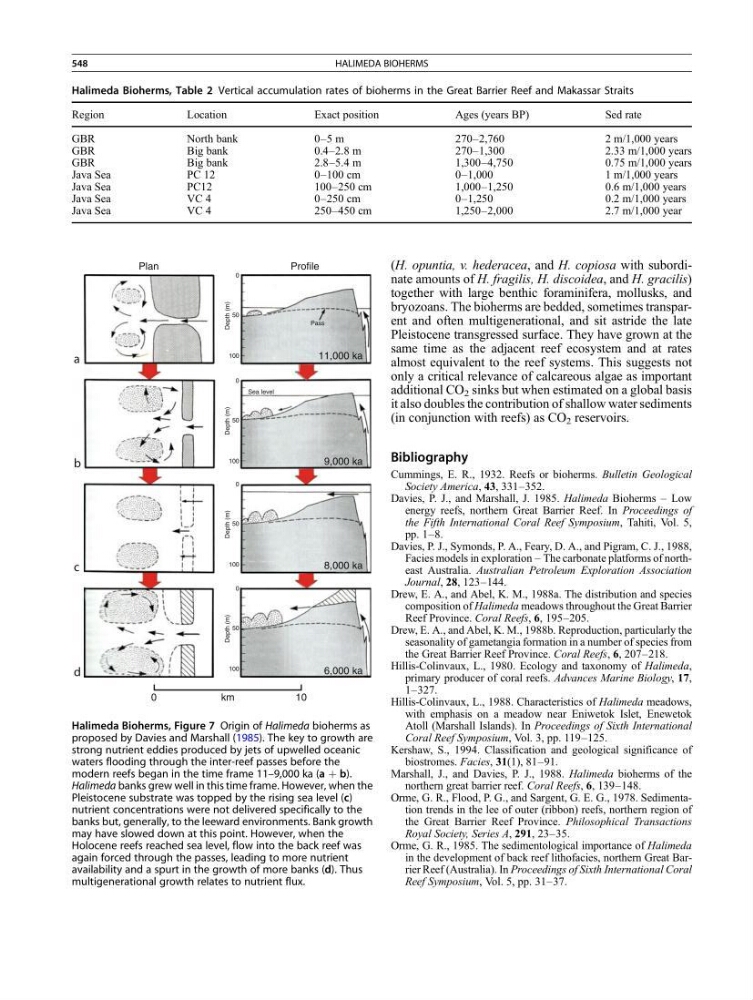
Halimeda Bioherms, Figure 7 Origin of Halimeda bioherms as
proposed by Davies and Marshall (1985). The key to growth are
strong nutrient eddies produced by jets of upwelled oceanic
waters flooding through the inter-reef passes before the
modern reefs began in the time frame 11–9,000 ka (a þ b).
Halimeda banks grew well in this time frame. However, when the
Pleistocene substrate was topped by the rising sea level (c)
nutrient concentrations were not delivered specifically to the
banks but, generally, to the leeward environments. Bank growth
may have slowed down at this point. However, when the
Holocene reefs reached sea level, flow into the back reef was
again forced through the passes, leading to more nutrient
availability and a spurt in the growth of more banks (d). Thus
multigenerational growth relates to nutrient flux.
Halimeda Bioherms, Table 2 Vertical accumulation rates of bioherms in the Great Barrier Reef and Makassar Straits
Region
Location
Exact position
Ages (years BP)
Sed rate
GBR
North bank
0–5 m
270–2,760
2 m/1,000 years
GBR
Big bank
0.4–2.8 m
270–1,300
2.33 m/1,000 years
GBR
Big bank
2.8–5.4 m
1,300–4,750
0.75 m/1,000 years
Java Sea
PC 12
0–100 cm
0–1,000
1 m/1,000 years
Java Sea
PC12
100–250 cm
1,000–1,250
0.6 m/1,000 years
Java Sea
VC 4
0–250 cm
0–1,250
0.2 m/1,000 years
Java Sea
VC 4
250–450 cm
1,250–2,000
2.7 m/1,000 year
548
HALIMEDA BIOHERMS