

through the Holocene and the deep hole through the total
thickness of the Great Barrier Reef (Davies et al., 1985;
Webster and Davies, 2003) reported above. The gigantoreefs of the central southern region (Pompey Reefs) are
indeed large (Figure 14d). Forming an almost continuous
barrier over a shelf edge length of 140 km, many of the
reefs are 50–100 km
2 in area, and 15 km long (Hopley,
2006; Hopley et al., 2007). They are surrounded by water
depths of 60 m and oceanwards give way to a terrace
sloping down to a shelf edge at 100 m. The morphology
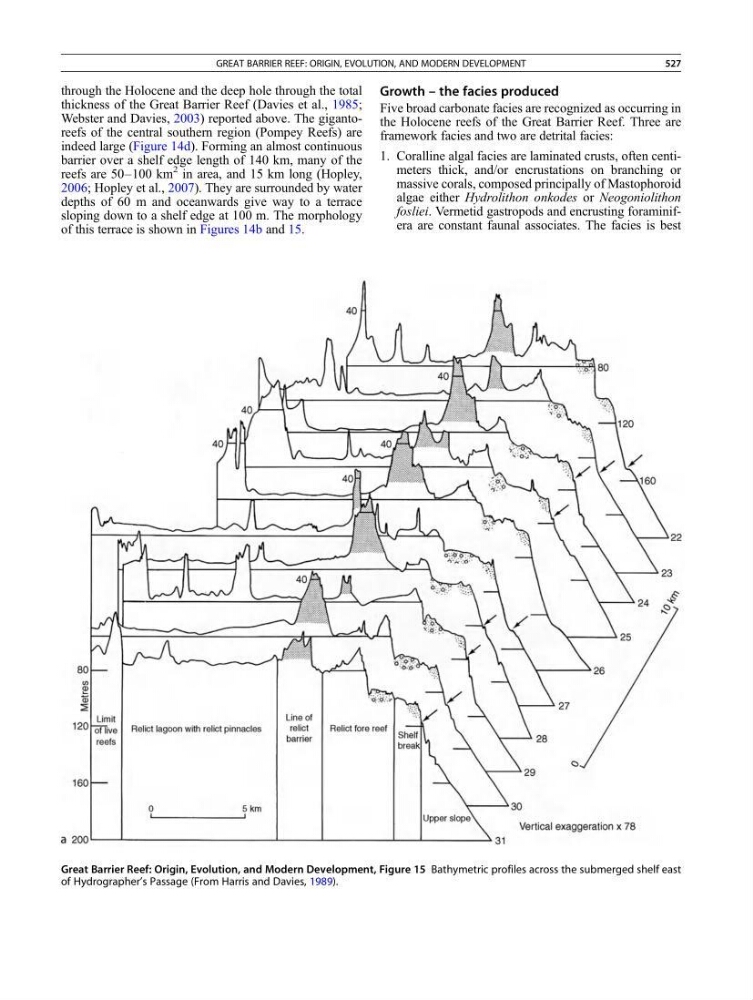
of this terrace is shown in Figures 14b and 15.
Growth – the facies produced
Five broad carbonate facies are recognized as occurring in
the Holocene reefs of the Great Barrier Reef. Three are
framework facies and two are detrital facies:
1. Coralline algal facies are laminated crusts, often centimeters thick, and/or encrustations on branching or
massive corals, composed principally of Mastophoroid
algae either Hydrolithon onkodes or Neogoniolithon
fosliei. Vermetid gastropods and encrusting foraminifera are constant faunal associates. The facies is best
Great Barrier Reef: Origin, Evolution, and Modern Development, Figure 15 Bathymetric profiles across the submerged shelf east
of Hydrographer’s Passage (From Harris and Davies, 1989).
GREAT BARRIER REEF: ORIGIN, EVOLUTION, AND MODERN DEVELOPMENT
527