

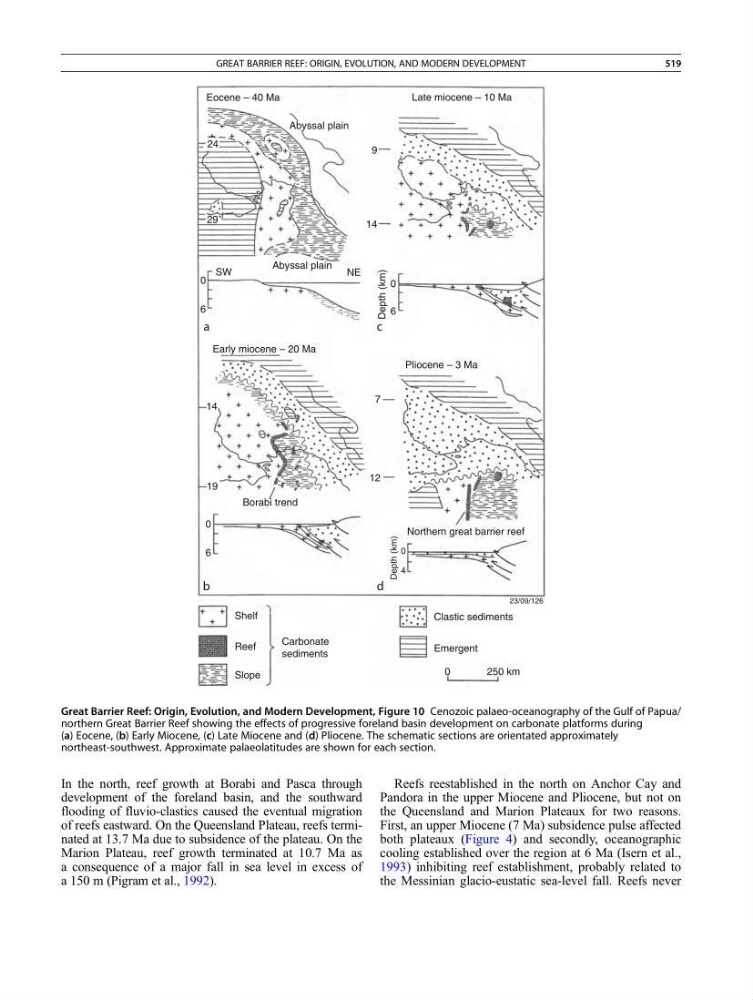
In the north, reef growth at Borabi and Pasca through
development of the foreland basin, and the southward
flooding of fluvio-clastics caused the eventual migration
of reefs eastward. On the Queensland Plateau, reefs terminated at 13.7 Ma due to subsidence of the plateau. On the
Marion Plateau, reef growth terminated at 10.7 Ma as
a consequence of a major fall in sea level in excess of
a 150 m (Pigram et al., 1992).
Reefs reestablished in the north on Anchor Cay and
Pandora in the upper Miocene and Pliocene, but not on
the Queensland and Marion Plateaux for two reasons.
First, an upper Miocene (7 Ma) subsidence pulse affected
both plateaux (Figure 4) and secondly, oceanographic
cooling established over the region at 6 Ma (Isern et al.,
1993) inhibiting reef establishment, probably related to
the Messinian glacio-eustatic sea-level fall. Reefs never
Eocene – 40 Ma
a
c
Abyssal plain
Abyssal plain
24
29
SW
0
6
0
6
NE
9
14
Late miocene – 10 Ma
Depth (km)
Early miocene – 20 Ma
Pliocene – 3 Ma
14
19
Borabi trend
0
6
7
12
Northern great barrier reef
Depth (km)
0
4
Shelf
Reef
Slope
Carbonate
sediments
Clastic sediments
Emergent
0
250 km
23/09/126
b
d
Great Barrier Reef: Origin, Evolution, and Modern Development, Figure 10 Cenozoic palaeo-oceanography of the Gulf of Papua/
northern Great Barrier Reef showing the effects of progressive foreland basin development on carbonate platforms during
(a) Eocene, (b) Early Miocene, (c) Late Miocene and (d) Pliocene. The schematic sections are orientated approximately
northeast-southwest. Approximate palaeolatitudes are shown for each section.
GREAT BARRIER REEF: ORIGIN, EVOLUTION, AND MODERN DEVELOPMENT
519
development of the foreland basin, and the southward
flooding of fluvio-clastics caused the eventual migration
of reefs eastward. On the Queensland Plateau, reefs terminated at 13.7 Ma due to subsidence of the plateau. On the
Marion Plateau, reef growth terminated at 10.7 Ma as
a consequence of a major fall in sea level in excess of
a 150 m (Pigram et al., 1992).
Reefs reestablished in the north on Anchor Cay and
Pandora in the upper Miocene and Pliocene, but not on
the Queensland and Marion Plateaux for two reasons.
First, an upper Miocene (7 Ma) subsidence pulse affected
both plateaux (Figure 4) and secondly, oceanographic
cooling established over the region at 6 Ma (Isern et al.,
1993) inhibiting reef establishment, probably related to
the Messinian glacio-eustatic sea-level fall. Reefs never
Eocene – 40 Ma
a
c
Abyssal plain
Abyssal plain
24
29
SW
0
6
0
6
NE
9
14
Late miocene – 10 Ma
Depth (km)
Early miocene – 20 Ma
Pliocene – 3 Ma
14
19
Borabi trend
0
6
7
12
Northern great barrier reef
Depth (km)
0
4
Shelf
Reef
Slope
Carbonate
sediments
Clastic sediments
Emergent
0
250 km
23/09/126
b
d
Great Barrier Reef: Origin, Evolution, and Modern Development, Figure 10 Cenozoic palaeo-oceanography of the Gulf of Papua/
northern Great Barrier Reef showing the effects of progressive foreland basin development on carbonate platforms during
(a) Eocene, (b) Early Miocene, (c) Late Miocene and (d) Pliocene. The schematic sections are orientated approximately
northeast-southwest. Approximate palaeolatitudes are shown for each section.
GREAT BARRIER REEF: ORIGIN, EVOLUTION, AND MODERN DEVELOPMENT
519