

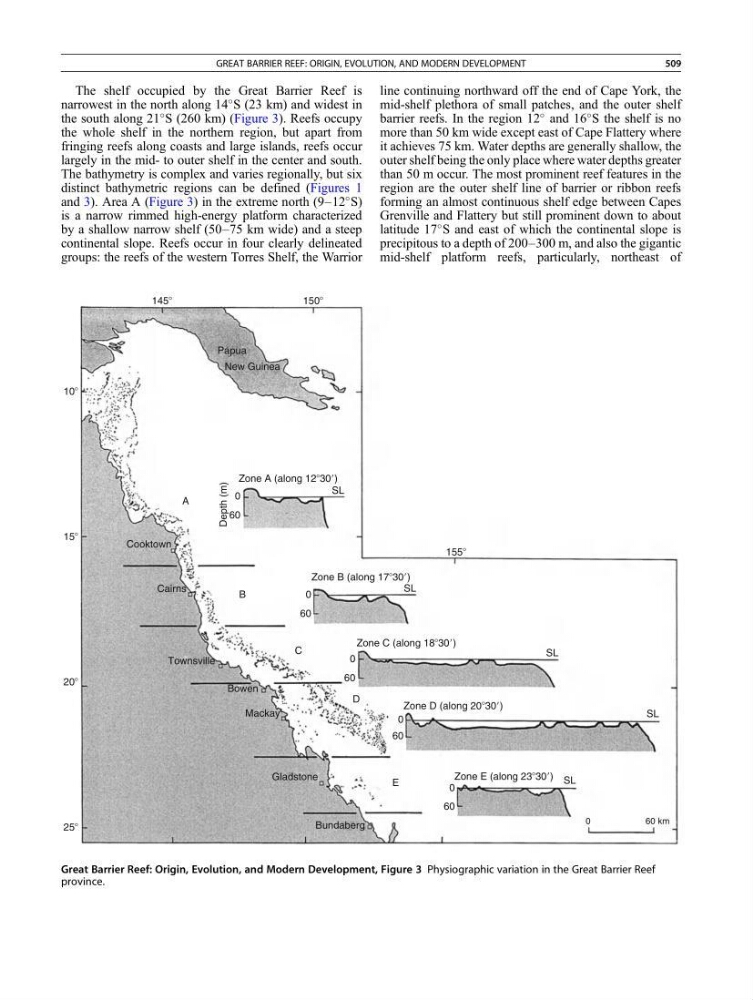
The shelf occupied by the Great Barrier Reef is
narrowest in the north along 14
S (23 km) and widest in
the south along 21
S (260 km) (Figure 3). Reefs occupy
the whole shelf in the northern region, but apart from
fringing reefs along coasts and large islands, reefs occur
largely in the mid- to outer shelf in the center and south.
The bathymetry is complex and varies regionally, but six
distinct bathymetric regions can be defined (Figures 1
and 3). Area A (Figure 3) in the extreme north (9–12
S)
is a narrow rimmed high-energy platform characterized
by a shallow narrow shelf (50–75 km wide) and a steep
continental slope. Reefs occur in four clearly delineated
groups: the reefs of the western Torres Shelf, the Warrior
line continuing northward off the end of Cape York, the
mid-shelf plethora of small patches, and the outer shelf
barrier reefs. In the region 12
and 16
S the shelf is no
more than 50 km wide except east of Cape Flattery where
it achieves 75 km. Water depths are generally shallow, the
outer shelf being the only place where water depths greater
than 50 m occur. The most prominent reef features in the
region are the outer shelf line of barrier or ribbon reefs
forming an almost continuous shelf edge between Capes
Grenville and Flattery but still prominent down to about
latitude 17
S and east of which the continental slope is
precipitous to a depth of 200–300 m, and also the gigantic
mid-shelf platform reefs, particularly, northeast of
145Њ
10Њ
15Њ
20Њ
25Њ
150Њ
155Њ
Papua
New Guinea
Zone A (along 12Њ30Ј)
Zone B (along 17Њ30Ј)
Zone C (along 18Њ30Ј)
Zone D (along 20Њ30Ј)
Zone E (along 23Њ30Ј)
0
60
0
60
0
60
0
60
0
60
SL
SL
SL
SL
SL
Depth (m)
A
B
C
D
E
Cooktown
Cairns
Townsville
Bowen
Mackay
Gladstone
Bundaberg
0
6 0 k m
Great Barrier Reef: Origin, Evolution, and Modern Development, Figure 3 Physiographic variation in the Great Barrier Reef
province.
GREAT BARRIER REEF: ORIGIN, EVOLUTION, AND MODERN DEVELOPMENT
509
narrowest in the north along 14
S (23 km) and widest in
the south along 21
S (260 km) (Figure 3). Reefs occupy
the whole shelf in the northern region, but apart from
fringing reefs along coasts and large islands, reefs occur
largely in the mid- to outer shelf in the center and south.
The bathymetry is complex and varies regionally, but six
distinct bathymetric regions can be defined (Figures 1
and 3). Area A (Figure 3) in the extreme north (9–12
S)
is a narrow rimmed high-energy platform characterized
by a shallow narrow shelf (50–75 km wide) and a steep
continental slope. Reefs occur in four clearly delineated
groups: the reefs of the western Torres Shelf, the Warrior
line continuing northward off the end of Cape York, the
mid-shelf plethora of small patches, and the outer shelf
barrier reefs. In the region 12
and 16
S the shelf is no
more than 50 km wide except east of Cape Flattery where
it achieves 75 km. Water depths are generally shallow, the
outer shelf being the only place where water depths greater
than 50 m occur. The most prominent reef features in the
region are the outer shelf line of barrier or ribbon reefs
forming an almost continuous shelf edge between Capes
Grenville and Flattery but still prominent down to about
latitude 17
S and east of which the continental slope is
precipitous to a depth of 200–300 m, and also the gigantic
mid-shelf platform reefs, particularly, northeast of
145Њ
10Њ
15Њ
20Њ
25Њ
150Њ
155Њ
Papua
New Guinea
Zone A (along 12Њ30Ј)
Zone B (along 17Њ30Ј)
Zone C (along 18Њ30Ј)
Zone D (along 20Њ30Ј)
Zone E (along 23Њ30Ј)
0
60
0
60
0
60
0
60
0
60
SL
SL
SL
SL
SL
Depth (m)
A
B
C
D
E
Cooktown
Cairns
Townsville
Bowen
Mackay
Gladstone
Bundaberg
0
6 0 k m
Great Barrier Reef: Origin, Evolution, and Modern Development, Figure 3 Physiographic variation in the Great Barrier Reef
province.
GREAT BARRIER REEF: ORIGIN, EVOLUTION, AND MODERN DEVELOPMENT
509