

shelf edge at $25 m down the reef slope to $60 m and can
extend laterally for tens of kilometers (e.g., Burke, 1982;
Blanchon and Jones, 1997). These extensive shelf-edge
reefs have generally been considered to be part of the main
“reef complex” and have not been widely considered to be
separate entities. However, several observations suggest
otherwise: First, shelf-edge reefs commonly form along
margins where breakwater reefs are absent (Blanchon
and Jones, 1997). Second, they have been reported along
the edge of much wider shelves where they are widely separated from breakwater reef complexes (e.g., Harris and
Davies, 1989). In most areas however, these structures
are juxtaposed along narrow shelves and, although
influenced by similar processes, respond independently,
producing distinctive reef architectures and biotopes
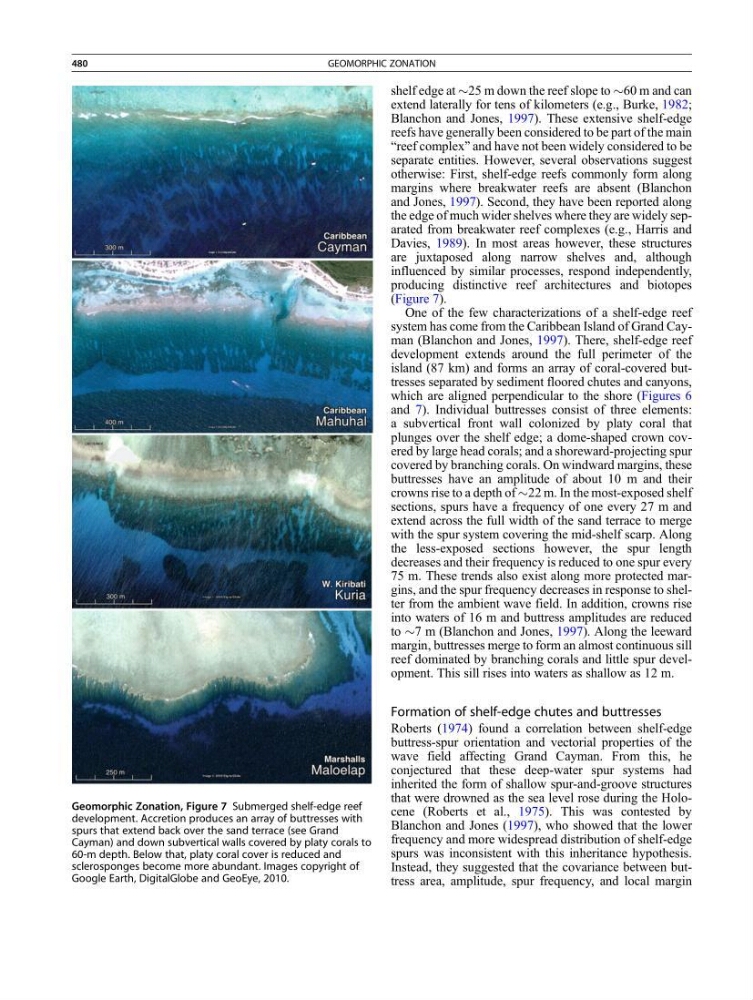
(Figure 7).
One of the few characterizations of a shelf-edge reef
system has come from the Caribbean Island of Grand Cayman (Blanchon and Jones, 1997). There, shelf-edge reef
development extends around the full perimeter of the
island (87 km) and forms an array of coral-covered buttresses separated by sediment floored chutes and canyons,
which are aligned perpendicular to the shore (Figures 6
and 7). Individual buttresses consist of three elements:
a subvertical front wall colonized by platy coral that
plunges over the shelf edge; a dome-shaped crown covered by large head corals; and a shoreward-projecting spur
covered by branching corals. On windward margins, these
buttresses have an amplitude of about 10 m and their
crowns rise to a depth of $22 m. In the most-exposed shelf
sections, spurs have a frequency of one every 27 m and
extend across the full width of the sand terrace to merge
with the spur system covering the mid-shelf scarp. Along
the less-exposed sections however, the spur length
decreases and their frequency is reduced to one spur every
75 m. These trends also exist along more protected margins, and the spur frequency decreases in response to shelter from the ambient wave field. In addition, crowns rise
into waters of 16 m and buttress amplitudes are reduced
to $7 m (Blanchon and Jones, 1997). Along the leeward
margin, buttresses merge to form an almost continuous sill
reef dominated by branching corals and little spur development. This sill rises into waters as shallow as 12 m.
Formation of shelf-edge chutes and buttresses
Roberts (1974) found a correlation between shelf-edge
buttress-spur orientation and vectorial properties of the
wave field affecting Grand Cayman. From this, he
conjectured that these deep-water spur systems had
inherited the form of shallow spur-and-groove structures
that were drowned as the sea level rose during the Holocene (Roberts et al., 1975). This was contested by
Blanchon and Jones (1997), who showed that the lower
frequency and more widespread distribution of shelf-edge
spurs was inconsistent with this inheritance hypothesis.
Instead, they suggested that the covariance between buttress area, amplitude, spur frequency, and local margin
Geomorphic Zonation, Figure 7 Submerged shelf-edge reef
development. Accretion produces an array of buttresses with
spurs that extend back over the sand terrace (see Grand
Cayman) and down subvertical walls covered by platy corals to
60-m depth. Below that, platy coral cover is reduced and
sclerosponges become more abundant. Images copyright of
Google Earth, DigitalGlobe and GeoEye, 2010.
480
GEOMORPHIC ZONATION
extend laterally for tens of kilometers (e.g., Burke, 1982;
Blanchon and Jones, 1997). These extensive shelf-edge
reefs have generally been considered to be part of the main
“reef complex” and have not been widely considered to be
separate entities. However, several observations suggest
otherwise: First, shelf-edge reefs commonly form along
margins where breakwater reefs are absent (Blanchon
and Jones, 1997). Second, they have been reported along
the edge of much wider shelves where they are widely separated from breakwater reef complexes (e.g., Harris and
Davies, 1989). In most areas however, these structures
are juxtaposed along narrow shelves and, although
influenced by similar processes, respond independently,
producing distinctive reef architectures and biotopes
(Figure 7).
One of the few characterizations of a shelf-edge reef
system has come from the Caribbean Island of Grand Cayman (Blanchon and Jones, 1997). There, shelf-edge reef
development extends around the full perimeter of the
island (87 km) and forms an array of coral-covered buttresses separated by sediment floored chutes and canyons,
which are aligned perpendicular to the shore (Figures 6
and 7). Individual buttresses consist of three elements:
a subvertical front wall colonized by platy coral that
plunges over the shelf edge; a dome-shaped crown covered by large head corals; and a shoreward-projecting spur
covered by branching corals. On windward margins, these
buttresses have an amplitude of about 10 m and their
crowns rise to a depth of $22 m. In the most-exposed shelf
sections, spurs have a frequency of one every 27 m and
extend across the full width of the sand terrace to merge
with the spur system covering the mid-shelf scarp. Along
the less-exposed sections however, the spur length
decreases and their frequency is reduced to one spur every
75 m. These trends also exist along more protected margins, and the spur frequency decreases in response to shelter from the ambient wave field. In addition, crowns rise
into waters of 16 m and buttress amplitudes are reduced
to $7 m (Blanchon and Jones, 1997). Along the leeward
margin, buttresses merge to form an almost continuous sill
reef dominated by branching corals and little spur development. This sill rises into waters as shallow as 12 m.
Formation of shelf-edge chutes and buttresses
Roberts (1974) found a correlation between shelf-edge
buttress-spur orientation and vectorial properties of the
wave field affecting Grand Cayman. From this, he
conjectured that these deep-water spur systems had
inherited the form of shallow spur-and-groove structures
that were drowned as the sea level rose during the Holocene (Roberts et al., 1975). This was contested by
Blanchon and Jones (1997), who showed that the lower
frequency and more widespread distribution of shelf-edge
spurs was inconsistent with this inheritance hypothesis.
Instead, they suggested that the covariance between buttress area, amplitude, spur frequency, and local margin
Geomorphic Zonation, Figure 7 Submerged shelf-edge reef
development. Accretion produces an array of buttresses with
spurs that extend back over the sand terrace (see Grand
Cayman) and down subvertical walls covered by platy corals to
60-m depth. Below that, platy coral cover is reduced and
sclerosponges become more abundant. Images copyright of
Google Earth, DigitalGlobe and GeoEye, 2010.
480
GEOMORPHIC ZONATION