

common and have been described from the Marshalls,
Tuamotus, Tonga, and the southern Maldives (Tracy
et al., 1948; Ladd et al., 1950; Wells, 1951; Newell,
1954; Wells, 1957; Stoddart, 1966; Nunn, 1993). The first
type is an elevated $1-m-high ridge (above mean low
water) fronting the most exposed reef sections, normally
associated with islands (ridges as high as 2.5 m have been
reported from the southern Tuamotus were storm swell is
severe; Salvat and Salvat, 1992). This high ridge type is
commonly dissected by surge channels, 1-m wide and as
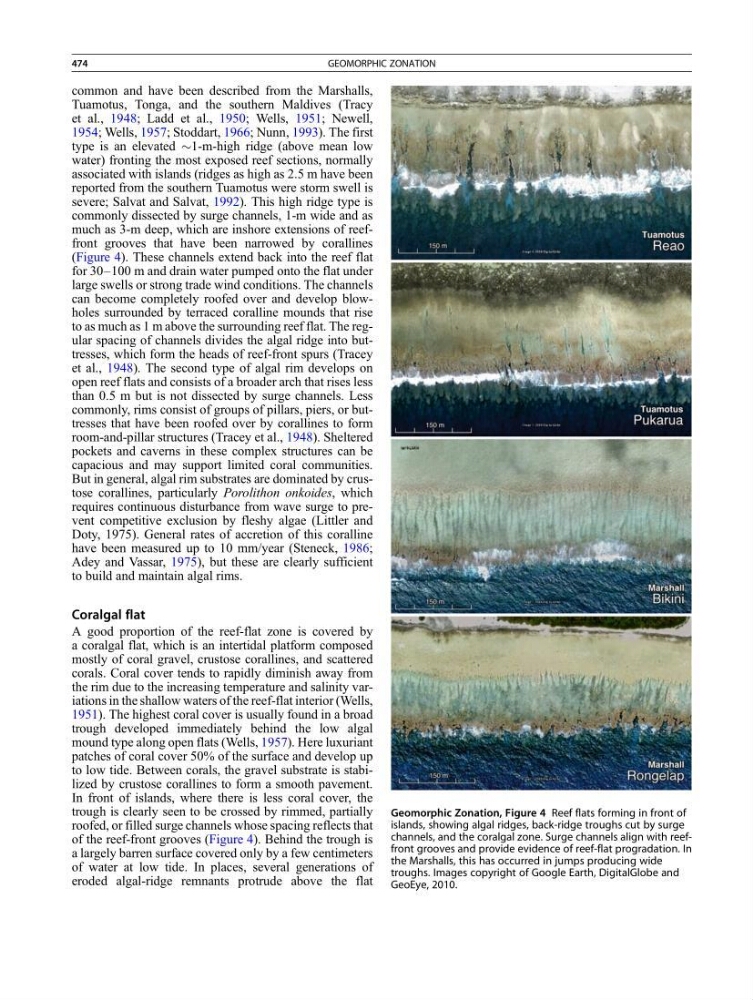
much as 3-m deep, which are inshore extensions of reeffront grooves that have been narrowed by corallines
(Figure 4). These channels extend back into the reef flat
for 30–100 m and drain water pumped onto the flat under
large swells or strong trade wind conditions. The channels
can become completely roofed over and develop blowholes surrounded by terraced coralline mounds that rise
to as much as 1 m above the surrounding reef flat. The regular spacing of channels divides the algal ridge into buttresses, which form the heads of reef-front spurs (Tracey
et al., 1948). The second type of algal rim develops on
open reef flats and consists of a broader arch that rises less
than 0.5 m but is not dissected by surge channels. Less
commonly, rims consist of groups of pillars, piers, or buttresses that have been roofed over by corallines to form
room-and-pillar structures (Tracey et al., 1948). Sheltered
pockets and caverns in these complex structures can be
capacious and may support limited coral communities.
But in general, algal rim substrates are dominated by crustose corallines, particularly Porolithon onkoides, which
requires continuous disturbance from wave surge to prevent competitive exclusion by fleshy algae (Littler and
Doty, 1975). General rates of accretion of this coralline
have been measured up to 10 mm/year (Steneck, 1986;
Adey and Vassar, 1975), but these are clearly sufficient
to build and maintain algal rims.
Coralgal flat
A good proportion of the reef-flat zone is covered by
a coralgal flat, which is an intertidal platform composed
mostly of coral gravel, crustose corallines, and scattered
corals. Coral cover tends to rapidly diminish away from
the rim due to the increasing temperature and salinity variations in the shallow waters of the reef-flat interior (Wells,
1951). The highest coral cover is usually found in a broad
trough developed immediately behind the low algal
mound type along open flats (Wells, 1957). Here luxuriant
patches of coral cover 50% of the surface and develop up
to low tide. Between corals, the gravel substrate is stabilized by crustose corallines to form a smooth pavement.
In front of islands, where there is less coral cover, the
trough is clearly seen to be crossed by rimmed, partially
roofed, or filled surge channels whose spacing reflects that
of the reef-front grooves (Figure 4). Behind the trough is
a largely barren surface covered only by a few centimeters
of water at low tide. In places, several generations of
eroded algal-ridge remnants protrude above the flat
Geomorphic Zonation, Figure 4 Reef flats forming in front of
islands, showing algal ridges, back-ridge troughs cut by surge
channels, and the coralgal zone. Surge channels align with reeffront grooves and provide evidence of reef-flat progradation. In
the Marshalls, this has occurred in jumps producing wide
troughs. Images copyright of Google Earth, DigitalGlobe and
GeoEye, 2010.
474
GEOMORPHIC ZONATION
Tuamotus, Tonga, and the southern Maldives (Tracy
et al., 1948; Ladd et al., 1950; Wells, 1951; Newell,
1954; Wells, 1957; Stoddart, 1966; Nunn, 1993). The first
type is an elevated $1-m-high ridge (above mean low
water) fronting the most exposed reef sections, normally
associated with islands (ridges as high as 2.5 m have been
reported from the southern Tuamotus were storm swell is
severe; Salvat and Salvat, 1992). This high ridge type is
commonly dissected by surge channels, 1-m wide and as
much as 3-m deep, which are inshore extensions of reeffront grooves that have been narrowed by corallines
(Figure 4). These channels extend back into the reef flat
for 30–100 m and drain water pumped onto the flat under
large swells or strong trade wind conditions. The channels
can become completely roofed over and develop blowholes surrounded by terraced coralline mounds that rise
to as much as 1 m above the surrounding reef flat. The regular spacing of channels divides the algal ridge into buttresses, which form the heads of reef-front spurs (Tracey
et al., 1948). The second type of algal rim develops on
open reef flats and consists of a broader arch that rises less
than 0.5 m but is not dissected by surge channels. Less
commonly, rims consist of groups of pillars, piers, or buttresses that have been roofed over by corallines to form
room-and-pillar structures (Tracey et al., 1948). Sheltered
pockets and caverns in these complex structures can be
capacious and may support limited coral communities.
But in general, algal rim substrates are dominated by crustose corallines, particularly Porolithon onkoides, which
requires continuous disturbance from wave surge to prevent competitive exclusion by fleshy algae (Littler and
Doty, 1975). General rates of accretion of this coralline
have been measured up to 10 mm/year (Steneck, 1986;
Adey and Vassar, 1975), but these are clearly sufficient
to build and maintain algal rims.
Coralgal flat
A good proportion of the reef-flat zone is covered by
a coralgal flat, which is an intertidal platform composed
mostly of coral gravel, crustose corallines, and scattered
corals. Coral cover tends to rapidly diminish away from
the rim due to the increasing temperature and salinity variations in the shallow waters of the reef-flat interior (Wells,
1951). The highest coral cover is usually found in a broad
trough developed immediately behind the low algal
mound type along open flats (Wells, 1957). Here luxuriant
patches of coral cover 50% of the surface and develop up
to low tide. Between corals, the gravel substrate is stabilized by crustose corallines to form a smooth pavement.
In front of islands, where there is less coral cover, the
trough is clearly seen to be crossed by rimmed, partially
roofed, or filled surge channels whose spacing reflects that
of the reef-front grooves (Figure 4). Behind the trough is
a largely barren surface covered only by a few centimeters
of water at low tide. In places, several generations of
eroded algal-ridge remnants protrude above the flat
Geomorphic Zonation, Figure 4 Reef flats forming in front of
islands, showing algal ridges, back-ridge troughs cut by surge
channels, and the coralgal zone. Surge channels align with reeffront grooves and provide evidence of reef-flat progradation. In
the Marshalls, this has occurred in jumps producing wide
troughs. Images copyright of Google Earth, DigitalGlobe and
GeoEye, 2010.
474
GEOMORPHIC ZONATION