

neighbors (Figure 2). Connected patches or knolls can
further develop into ridges with sinuous, stellate, or reticulate arrangements, with the latter closing off distinct
areas of deeper water, producing a cellular pattern of reef
development. This cellular structure develops at various
scales and can produce cells as large as 1,000 m in diameter (Figure 3).
Many lagoonal reefs have diverse coral assemblages,
which can develop a distinctive windward/leeward as well
as depth zonation (Wells, 1957). In Tikehau, for example,
emergent patch reefs are topped by skeletal sand and
cobble-sizedcoral gravel. The windward side has large
head corals of 6 m, and leeward and deeper sides are
covered by branching acroporids to depths of 15 m
(Intes and Caillart, 1994). In addition, there can be lateral
gradients in coral zonation within individual lagoons as
a consequence of various environmental gradients (Paulay
and Kerr, 2001).
An obvious control on lagoonal reef development is the
degree of water exchange with the open ocean. During
World War II, causeway construction blocked spillways
over reef flats and isolated lagoonal sections, causing mass
mortality of corals (Maragos, 1993). This led to the realization that a dominant exchange mechanism was related
to reef flat currents driven by wave setup and not necessarily to tidal exchange (Atkinson et al., 1981; Andrews and
Pickard, 1990). This has been most clearly demonstrated
by Callaghan et al. (2006), who showed that during most
Caribbean
Belize
Patch Patch
and knoll
and knoll
Sand Sand
flat flat
Coralgal Coralgal
flat flat
Gravel Gravel
rim rim
Spur and
Spur and
groove groove
Sand Sand
terrace terrace
Chute and
Chute and
buttress buttress
Crest Crest
Scarp Scarp
Shelf break
Shelf break
Sand slope
Sand slope
Reef Reef
lagoon lagoon
Reef Reef
flat flat
Reef Reef
front front
Reef Reef
slope slope
Patch Patch
and knoll
and knoll
Sand Sand
flat flat
Coralgal Coralgal
flat flat
Algal Algal
rim rim
Spur and
Spur and
groove groove
Sand Sand
terrace terrace
Chute and
Chute and
buttress buttress
Sand slope
Sand slope
Crest Crest
Scarp Scarp
Shelf break
Shelf break
Trade dominated
Swell dominated
Marshalls
Arno
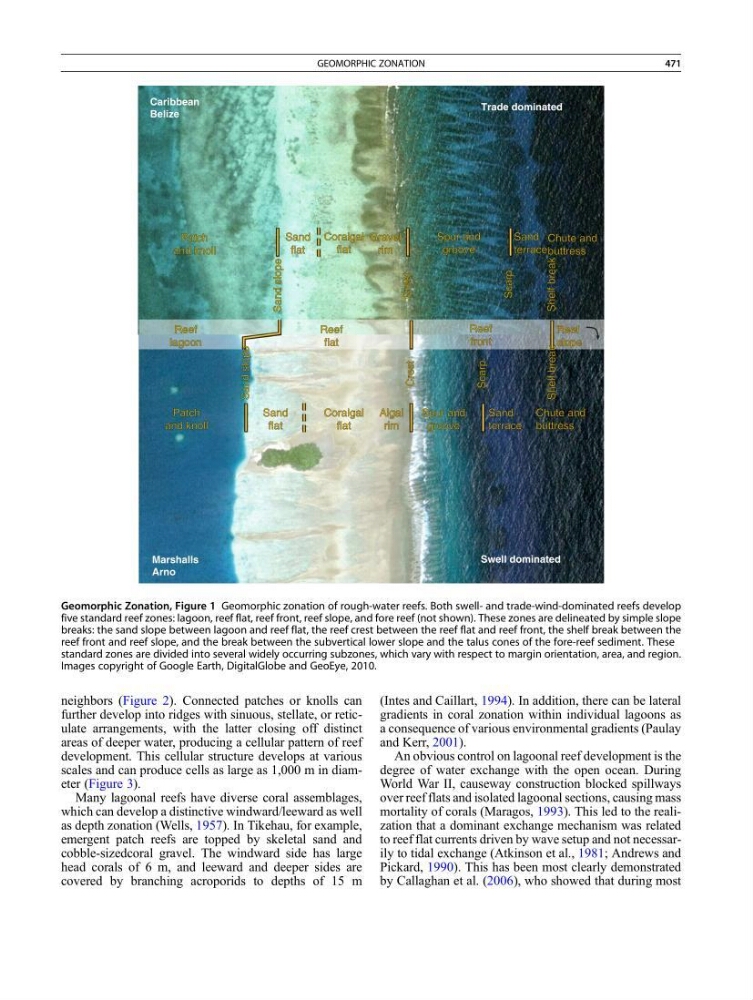
Geomorphic Zonation, Figure 1 Geomorphic zonation of rough-water reefs. Both swell- and trade-wind-dominated reefs develop
five standard reef zones: lagoon, reef flat, reef front, reef slope, and fore reef (not shown). These zones are delineated by simple slope
breaks: the sand slope between lagoon and reef flat, the reef crest between the reef flat and reef front, the shelf break between the
reef front and reef slope, and the break between the subvertical lower slope and the talus cones of the fore-reef sediment. These
standard zones are divided into several widely occurring subzones, which vary with respect to margin orientation, area, and region.
Images copyright of Google Earth, DigitalGlobe and GeoEye, 2010.
GEOMORPHIC ZONATION
471
further develop into ridges with sinuous, stellate, or reticulate arrangements, with the latter closing off distinct
areas of deeper water, producing a cellular pattern of reef
development. This cellular structure develops at various
scales and can produce cells as large as 1,000 m in diameter (Figure 3).
Many lagoonal reefs have diverse coral assemblages,
which can develop a distinctive windward/leeward as well
as depth zonation (Wells, 1957). In Tikehau, for example,
emergent patch reefs are topped by skeletal sand and
cobble-sizedcoral gravel. The windward side has large
head corals of 6 m, and leeward and deeper sides are
covered by branching acroporids to depths of 15 m
(Intes and Caillart, 1994). In addition, there can be lateral
gradients in coral zonation within individual lagoons as
a consequence of various environmental gradients (Paulay
and Kerr, 2001).
An obvious control on lagoonal reef development is the
degree of water exchange with the open ocean. During
World War II, causeway construction blocked spillways
over reef flats and isolated lagoonal sections, causing mass
mortality of corals (Maragos, 1993). This led to the realization that a dominant exchange mechanism was related
to reef flat currents driven by wave setup and not necessarily to tidal exchange (Atkinson et al., 1981; Andrews and
Pickard, 1990). This has been most clearly demonstrated
by Callaghan et al. (2006), who showed that during most
Caribbean
Belize
Patch Patch
and knoll
and knoll
Sand Sand
flat flat
Coralgal Coralgal
flat flat
Gravel Gravel
rim rim
Spur and
Spur and
groove groove
Sand Sand
terrace terrace
Chute and
Chute and
buttress buttress
Crest Crest
Scarp Scarp
Shelf break
Shelf break
Sand slope
Sand slope
Reef Reef
lagoon lagoon
Reef Reef
flat flat
Reef Reef
front front
Reef Reef
slope slope
Patch Patch
and knoll
and knoll
Sand Sand
flat flat
Coralgal Coralgal
flat flat
Algal Algal
rim rim
Spur and
Spur and
groove groove
Sand Sand
terrace terrace
Chute and
Chute and
buttress buttress
Sand slope
Sand slope
Crest Crest
Scarp Scarp
Shelf break
Shelf break
Trade dominated
Swell dominated
Marshalls
Arno
Geomorphic Zonation, Figure 1 Geomorphic zonation of rough-water reefs. Both swell- and trade-wind-dominated reefs develop
five standard reef zones: lagoon, reef flat, reef front, reef slope, and fore reef (not shown). These zones are delineated by simple slope
breaks: the sand slope between lagoon and reef flat, the reef crest between the reef flat and reef front, the shelf break between the
reef front and reef slope, and the break between the subvertical lower slope and the talus cones of the fore-reef sediment. These
standard zones are divided into several widely occurring subzones, which vary with respect to margin orientation, area, and region.
Images copyright of Google Earth, DigitalGlobe and GeoEye, 2010.
GEOMORPHIC ZONATION
471