

the potential to fundamentally alter the dynamics of reef
and other benthic marine communities.
In general, grazers and carnivores throughout the
Palaeozoic and early Mesozoic were relatively small individuals with limited foraging ranges incapable of excavating calcareous substrates. A radiation during the Devonian
of durophagous, mobile predators has been proposed by
Signor and Brett (1984), but these forms probably relied
upon manipulation only to crush or ingest (Harper and
Skelton, 1993). By the early Mesozoic, sessile organisms
had to contend with an increasing battery of novel and
more advanced feeding methods as well as sediment disruption due to deep bioturbating activity (see summary
in Vermeij, 1987). Most notable was the rise of efficient
excavation behaviors.
Bioerosion notably increased in intensity from the midto-late Jurassic. A radiation of borers occurred from the
Triassic onward, with deep borers (capable of penetration
greater than 50 mm) appearing from the Jurassic. Clionid
sponges – one of the major bioeroders on modern coral
reefs – had become abundant by the latest Jurassic. The
first live borers are known from the Eocene (Krumm and
Jones, 1993), as are fishes similar to modern reef faunas
(Bellwood, 1996). The ability for substantial excavation
of hard substrata over large areas increased considerably
from the latest Cretaceous-early Tertiary when deepgrazing limpets, camerodont sea urchins, and especially
the reef fishes appeared. The complex pharyngeal apparatus of labrids was present at this time, and major labrid
clades were already differentiated (Bellwood, 1997).
Balistids first appeared in the Oligocene, and the oldest
scarid fossil capable of deep excavation currently known
is from the Miocene (14 Ma) (Bellwood and Schulz,
1991). It seems likely that sometime during the Oligocene–Miocene, reef bioerosion gained a modern caste.
The abundance of reef fishes is assumed to be of great
importance on coral reefs, as evidenced by the dramatic
increase of algal growth as a result of their decline on
Jamaican reefs. Tropical marine hard substrata are usually
sparsely vegetated, but a rich algal flora develops when herbivorous fish are excluded and/or nutrient input increases.
Grazers not only allow the dominance of corals and coralline algae on coral reefs, they also contribute notably to carbonate sediment production and redistribution, algal ridge
formation, and the maintenance of overall diversity. Like
other predators, they can also ameliorate the effects of competition and may combine with physical controls to produce the characteristic zonation of modern coral reefs.
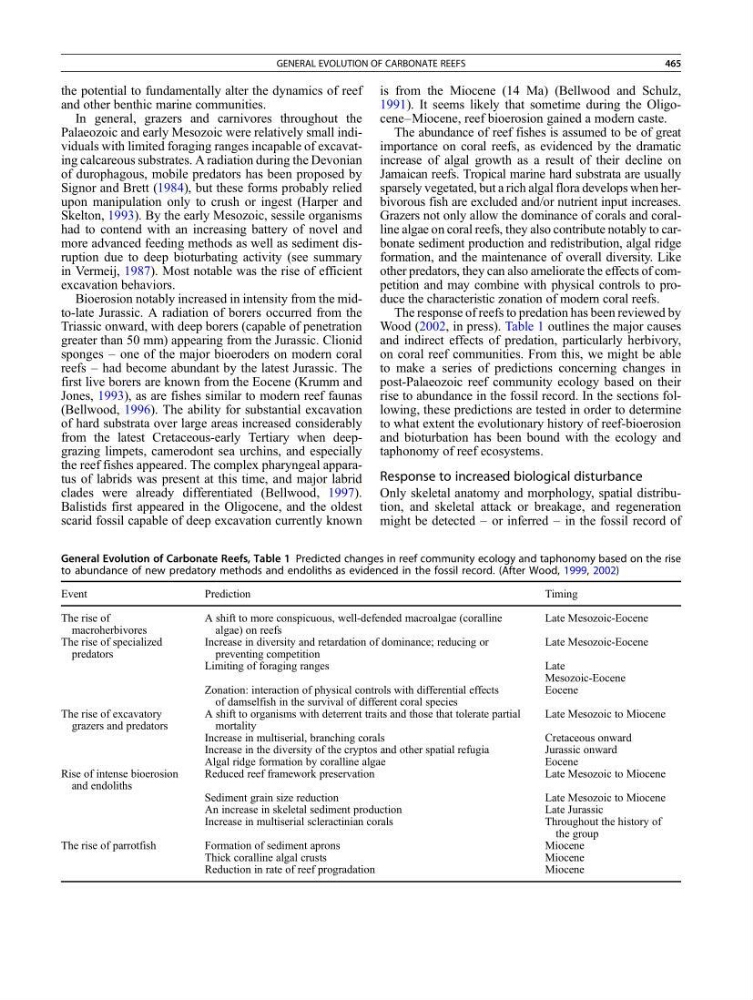
The response of reefs to predation has been reviewed by
Wood (2002, in press). Table 1 outlines the major causes
and indirect effects of predation, particularly herbivory,
on coral reef communities. From this, we might be able
to make a series of predictions concerning changes in
post-Palaeozoic reef community ecology based on their
rise to abundance in the fossil record. In the sections following, these predictions are tested in order to determine
to what extent the evolutionary history of reef-bioerosion
and bioturbation has been bound with the ecology and
taphonomy of reef ecosystems.
Response to increased biological disturbance
Only skeletal anatomy and morphology, spatial distribution, and skeletal attack or breakage, and regeneration
might be detected – or inferred – in the fossil record of
General Evolution of Carbonate Reefs, Table 1 Predicted changes in reef community ecology and taphonomy based on the rise
to abundance of new predatory methods and endoliths as evidenced in the fossil record. (After Wood, 1999, 2002)
Event
Prediction
Timing
The rise of
macroherbivores
A shift to more conspicuous, well-defended macroalgae (coralline
algae) on reefs
Late Mesozoic-Eocene
The rise of specialized
predators
Increase in diversity and retardation of dominance; reducing or
preventing competition
Late Mesozoic-Eocene
Limiting of foraging ranges
Late
Mesozoic-Eocene
Zonation: interaction of physical controls with differential effects
of damselfish in the survival of different coral species
Eocene
The rise of excavatory
grazers and predators
A shift to organisms with deterrent traits and those that tolerate partial
mortality
Late Mesozoic to Miocene
Increase in multiserial, branching corals
Cretaceous onward
Increase in the diversity of the cryptos and other spatial refugia
Jurassic onward
Algal ridge formation by coralline algae
Eocene
Rise of intense bioerosion
and endoliths
Reduced reef framework preservation
Late Mesozoic to Miocene
Sediment grain size reduction
Late Mesozoic to Miocene
An increase in skeletal sediment production
Late Jurassic
Increase in multiserial scleractinian corals
Throughout the history of
the group
The rise of parrotfish
Formation of sediment aprons
Miocene
Thick coralline algal crusts
Miocene
Reduction in rate of reef progradation
Miocene
GENERAL EVOLUTION OF CARBONATE REEFS
465
and other benthic marine communities.
In general, grazers and carnivores throughout the
Palaeozoic and early Mesozoic were relatively small individuals with limited foraging ranges incapable of excavating calcareous substrates. A radiation during the Devonian
of durophagous, mobile predators has been proposed by
Signor and Brett (1984), but these forms probably relied
upon manipulation only to crush or ingest (Harper and
Skelton, 1993). By the early Mesozoic, sessile organisms
had to contend with an increasing battery of novel and
more advanced feeding methods as well as sediment disruption due to deep bioturbating activity (see summary
in Vermeij, 1987). Most notable was the rise of efficient
excavation behaviors.
Bioerosion notably increased in intensity from the midto-late Jurassic. A radiation of borers occurred from the
Triassic onward, with deep borers (capable of penetration
greater than 50 mm) appearing from the Jurassic. Clionid
sponges – one of the major bioeroders on modern coral
reefs – had become abundant by the latest Jurassic. The
first live borers are known from the Eocene (Krumm and
Jones, 1993), as are fishes similar to modern reef faunas
(Bellwood, 1996). The ability for substantial excavation
of hard substrata over large areas increased considerably
from the latest Cretaceous-early Tertiary when deepgrazing limpets, camerodont sea urchins, and especially
the reef fishes appeared. The complex pharyngeal apparatus of labrids was present at this time, and major labrid
clades were already differentiated (Bellwood, 1997).
Balistids first appeared in the Oligocene, and the oldest
scarid fossil capable of deep excavation currently known
is from the Miocene (14 Ma) (Bellwood and Schulz,
1991). It seems likely that sometime during the Oligocene–Miocene, reef bioerosion gained a modern caste.
The abundance of reef fishes is assumed to be of great
importance on coral reefs, as evidenced by the dramatic
increase of algal growth as a result of their decline on
Jamaican reefs. Tropical marine hard substrata are usually
sparsely vegetated, but a rich algal flora develops when herbivorous fish are excluded and/or nutrient input increases.
Grazers not only allow the dominance of corals and coralline algae on coral reefs, they also contribute notably to carbonate sediment production and redistribution, algal ridge
formation, and the maintenance of overall diversity. Like
other predators, they can also ameliorate the effects of competition and may combine with physical controls to produce the characteristic zonation of modern coral reefs.
The response of reefs to predation has been reviewed by
Wood (2002, in press). Table 1 outlines the major causes
and indirect effects of predation, particularly herbivory,
on coral reef communities. From this, we might be able
to make a series of predictions concerning changes in
post-Palaeozoic reef community ecology based on their
rise to abundance in the fossil record. In the sections following, these predictions are tested in order to determine
to what extent the evolutionary history of reef-bioerosion
and bioturbation has been bound with the ecology and
taphonomy of reef ecosystems.
Response to increased biological disturbance
Only skeletal anatomy and morphology, spatial distribution, and skeletal attack or breakage, and regeneration
might be detected – or inferred – in the fossil record of
General Evolution of Carbonate Reefs, Table 1 Predicted changes in reef community ecology and taphonomy based on the rise
to abundance of new predatory methods and endoliths as evidenced in the fossil record. (After Wood, 1999, 2002)
Event
Prediction
Timing
The rise of
macroherbivores
A shift to more conspicuous, well-defended macroalgae (coralline
algae) on reefs
Late Mesozoic-Eocene
The rise of specialized
predators
Increase in diversity and retardation of dominance; reducing or
preventing competition
Late Mesozoic-Eocene
Limiting of foraging ranges
Late
Mesozoic-Eocene
Zonation: interaction of physical controls with differential effects
of damselfish in the survival of different coral species
Eocene
The rise of excavatory
grazers and predators
A shift to organisms with deterrent traits and those that tolerate partial
mortality
Late Mesozoic to Miocene
Increase in multiserial, branching corals
Cretaceous onward
Increase in the diversity of the cryptos and other spatial refugia
Jurassic onward
Algal ridge formation by coralline algae
Eocene
Rise of intense bioerosion
and endoliths
Reduced reef framework preservation
Late Mesozoic to Miocene
Sediment grain size reduction
Late Mesozoic to Miocene
An increase in skeletal sediment production
Late Jurassic
Increase in multiserial scleractinian corals
Throughout the history of
the group
The rise of parrotfish
Formation of sediment aprons
Miocene
Thick coralline algal crusts
Miocene
Reduction in rate of reef progradation
Miocene
GENERAL EVOLUTION OF CARBONATE REEFS
465