

oscillations (e.g., Milankovitch and glacial–interglacial
cycles) as well as to longer-term climatic intervals driven
by slower, tectonically driven processes.
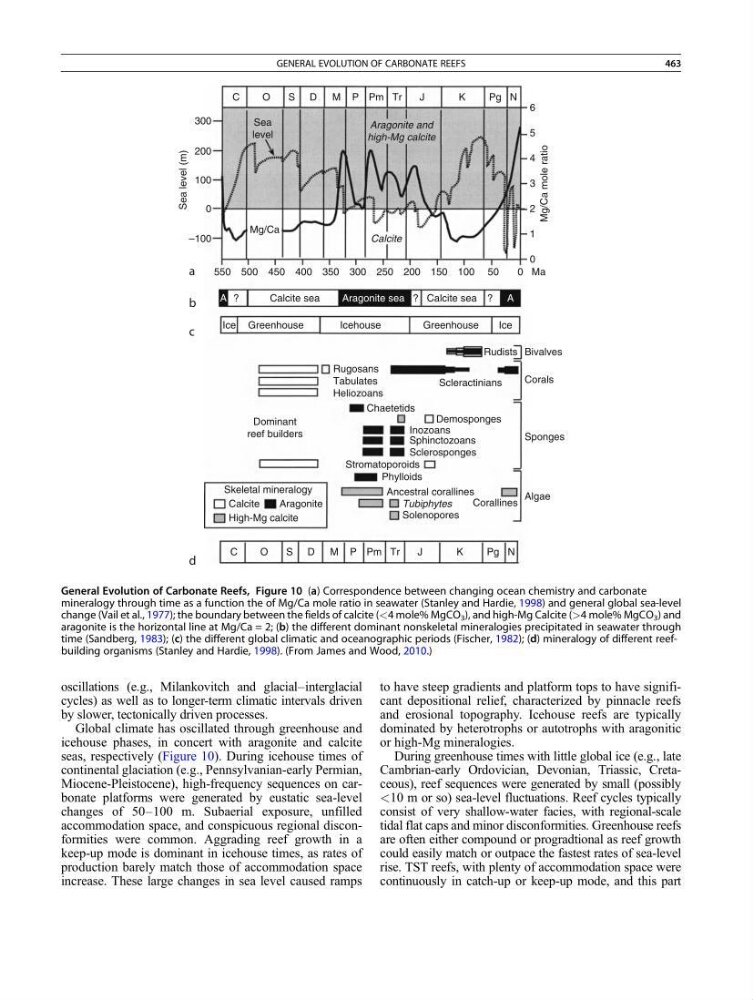
Global climate has oscillated through greenhouse and
icehouse phases, in concert with aragonite and calcite
seas, respectively (Figure 10). During icehouse times of
continental glaciation (e.g., Pennsylvanian-early Permian,
Miocene-Pleistocene), high-frequency sequences on carbonate platforms were generated by eustatic sea-level
changes of 50–100 m. Subaerial exposure, unfilled
accommodation space, and conspicuous regional disconformities were common. Aggrading reef growth in a
keep-up mode is dominant in icehouse times, as rates of
production barely match those of accommodation space
increase. These large changes in sea level caused ramps
to have steep gradients and platform tops to have significant depositional relief, characterized by pinnacle reefs
and erosional topography. Icehouse reefs are typically
dominated by heterotrophs or autotrophs with aragonitic
or high-Mg mineralogies.
During greenhouse times with little global ice (e.g., late
Cambrian-early Ordovician, Devonian, Triassic, Cretaceous), reef sequences were generated by small (possibly
<10 m or so) sea-level fluctuations. Reef cycles typically
consist of very shallow-water facies, with regional-scale
tidal flat caps and minor disconformities. Greenhouse reefs
are often either compound or progradtional as reef growth
could easily match or outpace the fastest rates of sea-level
rise. TST reefs, with plenty of accommodation space were
continuously in catch-up or keep-up mode, and this part
Sea
level
C
O
S D
M P Pm Tr
J
K
Pg N
C
O
S D
M P Pm Tr
J
K
Pg N
Mg/Ca
550
–100
100
200
300
Sea level (m)
0
500
A
A
Calcite sea
Greenhouse
Greenhouse
Rudists Bivalves
Corals
Sponges
Algae
Corallines
Scleractinians
Rugosans
Tabulates
Heliozoans
Chaetetids
Demosponges
Stromatoporoids
Skeletal mineralogy
Dominant
reef builders
Phylloids
Ancestral corallines
Calcite
Aragonite
High-Mg calcite
Tubiphytes
Solenopores
Inozoans
Sclerosponges
Sphinctozoans
Icehouse
Ice
Ice
Calcite sea
Aragonite sea
?
?
?
450 400 350 300 250 200 150 100 50
0 Ma
0
1
2
Mg/Ca mole ratio
3
4
5
6
Calcite
Aragonite and
high-Mg calcite
a
b
c
d
General Evolution of Carbonate Reefs, Figure 10 (a) Correspondence between changing ocean chemistry and carbonate
mineralogy through time as a function the of Mg/Ca mole ratio in seawater (Stanley and Hardie, 1998) and general global sea-level
change (Vail et al., 1977); the boundary between the fields of calcite (<4 mole% MgCO 3 ), and high-Mg Calcite (>4 mole% MgCO 3 ) and
aragonite is the horizontal line at Mg/Ca = 2; (b) the different dominant nonskeletal mineralogies precipitated in seawater through
time (Sandberg, 1983); (c) the different global climatic and oceanographic periods (Fischer, 1982); (d) mineralogy of different reefbuilding organisms (Stanley and Hardie, 1998). (From James and Wood, 2010.)
GENERAL EVOLUTION OF CARBONATE REEFS
463
cycles) as well as to longer-term climatic intervals driven
by slower, tectonically driven processes.
Global climate has oscillated through greenhouse and
icehouse phases, in concert with aragonite and calcite
seas, respectively (Figure 10). During icehouse times of
continental glaciation (e.g., Pennsylvanian-early Permian,
Miocene-Pleistocene), high-frequency sequences on carbonate platforms were generated by eustatic sea-level
changes of 50–100 m. Subaerial exposure, unfilled
accommodation space, and conspicuous regional disconformities were common. Aggrading reef growth in a
keep-up mode is dominant in icehouse times, as rates of
production barely match those of accommodation space
increase. These large changes in sea level caused ramps
to have steep gradients and platform tops to have significant depositional relief, characterized by pinnacle reefs
and erosional topography. Icehouse reefs are typically
dominated by heterotrophs or autotrophs with aragonitic
or high-Mg mineralogies.
During greenhouse times with little global ice (e.g., late
Cambrian-early Ordovician, Devonian, Triassic, Cretaceous), reef sequences were generated by small (possibly
<10 m or so) sea-level fluctuations. Reef cycles typically
consist of very shallow-water facies, with regional-scale
tidal flat caps and minor disconformities. Greenhouse reefs
are often either compound or progradtional as reef growth
could easily match or outpace the fastest rates of sea-level
rise. TST reefs, with plenty of accommodation space were
continuously in catch-up or keep-up mode, and this part
Sea
level
C
O
S D
M P Pm Tr
J
K
Pg N
C
O
S D
M P Pm Tr
J
K
Pg N
Mg/Ca
550
–100
100
200
300
Sea level (m)
0
500
A
A
Calcite sea
Greenhouse
Greenhouse
Rudists Bivalves
Corals
Sponges
Algae
Corallines
Scleractinians
Rugosans
Tabulates
Heliozoans
Chaetetids
Demosponges
Stromatoporoids
Skeletal mineralogy
Dominant
reef builders
Phylloids
Ancestral corallines
Calcite
Aragonite
High-Mg calcite
Tubiphytes
Solenopores
Inozoans
Sclerosponges
Sphinctozoans
Icehouse
Ice
Ice
Calcite sea
Aragonite sea
?
?
?
450 400 350 300 250 200 150 100 50
0 Ma
0
1
2
Mg/Ca mole ratio
3
4
5
6
Calcite
Aragonite and
high-Mg calcite
a
b
c
d
General Evolution of Carbonate Reefs, Figure 10 (a) Correspondence between changing ocean chemistry and carbonate
mineralogy through time as a function the of Mg/Ca mole ratio in seawater (Stanley and Hardie, 1998) and general global sea-level
change (Vail et al., 1977); the boundary between the fields of calcite (<4 mole% MgCO 3 ), and high-Mg Calcite (>4 mole% MgCO 3 ) and
aragonite is the horizontal line at Mg/Ca = 2; (b) the different dominant nonskeletal mineralogies precipitated in seawater through
time (Sandberg, 1983); (c) the different global climatic and oceanographic periods (Fischer, 1982); (d) mineralogy of different reefbuilding organisms (Stanley and Hardie, 1998). (From James and Wood, 2010.)
GENERAL EVOLUTION OF CARBONATE REEFS
463