

Introduction
Funafuti Atoll (8
31
0 S, 179
12
0 E) forms a part of the
Tuvalu Group (formerly the Ellice Islands). It is a typical
atoll composed of $33 reef islands (a total land area of
2.4 km
2
) and a lagoon of $18-km diameter (275 km
2
).
The islands are formed from fossil coral limestone and
calcareous marine carbonates, particularly larger foraminifera. The lagoon has three main deep channels. Additional lagoon/ocean water interchange takes place over
the reef rim, especially on the western side where the islets
are small and widely separated. A total of 36 species of
coral were recorded in 1983 and the blue coral Heliopora
coerulea was abundant on the western rim (Buckley,
1985). A variety of corals occur on the reef slope and reef
buttresses including Acropora, Pocillopora, Montipora,
Millepora, Acanthastrea, Favia, etc. Over 200 fish species
and 400 mollusks have been identified from the lagoon
(UNEP, 1988). In the shallow lagoon, larger foraminifera
are the dominant component of sand and gravel, while
Halimeda replaces the foraminifera in deeper water
(Collen and Garton, 2004). There are abundant coral reef
fauna in the lagoon and on the reef.
The capital of Tuvalu is located on Fongafale islet, the
main island of the atoll. Four thousand four hundred and
ninety two people live on Funafuti Atoll (2002 Census).
The total national population of Tuvalu is 11,126 in
2007 (http://www.spc.int/prism/country/tv/stats/). While
tropical cyclones (recorded in 1891, 1958, 1972, and
1997) have destroyed many buildings on Funafuti, they
have also played a significant role in land formation by
re-sedimentation of submarine carbonates (Maragos et al.,
1973). Recently, floods on Funafuti, especially on
Fongafale islet during spring high tides were possibly associated with sea-level rise caused by global warming (Patel,
2006). More than 100 years ago, the Royal Society of
London mounted an expedition to Funafuti Atoll to test
Darwin’s theory of the formation of coral atolls (Royal
Society, 1904). The IUCN Conservation Monitoring
Centre book, Coral Reefs of the World, provides useful
information of Funafuti (UNEP, 1988). Also, over 1,000
references concerning the geology and biology of Tuvalu
are indexed and annotated by Rodgers and Cantrell (1988).
The Royal Society Coral Reef Expeditions
In 1896–1898, under the leadership of Professor Tannant
Edgeworth David (Sydney University), the Royal Society
drilled a 339-m drill hole on Funafuti Atoll to carry out the
experiment desired by Darwin to interpret the origin and
history of coral reefs (Darwin, 1842; The Royal Society,
1904; Grimsdale, 1952). But, the drilling did not reach
the base of the atoll; however, it showed clearly that shallow water limestone over such a thickness must have been
accompanied by a subsidence. Subsequent, but much later
drilling by the U.S.G.S. at Enewetak and Bikini Atolls
in the 1950s proved finally that at least some atolls also
had volcanic basements (Emery et al., 1954; Ladd and
Schlanger, 1960). Over a century after the Funafuti
Expedition, selected samples from the 339-m-long drill
core (preserved at the Natural History Museum) have been
dated using high-precision radiocarbon and Sr isotope
measurements (Ohde et al., 2002). From the radiocarbon
dating, the top 26.4 m of the core records the history of
sea-level rise during the last 8,000 years. For the previous
two million years, however, only the recent use of highprecision Sr isotopic data have made it possible to provide
records of the Quaternary sea-level history preserved in
the atoll carbonates. During the past 1.5 million years,
more than 150 m of reef-lagoonal carbonate was deposited
through an interaction between glacial/interglacial sealevel changes and plate subsidence. Sections of dolomite
in the lower core (196–339 m) were formed through diagenetic alteration between one and two million years
ago, possibly resulting from seawater percolation. The
atoll sequence reflects the interaction between carbonate
sedimentation, tectonic subsidence, and eustatic sea-level
change, and potentially provides a two million–year
record of environmental change.
Holocene reef growth at Funafuti
Radiocarbon dating of fossil corals provides information
on Holocene reef history at Funafuti. Three shallow borings were carried out on the reef-flat of Fongafale (Royal
Society, 1904). The top 26.4 m of the main boring is
mainly composed of corals, including the soft coral
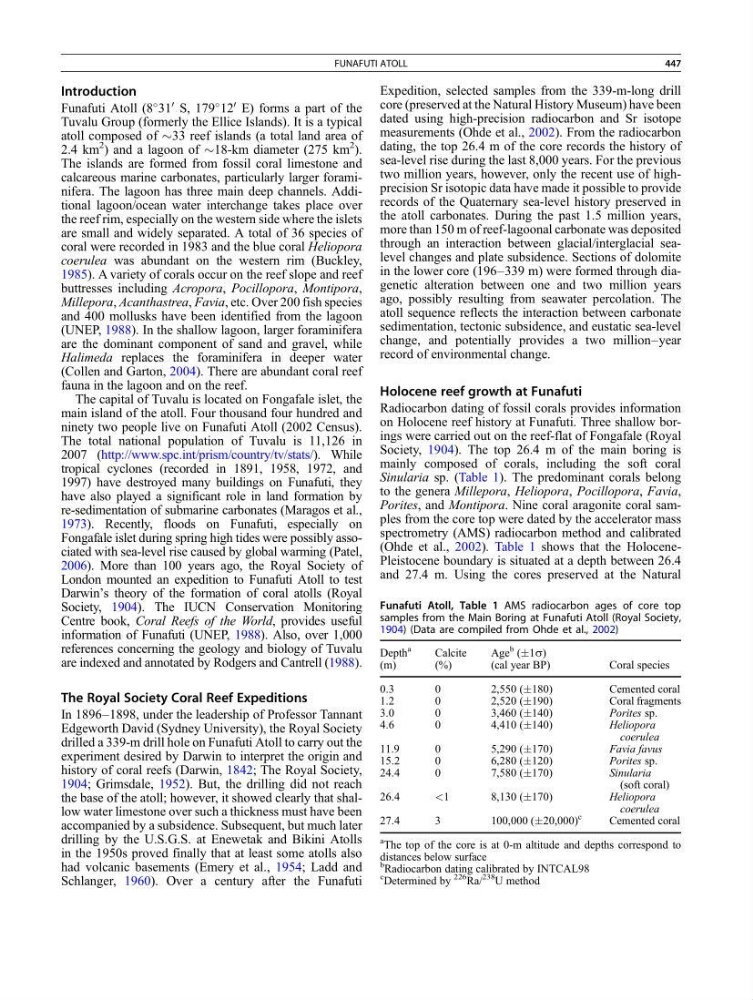
Sinularia sp. (Table 1). The predominant corals belong
to the genera Millepora, Heliopora, Pocillopora, Favia,
Porites, and Montipora. Nine coral aragonite coral samples from the core top were dated by the accelerator mass
spectrometry (AMS) radiocarbon method and calibrated
(Ohde et al., 2002). Table 1 shows that the HolocenePleistocene boundary is situated at a depth between 26.4
and 27.4 m. Using the cores preserved at the Natural
Funafuti Atoll, Table 1 AMS radiocarbon ages of core top
samples from the Main Boring at Funafuti Atoll (Royal Society,
1904) (Data are compiled from Ohde et al., 2002)
Depth
a
(m)
Calcite
(%)
Age
b (Æ1s)
(cal year BP)
Coral species
0.3
0
2,550 (Æ180)
Cemented coral
1.2
0
2,520 (Æ190)
Coral fragments
3.0
0
3,460 (Æ140)
Porites sp.
4.6
0
4,410 (Æ140)
Heliopora
coerulea
11.9
0
5,290 (Æ170)
Favia favus
15.2
0
6,280 (Æ120)
Porites sp.
24.4
0
7,580 (Æ170)
Sinularia
(soft coral)
26.4
<1
8,130 (Æ170)
Heliopora
coerulea
27.4
3
100,000 (Æ20,000)
c
Cemented coral
a The top of the core is at 0-m altitude and depths correspond to
distances below surface
b
Radiocarbon dating calibrated by INTCAL98
c Determined by
226 Ra/
238 U method
FUNAFUTI ATOLL
447
Funafuti Atoll (8
31
0 S, 179
12
0 E) forms a part of the
Tuvalu Group (formerly the Ellice Islands). It is a typical
atoll composed of $33 reef islands (a total land area of
2.4 km
2
) and a lagoon of $18-km diameter (275 km
2
).
The islands are formed from fossil coral limestone and
calcareous marine carbonates, particularly larger foraminifera. The lagoon has three main deep channels. Additional lagoon/ocean water interchange takes place over
the reef rim, especially on the western side where the islets
are small and widely separated. A total of 36 species of
coral were recorded in 1983 and the blue coral Heliopora
coerulea was abundant on the western rim (Buckley,
1985). A variety of corals occur on the reef slope and reef
buttresses including Acropora, Pocillopora, Montipora,
Millepora, Acanthastrea, Favia, etc. Over 200 fish species
and 400 mollusks have been identified from the lagoon
(UNEP, 1988). In the shallow lagoon, larger foraminifera
are the dominant component of sand and gravel, while
Halimeda replaces the foraminifera in deeper water
(Collen and Garton, 2004). There are abundant coral reef
fauna in the lagoon and on the reef.
The capital of Tuvalu is located on Fongafale islet, the
main island of the atoll. Four thousand four hundred and
ninety two people live on Funafuti Atoll (2002 Census).
The total national population of Tuvalu is 11,126 in
2007 (http://www.spc.int/prism/country/tv/stats/). While
tropical cyclones (recorded in 1891, 1958, 1972, and
1997) have destroyed many buildings on Funafuti, they
have also played a significant role in land formation by
re-sedimentation of submarine carbonates (Maragos et al.,
1973). Recently, floods on Funafuti, especially on
Fongafale islet during spring high tides were possibly associated with sea-level rise caused by global warming (Patel,
2006). More than 100 years ago, the Royal Society of
London mounted an expedition to Funafuti Atoll to test
Darwin’s theory of the formation of coral atolls (Royal
Society, 1904). The IUCN Conservation Monitoring
Centre book, Coral Reefs of the World, provides useful
information of Funafuti (UNEP, 1988). Also, over 1,000
references concerning the geology and biology of Tuvalu
are indexed and annotated by Rodgers and Cantrell (1988).
The Royal Society Coral Reef Expeditions
In 1896–1898, under the leadership of Professor Tannant
Edgeworth David (Sydney University), the Royal Society
drilled a 339-m drill hole on Funafuti Atoll to carry out the
experiment desired by Darwin to interpret the origin and
history of coral reefs (Darwin, 1842; The Royal Society,
1904; Grimsdale, 1952). But, the drilling did not reach
the base of the atoll; however, it showed clearly that shallow water limestone over such a thickness must have been
accompanied by a subsidence. Subsequent, but much later
drilling by the U.S.G.S. at Enewetak and Bikini Atolls
in the 1950s proved finally that at least some atolls also
had volcanic basements (Emery et al., 1954; Ladd and
Schlanger, 1960). Over a century after the Funafuti
Expedition, selected samples from the 339-m-long drill
core (preserved at the Natural History Museum) have been
dated using high-precision radiocarbon and Sr isotope
measurements (Ohde et al., 2002). From the radiocarbon
dating, the top 26.4 m of the core records the history of
sea-level rise during the last 8,000 years. For the previous
two million years, however, only the recent use of highprecision Sr isotopic data have made it possible to provide
records of the Quaternary sea-level history preserved in
the atoll carbonates. During the past 1.5 million years,
more than 150 m of reef-lagoonal carbonate was deposited
through an interaction between glacial/interglacial sealevel changes and plate subsidence. Sections of dolomite
in the lower core (196–339 m) were formed through diagenetic alteration between one and two million years
ago, possibly resulting from seawater percolation. The
atoll sequence reflects the interaction between carbonate
sedimentation, tectonic subsidence, and eustatic sea-level
change, and potentially provides a two million–year
record of environmental change.
Holocene reef growth at Funafuti
Radiocarbon dating of fossil corals provides information
on Holocene reef history at Funafuti. Three shallow borings were carried out on the reef-flat of Fongafale (Royal
Society, 1904). The top 26.4 m of the main boring is
mainly composed of corals, including the soft coral
Sinularia sp. (Table 1). The predominant corals belong
to the genera Millepora, Heliopora, Pocillopora, Favia,
Porites, and Montipora. Nine coral aragonite coral samples from the core top were dated by the accelerator mass
spectrometry (AMS) radiocarbon method and calibrated
(Ohde et al., 2002). Table 1 shows that the HolocenePleistocene boundary is situated at a depth between 26.4
and 27.4 m. Using the cores preserved at the Natural
Funafuti Atoll, Table 1 AMS radiocarbon ages of core top
samples from the Main Boring at Funafuti Atoll (Royal Society,
1904) (Data are compiled from Ohde et al., 2002)
Depth
a
(m)
Calcite
(%)
Age
b (Æ1s)
(cal year BP)
Coral species
0.3
0
2,550 (Æ180)
Cemented coral
1.2
0
2,520 (Æ190)
Coral fragments
3.0
0
3,460 (Æ140)
Porites sp.
4.6
0
4,410 (Æ140)
Heliopora
coerulea
11.9
0
5,290 (Æ170)
Favia favus
15.2
0
6,280 (Æ120)
Porites sp.
24.4
0
7,580 (Æ170)
Sinularia
(soft coral)
26.4
<1
8,130 (Æ170)
Heliopora
coerulea
27.4
3
100,000 (Æ20,000)
c
Cemented coral
a The top of the core is at 0-m altitude and depths correspond to
distances below surface
b
Radiocarbon dating calibrated by INTCAL98
c Determined by
226 Ra/
238 U method
FUNAFUTI ATOLL
447