

veneer over the seaward edge of a Pleistocene reefal substrate. Another mode of fringing reef development was
described from China Reef, Japan, where a narrow fringing reef initiated on a narrow Pleistocene reef terrace at
around À10 m, approximately 7,000 years ago, kept up
with sea-level rise to form a narrow reef flat that has
increased in width not through seaward progradation,
which is depth limited, but through scarp retreat of the
backing cliff in this high energy location (Kan et al.,
1995) (Figure 5g). In contrast, some fringing reefs may
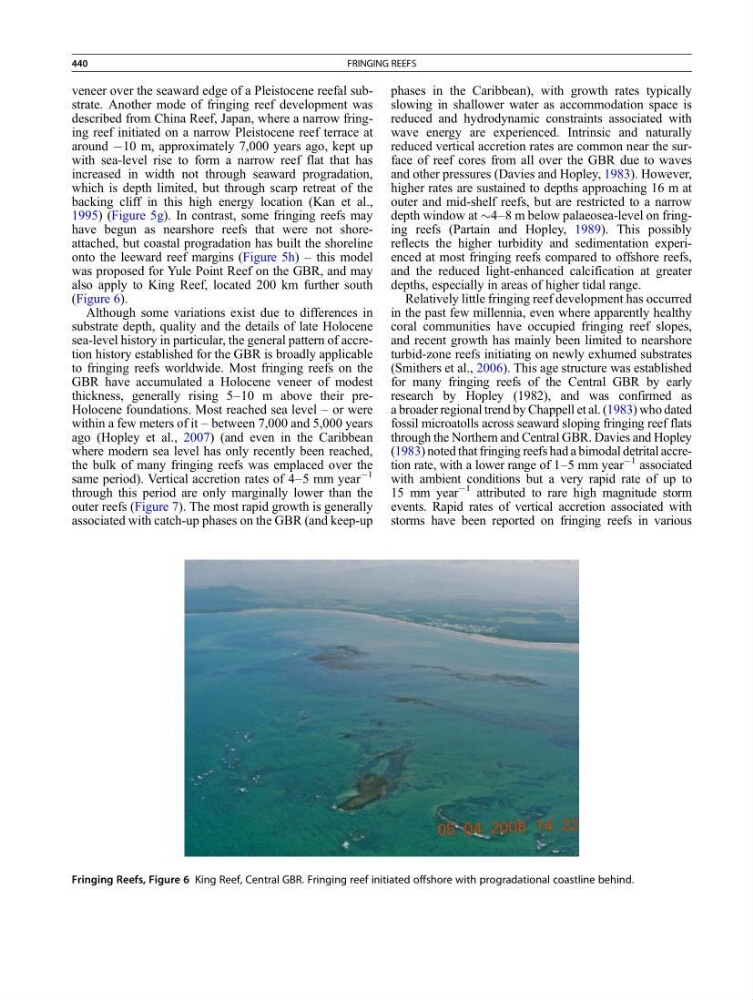
have begun as nearshore reefs that were not shoreattached, but coastal progradation has built the shoreline
onto the leeward reef margins (Figure 5h) – this model
was proposed for Yule Point Reef on the GBR, and may
also apply to King Reef, located 200 km further south
(Figure 6).
Although some variations exist due to differences in
substrate depth, quality and the details of late Holocene
sea-level history in particular, the general pattern of accretion history established for the GBR is broadly applicable
to fringing reefs worldwide. Most fringing reefs on the
GBR have accumulated a Holocene veneer of modest
thickness, generally rising 5–10 m above their preHolocene foundations. Most reached sea level – or were
within a few meters of it – between 7,000 and 5,000 years
ago (Hopley et al., 2007) (and even in the Caribbean
where modern sea level has only recently been reached,
the bulk of many fringing reefs was emplaced over the
same period). Vertical accretion rates of 4–5 mm year
À1
through this period are only marginally lower than the
outer reefs (Figure 7). The most rapid growth is generally
associated with catch-up phases on the GBR (and keep-up
phases in the Caribbean), with growth rates typically
slowing in shallower water as accommodation space is
reduced and hydrodynamic constraints associated with
wave energy are experienced. Intrinsic and naturally
reduced vertical accretion rates are common near the surface of reef cores from all over the GBR due to waves
and other pressures (Davies and Hopley, 1983). However,
higher rates are sustained to depths approaching 16 m at
outer and mid-shelf reefs, but are restricted to a narrow
depth window at $4–8 m below palaeosea-level on fringing reefs (Partain and Hopley, 1989). This possibly
reflects the higher turbidity and sedimentation experienced at most fringing reefs compared to offshore reefs,
and the reduced light-enhanced calcification at greater
depths, especially in areas of higher tidal range.
Relatively little fringing reef development has occurred
in the past few millennia, even where apparently healthy
coral communities have occupied fringing reef slopes,
and recent growth has mainly been limited to nearshore
turbid-zone reefs initiating on newly exhumed substrates
(Smithers et al., 2006). This age structure was established
for many fringing reefs of the Central GBR by early
research by Hopley (1982), and was confirmed as
a broader regional trend by Chappell et al. (1983) who dated
fossil microatolls across seaward sloping fringing reef flats
through the Northern and Central GBR. Davies and Hopley
(1983) noted that fringing reefs had a bimodal detrital accretion rate, with a lower range of 1–5 mm year
À1 associated
with ambient conditions but a very rapid rate of up to
15 mm year
À1 attributed to rare high magnitude storm
events. Rapid rates of vertical accretion associated with
storms have been reported on fringing reefs in various
Fringing Reefs, Figure 6 King Reef, Central GBR. Fringing reef initiated offshore with progradational coastline behind.
440
FRINGING REEFS
described from China Reef, Japan, where a narrow fringing reef initiated on a narrow Pleistocene reef terrace at
around À10 m, approximately 7,000 years ago, kept up
with sea-level rise to form a narrow reef flat that has
increased in width not through seaward progradation,
which is depth limited, but through scarp retreat of the
backing cliff in this high energy location (Kan et al.,
1995) (Figure 5g). In contrast, some fringing reefs may
have begun as nearshore reefs that were not shoreattached, but coastal progradation has built the shoreline
onto the leeward reef margins (Figure 5h) – this model
was proposed for Yule Point Reef on the GBR, and may
also apply to King Reef, located 200 km further south
(Figure 6).
Although some variations exist due to differences in
substrate depth, quality and the details of late Holocene
sea-level history in particular, the general pattern of accretion history established for the GBR is broadly applicable
to fringing reefs worldwide. Most fringing reefs on the
GBR have accumulated a Holocene veneer of modest
thickness, generally rising 5–10 m above their preHolocene foundations. Most reached sea level – or were
within a few meters of it – between 7,000 and 5,000 years
ago (Hopley et al., 2007) (and even in the Caribbean
where modern sea level has only recently been reached,
the bulk of many fringing reefs was emplaced over the
same period). Vertical accretion rates of 4–5 mm year
À1
through this period are only marginally lower than the
outer reefs (Figure 7). The most rapid growth is generally
associated with catch-up phases on the GBR (and keep-up
phases in the Caribbean), with growth rates typically
slowing in shallower water as accommodation space is
reduced and hydrodynamic constraints associated with
wave energy are experienced. Intrinsic and naturally
reduced vertical accretion rates are common near the surface of reef cores from all over the GBR due to waves
and other pressures (Davies and Hopley, 1983). However,
higher rates are sustained to depths approaching 16 m at
outer and mid-shelf reefs, but are restricted to a narrow
depth window at $4–8 m below palaeosea-level on fringing reefs (Partain and Hopley, 1989). This possibly
reflects the higher turbidity and sedimentation experienced at most fringing reefs compared to offshore reefs,
and the reduced light-enhanced calcification at greater
depths, especially in areas of higher tidal range.
Relatively little fringing reef development has occurred
in the past few millennia, even where apparently healthy
coral communities have occupied fringing reef slopes,
and recent growth has mainly been limited to nearshore
turbid-zone reefs initiating on newly exhumed substrates
(Smithers et al., 2006). This age structure was established
for many fringing reefs of the Central GBR by early
research by Hopley (1982), and was confirmed as
a broader regional trend by Chappell et al. (1983) who dated
fossil microatolls across seaward sloping fringing reef flats
through the Northern and Central GBR. Davies and Hopley
(1983) noted that fringing reefs had a bimodal detrital accretion rate, with a lower range of 1–5 mm year
À1 associated
with ambient conditions but a very rapid rate of up to
15 mm year
À1 attributed to rare high magnitude storm
events. Rapid rates of vertical accretion associated with
storms have been reported on fringing reefs in various
Fringing Reefs, Figure 6 King Reef, Central GBR. Fringing reef initiated offshore with progradational coastline behind.
440
FRINGING REEFS