

application (as do a variety of other fringing reef growth
models outlined in section “Fringing reef structure and
growth models”).
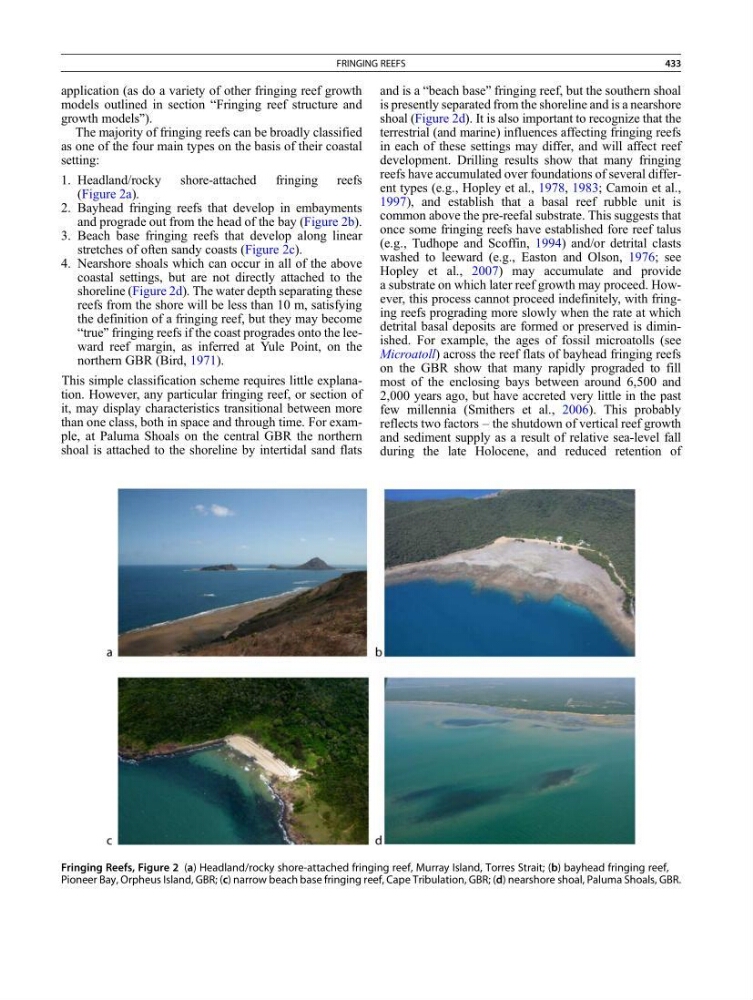
The majority of fringing reefs can be broadly classified
as one of the four main types on the basis of their coastal
setting:
1. Headland/rocky shore-attached fringing reefs
(Figure 2a).
2. Bayhead fringing reefs that develop in embayments
and prograde out from the head of the bay (Figure 2b).
3. Beach base fringing reefs that develop along linear
stretches of often sandy coasts (Figure 2c).
4. Nearshore shoals which can occur in all of the above
coastal settings, but are not directly attached to the
shoreline (Figure 2d). The water depth separating these
reefs from the shore will be less than 10 m, satisfying
the definition of a fringing reef, but they may become
“true” fringing reefs if the coast progrades onto the leeward reef margin, as inferred at Yule Point, on the
northern GBR (Bird, 1971).
This simple classification scheme requires little explanation. However, any particular fringing reef, or section of
it, may display characteristics transitional between more
than one class, both in space and through time. For example, at Paluma Shoals on the central GBR the northern
shoal is attached to the shoreline by intertidal sand flats
and is a “beach base” fringing reef, but the southern shoal
is presently separated from the shoreline and is a nearshore
shoal (Figure 2d). It is also important to recognize that the
terrestrial (and marine) influences affecting fringing reefs
in each of these settings may differ, and will affect reef
development. Drilling results show that many fringing
reefs have accumulated over foundations of several different types (e.g., Hopley et al., 1978, 1983; Camoin et al.,
1997), and establish that a basal reef rubble unit is
common above the pre-reefal substrate. This suggests that
once some fringing reefs have established fore reef talus
(e.g., Tudhope and Scoffin, 1994) and/or detrital clasts
washed to leeward (e.g., Easton and Olson, 1976; see
Hopley et al., 2007) may accumulate and provide
a substrate on which later reef growth may proceed. However, this process cannot proceed indefinitely, with fringing reefs prograding more slowly when the rate at which
detrital basal deposits are formed or preserved is diminished. For example, the ages of fossil microatolls (see
Microatoll) across the reef flats of bayhead fringing reefs
on the GBR show that many rapidly prograded to fill
most of the enclosing bays between around 6,500 and
2,000 years ago, but have accreted very little in the past
few millennia (Smithers et al., 2006). This probably
reflects two factors – the shutdown of vertical reef growth
and sediment supply as a result of relative sea-level fall
during the late Holocene, and reduced retention of
Fringing Reefs, Figure 2 (a) Headland/rocky shore-attached fringing reef, Murray Island, Torres Strait; (b) bayhead fringing reef,
Pioneer Bay, Orpheus Island, GBR; (c) narrow beach base fringing reef, Cape Tribulation, GBR; (d) nearshore shoal, Paluma Shoals, GBR.
FRINGING REEFS
433
models outlined in section “Fringing reef structure and
growth models”).
The majority of fringing reefs can be broadly classified
as one of the four main types on the basis of their coastal
setting:
1. Headland/rocky shore-attached fringing reefs
(Figure 2a).
2. Bayhead fringing reefs that develop in embayments
and prograde out from the head of the bay (Figure 2b).
3. Beach base fringing reefs that develop along linear
stretches of often sandy coasts (Figure 2c).
4. Nearshore shoals which can occur in all of the above
coastal settings, but are not directly attached to the
shoreline (Figure 2d). The water depth separating these
reefs from the shore will be less than 10 m, satisfying
the definition of a fringing reef, but they may become
“true” fringing reefs if the coast progrades onto the leeward reef margin, as inferred at Yule Point, on the
northern GBR (Bird, 1971).
This simple classification scheme requires little explanation. However, any particular fringing reef, or section of
it, may display characteristics transitional between more
than one class, both in space and through time. For example, at Paluma Shoals on the central GBR the northern
shoal is attached to the shoreline by intertidal sand flats
and is a “beach base” fringing reef, but the southern shoal
is presently separated from the shoreline and is a nearshore
shoal (Figure 2d). It is also important to recognize that the
terrestrial (and marine) influences affecting fringing reefs
in each of these settings may differ, and will affect reef
development. Drilling results show that many fringing
reefs have accumulated over foundations of several different types (e.g., Hopley et al., 1978, 1983; Camoin et al.,
1997), and establish that a basal reef rubble unit is
common above the pre-reefal substrate. This suggests that
once some fringing reefs have established fore reef talus
(e.g., Tudhope and Scoffin, 1994) and/or detrital clasts
washed to leeward (e.g., Easton and Olson, 1976; see
Hopley et al., 2007) may accumulate and provide
a substrate on which later reef growth may proceed. However, this process cannot proceed indefinitely, with fringing reefs prograding more slowly when the rate at which
detrital basal deposits are formed or preserved is diminished. For example, the ages of fossil microatolls (see
Microatoll) across the reef flats of bayhead fringing reefs
on the GBR show that many rapidly prograded to fill
most of the enclosing bays between around 6,500 and
2,000 years ago, but have accreted very little in the past
few millennia (Smithers et al., 2006). This probably
reflects two factors – the shutdown of vertical reef growth
and sediment supply as a result of relative sea-level fall
during the late Holocene, and reduced retention of
Fringing Reefs, Figure 2 (a) Headland/rocky shore-attached fringing reef, Murray Island, Torres Strait; (b) bayhead fringing reef,
Pioneer Bay, Orpheus Island, GBR; (c) narrow beach base fringing reef, Cape Tribulation, GBR; (d) nearshore shoal, Paluma Shoals, GBR.
FRINGING REEFS
433