

(i.e., autotrophic and heterotrophic processes predominate), but not so much (or there is sufficient circulation)
that biological oxygen demand in the upper sediments
does not become limiting. Where oxygen becomes limiting, stress-tolerant taxa prevail. The more nutrient poor
the environment, the more prevalent the mixotrophic taxa
become. Calcifying mixotrophs, especially algal symbiont-bearing foraminifers and zooxanthellate corals, also
tend to be longer lived and slower growing than their autotrophic and heterotrophic competitors for space, and more
sensitive to highly variable oxygen because they have
such high respiratory needs at night and produce excess
oxygen during the daylight. For FI > 4, symbiont-bearing
taxa must make up at least 25% of the foraminiferal assemblage, providing the basis for the prediction that, if FI > 4,
local water quality should support calcifying mixotrophs.
Bibliography
Hallock, P., Lidz, B., Cockey-Burhard, E. M., Donnelly, K. B.,
2003. Foramiifera as bioindicators in coral reef assessment and
monitoring: The FORAM Index. Environmental Monitoring
and Assessment, 81, 221–238.
Schafer, C. T., 2000. Monitoring nearshore marine environments
using benthic foraminifera: Some protocols and pitfalls. Micropaleontology, 46, 161–169.
Yanko, V., Kronfeld, J., Flexer, A., 1994. Response of benthic foraminifera to various pollution sources: implications for pollution
monitoring. Journal of Foraminiferal Research, 24, 1–17.
Cross-references
Florida Keys
Foraminifera
Nutrient Pollution/Eutrophication
FORAMINIFERA
Pamela Hallock
University of South Florida, St. Petersburg, FL, USA
Definition and introduction
Members of the Class Foraminifera are among the most
abundant and most useful protists in the marine realm.
Foraminifers are characterized by a protective shell
(commonly called a test), which can be membranous,
agglutinated, or calcareous (Sen Gupta, 2002). The shell
can be a single chamber or multiple chambers that are
interconnected by one or more openings called foramen
(plural foramina), from which the class name is taken
(http:/ /www.ucmp.berkeley.edu/people/jlipps/glossary.html).
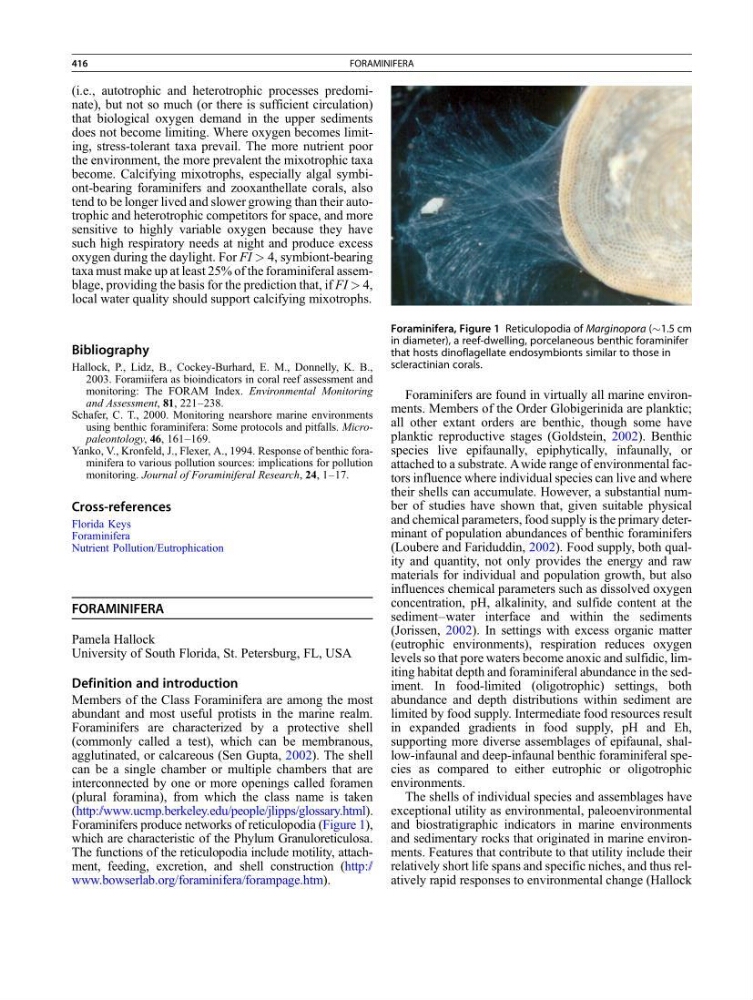
Foraminifers produce networks of reticulopodia (Figure 1),
which are characteristic of the Phylum Granuloreticulosa.
The functions of the reticulopodia include motility, attachment, feeding, excretion, and shell construction (http:/ /
www.bowserlab.org/foraminifera/forampage.htm).
Foraminifers are found in virtually all marine environments. Members of the Order Globigerinida are planktic;
all other extant orders are benthic, though some have
planktic reproductive stages (Goldstein, 2002). Benthic
species live epifaunally, epiphytically, infaunally, or
attached to a substrate. A wide range of environmental factors influence where individual species can live and where
their shells can accumulate. However, a substantial number of studies have shown that, given suitable physical
and chemical parameters, food supply is the primary determinant of population abundances of benthic foraminifers
(Loubere and Fariduddin, 2002). Food supply, both quality and quantity, not only provides the energy and raw
materials for individual and population growth, but also
influences chemical parameters such as dissolved oxygen
concentration, pH, alkalinity, and sulfide content at the
sediment–water interface and within the sediments
(Jorissen, 2002). In settings with excess organic matter
(eutrophic environments), respiration reduces oxygen
levels so that pore waters become anoxic and sulfidic, limiting habitat depth and foraminiferal abundance in the sediment. In food-limited (oligotrophic) settings, both
abundance and depth distributions within sediment are
limited by food supply. Intermediate food resources result
in expanded gradients in food supply, pH and Eh,
supporting more diverse assemblages of epifaunal, shallow-infaunal and deep-infaunal benthic foraminiferal species as compared to either eutrophic or oligotrophic
environments.
The shells of individual species and assemblages have
exceptional utility as environmental, paleoenvironmental
and biostratigraphic indicators in marine environments
and sedimentary rocks that originated in marine environments. Features that contribute to that utility include their
relatively short life spans and specific niches, and thus relatively rapid responses to environmental change (Hallock
Foraminifera, Figure 1 Reticulopodia of Marginopora ($1.5 cm
in diameter), a reef-dwelling, porcelaneous benthic foraminifer
that hosts dinoflagellate endosymbionts similar to those in
scleractinian corals.
416
FORAMINIFERA
that biological oxygen demand in the upper sediments
does not become limiting. Where oxygen becomes limiting, stress-tolerant taxa prevail. The more nutrient poor
the environment, the more prevalent the mixotrophic taxa
become. Calcifying mixotrophs, especially algal symbiont-bearing foraminifers and zooxanthellate corals, also
tend to be longer lived and slower growing than their autotrophic and heterotrophic competitors for space, and more
sensitive to highly variable oxygen because they have
such high respiratory needs at night and produce excess
oxygen during the daylight. For FI > 4, symbiont-bearing
taxa must make up at least 25% of the foraminiferal assemblage, providing the basis for the prediction that, if FI > 4,
local water quality should support calcifying mixotrophs.
Bibliography
Hallock, P., Lidz, B., Cockey-Burhard, E. M., Donnelly, K. B.,
2003. Foramiifera as bioindicators in coral reef assessment and
monitoring: The FORAM Index. Environmental Monitoring
and Assessment, 81, 221–238.
Schafer, C. T., 2000. Monitoring nearshore marine environments
using benthic foraminifera: Some protocols and pitfalls. Micropaleontology, 46, 161–169.
Yanko, V., Kronfeld, J., Flexer, A., 1994. Response of benthic foraminifera to various pollution sources: implications for pollution
monitoring. Journal of Foraminiferal Research, 24, 1–17.
Cross-references
Florida Keys
Foraminifera
Nutrient Pollution/Eutrophication
FORAMINIFERA
Pamela Hallock
University of South Florida, St. Petersburg, FL, USA
Definition and introduction
Members of the Class Foraminifera are among the most
abundant and most useful protists in the marine realm.
Foraminifers are characterized by a protective shell
(commonly called a test), which can be membranous,
agglutinated, or calcareous (Sen Gupta, 2002). The shell
can be a single chamber or multiple chambers that are
interconnected by one or more openings called foramen
(plural foramina), from which the class name is taken
(http:/ /www.ucmp.berkeley.edu/people/jlipps/glossary.html).
Foraminifers produce networks of reticulopodia (Figure 1),
which are characteristic of the Phylum Granuloreticulosa.
The functions of the reticulopodia include motility, attachment, feeding, excretion, and shell construction (http:/ /
www.bowserlab.org/foraminifera/forampage.htm).
Foraminifers are found in virtually all marine environments. Members of the Order Globigerinida are planktic;
all other extant orders are benthic, though some have
planktic reproductive stages (Goldstein, 2002). Benthic
species live epifaunally, epiphytically, infaunally, or
attached to a substrate. A wide range of environmental factors influence where individual species can live and where
their shells can accumulate. However, a substantial number of studies have shown that, given suitable physical
and chemical parameters, food supply is the primary determinant of population abundances of benthic foraminifers
(Loubere and Fariduddin, 2002). Food supply, both quality and quantity, not only provides the energy and raw
materials for individual and population growth, but also
influences chemical parameters such as dissolved oxygen
concentration, pH, alkalinity, and sulfide content at the
sediment–water interface and within the sediments
(Jorissen, 2002). In settings with excess organic matter
(eutrophic environments), respiration reduces oxygen
levels so that pore waters become anoxic and sulfidic, limiting habitat depth and foraminiferal abundance in the sediment. In food-limited (oligotrophic) settings, both
abundance and depth distributions within sediment are
limited by food supply. Intermediate food resources result
in expanded gradients in food supply, pH and Eh,
supporting more diverse assemblages of epifaunal, shallow-infaunal and deep-infaunal benthic foraminiferal species as compared to either eutrophic or oligotrophic
environments.
The shells of individual species and assemblages have
exceptional utility as environmental, paleoenvironmental
and biostratigraphic indicators in marine environments
and sedimentary rocks that originated in marine environments. Features that contribute to that utility include their
relatively short life spans and specific niches, and thus relatively rapid responses to environmental change (Hallock
Foraminifera, Figure 1 Reticulopodia of Marginopora ($1.5 cm
in diameter), a reef-dwelling, porcelaneous benthic foraminifer
that hosts dinoflagellate endosymbionts similar to those in
scleractinian corals.
416
FORAMINIFERA