

aesthetics. Meanwhile the government and resorts continue to hire consultants to study and debate the dilemma.
Sewage discharges in the lagoon of Kāne‘ohe Bay
(Hawaii) in the 1960s resulted in decline of corals and proliferation of green algae stimulated by nutrients in the sewage that were overgrowing and smothering corals. After
1968–1972 ecological studies demonstrated the adverse
effects of the sewage, government and community leaders
agreed to move the sewage outfall to a deeper site outside
the lagoon in 1977–1978 where wave energy dissipated
and diluted the sewage and caused only minor effects to
coral reefs (Figure 7). Subsequent lagoon surveys in
1983 and 1997 in the Bay revealed the recovery of coral
and decline of the invasive green algae. Additional
surveys were accomplished in the Bay in 2009, revealing
further declines in green algae but the rise of alien red
algae (Nadiera Sukhraj, pers. comm.).
Summary
Planning teams should be assembled before engineering plans and specifications are approved and include
engineers, scientists, planners, economists, and members of the affected communities.
Governments should adopt and require Environmental
Impact Assessment (EIA) procedures and coordination
before decisions are made.
The EIA process should include: public scoping of
issues; baseline ecological, oceanographic and cultural
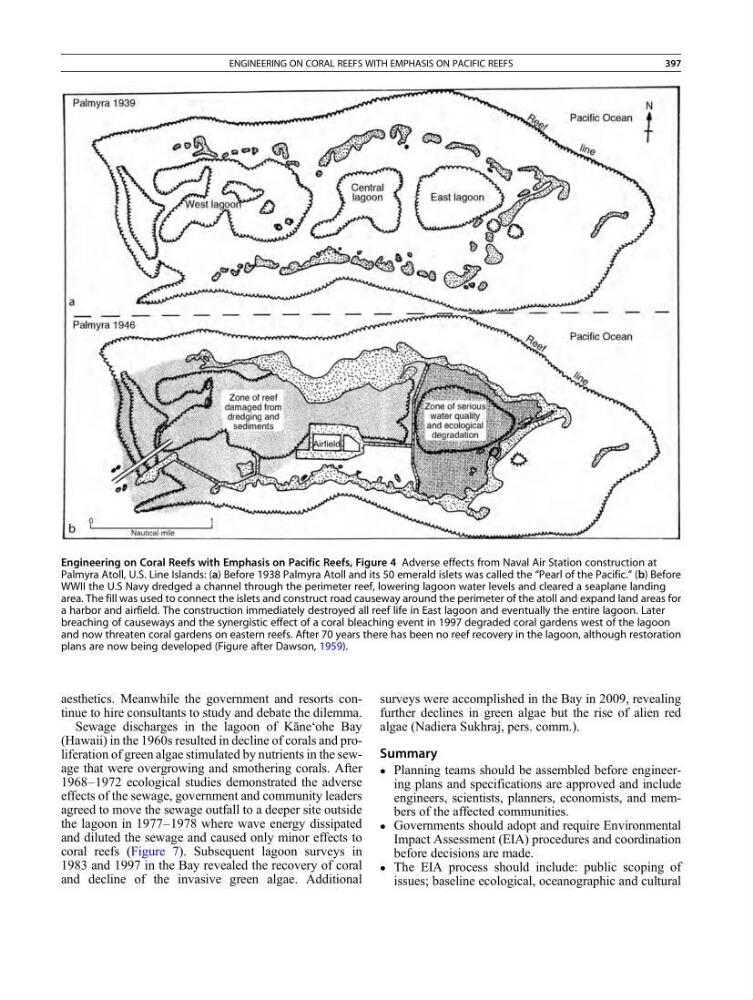
Engineering on Coral Reefs with Emphasis on Pacific Reefs, Figure 4 Adverse effects from Naval Air Station construction at
Palmyra Atoll, U.S. Line Islands: (a) Before 1938 Palmyra Atoll and its 50 emerald islets was called the “Pearl of the Pacific.” (b) Before
WWII the U.S Navy dredged a channel through the perimeter reef, lowering lagoon water levels and cleared a seaplane landing
area. The fill was used to connect the islets and construct road causeway around the perimeter of the atoll and expand land areas for
a harbor and airfield. The construction immediately destroyed all reef life in East lagoon and eventually the entire lagoon. Later
breaching of causeways and the synergistic effect of a coral bleaching event in 1997 degraded coral gardens west of the lagoon
and now threaten coral gardens on eastern reefs. After 70 years there has been no reef recovery in the lagoon, although restoration
plans are now being developed (Figure after Dawson, 1959).
ENGINEERING ON CORAL REEFS WITH EMPHASIS ON PACIFIC REEFS
397
Sewage discharges in the lagoon of Kāne‘ohe Bay
(Hawaii) in the 1960s resulted in decline of corals and proliferation of green algae stimulated by nutrients in the sewage that were overgrowing and smothering corals. After
1968–1972 ecological studies demonstrated the adverse
effects of the sewage, government and community leaders
agreed to move the sewage outfall to a deeper site outside
the lagoon in 1977–1978 where wave energy dissipated
and diluted the sewage and caused only minor effects to
coral reefs (Figure 7). Subsequent lagoon surveys in
1983 and 1997 in the Bay revealed the recovery of coral
and decline of the invasive green algae. Additional
surveys were accomplished in the Bay in 2009, revealing
further declines in green algae but the rise of alien red
algae (Nadiera Sukhraj, pers. comm.).
Summary
Planning teams should be assembled before engineering plans and specifications are approved and include
engineers, scientists, planners, economists, and members of the affected communities.
Governments should adopt and require Environmental
Impact Assessment (EIA) procedures and coordination
before decisions are made.
The EIA process should include: public scoping of
issues; baseline ecological, oceanographic and cultural
Engineering on Coral Reefs with Emphasis on Pacific Reefs, Figure 4 Adverse effects from Naval Air Station construction at
Palmyra Atoll, U.S. Line Islands: (a) Before 1938 Palmyra Atoll and its 50 emerald islets was called the “Pearl of the Pacific.” (b) Before
WWII the U.S Navy dredged a channel through the perimeter reef, lowering lagoon water levels and cleared a seaplane landing
area. The fill was used to connect the islets and construct road causeway around the perimeter of the atoll and expand land areas for
a harbor and airfield. The construction immediately destroyed all reef life in East lagoon and eventually the entire lagoon. Later
breaching of causeways and the synergistic effect of a coral bleaching event in 1997 degraded coral gardens west of the lagoon
and now threaten coral gardens on eastern reefs. After 70 years there has been no reef recovery in the lagoon, although restoration
plans are now being developed (Figure after Dawson, 1959).
ENGINEERING ON CORAL REEFS WITH EMPHASIS ON PACIFIC REEFS
397