

Additional indirect adverse effects to adjacent reefs are
often more severe when ship channels dredged through
atoll perimeter reefs:
Fine sediments are stirred up on lagoon floors
Lagoon waters become stratified
Reef crests are permanently exposed to air
Lagoon and ocean reef habitats are degraded
Water circulation between ocean and lagoon habitats is
reduced (Figure 6)
Irreparable impacts to coral reefs have been documented at
U.S. Navy installations constructed before and during
WWII at several atolls and islands in the central Pacific:
Pearl Harbor; French Frigate Shoals; Midway Atoll;
Kāne‘ohe Bay (Figure 7); Johnston Atoll; Palmyra Atoll;
Kiritimati Atoll; Wake Atoll; and Kanton Atoll. Also,
1960 airfield constructed at Tutu‘ila Island (American
Samoa) blocked circulation at neighboring Pala Lagoon
that killed corals, degraded water quality and mangroves,
and caused shoreline erosion at nearby villages
(Figure 8). Harbors not properly designed may also invite
ship collisions and groundings as has also occurred at
Pearl Harbor and Palmyra Atoll. The reefs of Baker Island
(Phoenix Islands) have also been degraded at an anchorage where extensive war materiel was dumped and vessels
scuttled immediately offshore before the troops left the
island. Alternatively, harbors placed inland from the
shoreline reduce impacts to coral reefs at small boat and
deep draft harbors in Hawaii (Figure 9).
Engineering and construction projects that do not
address long-term trends and the indirect impacts of population growth and crowding on coral reef islands are also
bound to fail. For example, the U.S. Army missile testing
center at Kwalajein Atoll has not adequately addressed the
impact of population growth at Ebeye stimulated by more
than a thousand workers who commute daily to the neighboring military base at Kwajalein Island. In essence,
Ebeye has become a “border town” outside the jurisdiction
of the military base, but with the local government lacking
long-range plans and funds for water supply, sanitation,
garbage, and health care deficiencies at Ebeye. The reefs
and resort areas on Maui and Waikiki (Hawaii) and
Denarau (Vanua Levu, Fiji) have also suffered from myopic decision-making by government engineers and planners. Continuous beach replenishment is now required at
Waikiki and seawalls have replaced the once beautiful
beaches at Denarau because the hotels were allowed to
be constructed too close to the ocean, putting them in
harms way during high seas and storm conditions. An airfield placed offshore from Kuta Beach in Bali permanently destroyed much of the beach and could have been
avoided by moving it behind the shoreline (Figure 10).
Maui (Hawaii) resorts and the local government needed
better planning and support for an ocean outfall to
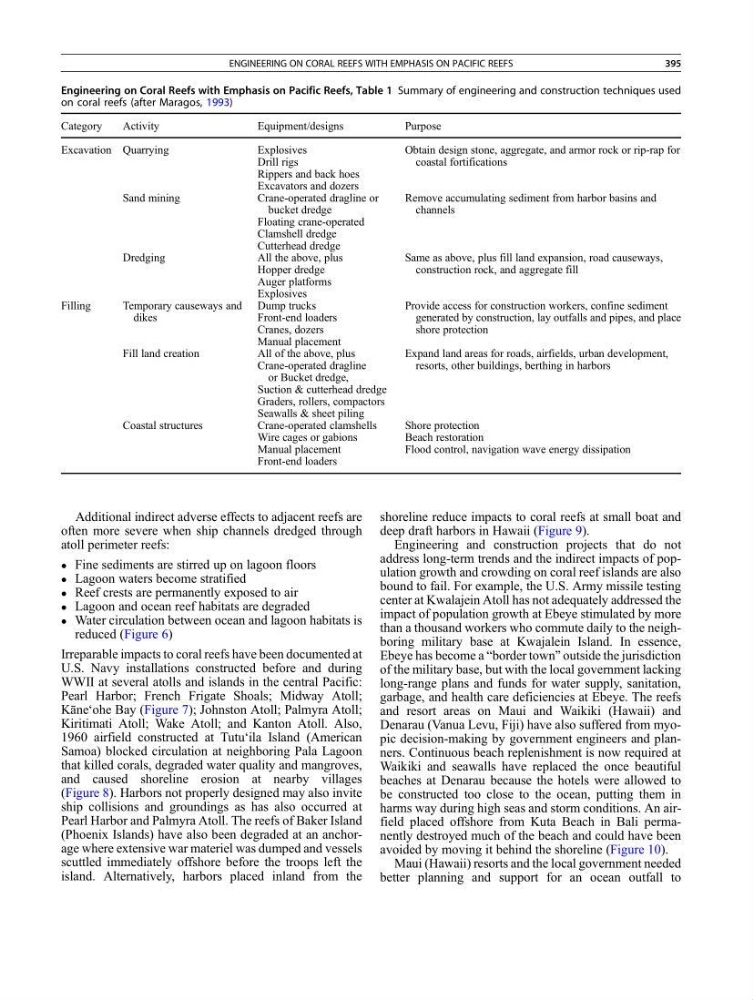
Engineering on Coral Reefs with Emphasis on Pacific Reefs, Table 1 Summary of engineering and construction techniques used
on coral reefs (after Maragos, 1993)
Category
Activity
Equipment/designs
Purpose
Excavation Quarrying
Explosives
Obtain design stone, aggregate, and armor rock or rip-rap for
coastal fortifications
Drill rigs
Rippers and back hoes
Excavators and dozers
Sand mining
Crane-operated dragline or
bucket dredge
Remove accumulating sediment from harbor basins and
channels
Floating crane-operated
Clamshell dredge
Cutterhead dredge
Dredging
All the above, plus
Same as above, plus fill land expansion, road causeways,
construction rock, and aggregate fill
Hopper dredge
Auger platforms
Explosives
Filling
Temporary causeways and
dikes
Dump trucks
Provide access for construction workers, confine sediment
generated by construction, lay outfalls and pipes, and place
shore protection
Front-end loaders
Cranes, dozers
Manual placement
Fill land creation
All of the above, plus
Expand land areas for roads, airfields, urban development,
resorts, other buildings, berthing in harbors
Crane-operated dragline
or Bucket dredge,
Suction & cutterhead dredge
Graders, rollers, compactors
Seawalls & sheet piling
Coastal structures
Crane-operated clamshells
Shore protection
Wire cages or gabions
Beach restoration
Manual placement
Flood control, navigation wave energy dissipation
Front-end loaders
ENGINEERING ON CORAL REEFS WITH EMPHASIS ON PACIFIC REEFS
395
often more severe when ship channels dredged through
atoll perimeter reefs:
Fine sediments are stirred up on lagoon floors
Lagoon waters become stratified
Reef crests are permanently exposed to air
Lagoon and ocean reef habitats are degraded
Water circulation between ocean and lagoon habitats is
reduced (Figure 6)
Irreparable impacts to coral reefs have been documented at
U.S. Navy installations constructed before and during
WWII at several atolls and islands in the central Pacific:
Pearl Harbor; French Frigate Shoals; Midway Atoll;
Kāne‘ohe Bay (Figure 7); Johnston Atoll; Palmyra Atoll;
Kiritimati Atoll; Wake Atoll; and Kanton Atoll. Also,
1960 airfield constructed at Tutu‘ila Island (American
Samoa) blocked circulation at neighboring Pala Lagoon
that killed corals, degraded water quality and mangroves,
and caused shoreline erosion at nearby villages
(Figure 8). Harbors not properly designed may also invite
ship collisions and groundings as has also occurred at
Pearl Harbor and Palmyra Atoll. The reefs of Baker Island
(Phoenix Islands) have also been degraded at an anchorage where extensive war materiel was dumped and vessels
scuttled immediately offshore before the troops left the
island. Alternatively, harbors placed inland from the
shoreline reduce impacts to coral reefs at small boat and
deep draft harbors in Hawaii (Figure 9).
Engineering and construction projects that do not
address long-term trends and the indirect impacts of population growth and crowding on coral reef islands are also
bound to fail. For example, the U.S. Army missile testing
center at Kwalajein Atoll has not adequately addressed the
impact of population growth at Ebeye stimulated by more
than a thousand workers who commute daily to the neighboring military base at Kwajalein Island. In essence,
Ebeye has become a “border town” outside the jurisdiction
of the military base, but with the local government lacking
long-range plans and funds for water supply, sanitation,
garbage, and health care deficiencies at Ebeye. The reefs
and resort areas on Maui and Waikiki (Hawaii) and
Denarau (Vanua Levu, Fiji) have also suffered from myopic decision-making by government engineers and planners. Continuous beach replenishment is now required at
Waikiki and seawalls have replaced the once beautiful
beaches at Denarau because the hotels were allowed to
be constructed too close to the ocean, putting them in
harms way during high seas and storm conditions. An airfield placed offshore from Kuta Beach in Bali permanently destroyed much of the beach and could have been
avoided by moving it behind the shoreline (Figure 10).
Maui (Hawaii) resorts and the local government needed
better planning and support for an ocean outfall to
Engineering on Coral Reefs with Emphasis on Pacific Reefs, Table 1 Summary of engineering and construction techniques used
on coral reefs (after Maragos, 1993)
Category
Activity
Equipment/designs
Purpose
Excavation Quarrying
Explosives
Obtain design stone, aggregate, and armor rock or rip-rap for
coastal fortifications
Drill rigs
Rippers and back hoes
Excavators and dozers
Sand mining
Crane-operated dragline or
bucket dredge
Remove accumulating sediment from harbor basins and
channels
Floating crane-operated
Clamshell dredge
Cutterhead dredge
Dredging
All the above, plus
Same as above, plus fill land expansion, road causeways,
construction rock, and aggregate fill
Hopper dredge
Auger platforms
Explosives
Filling
Temporary causeways and
dikes
Dump trucks
Provide access for construction workers, confine sediment
generated by construction, lay outfalls and pipes, and place
shore protection
Front-end loaders
Cranes, dozers
Manual placement
Fill land creation
All of the above, plus
Expand land areas for roads, airfields, urban development,
resorts, other buildings, berthing in harbors
Crane-operated dragline
or Bucket dredge,
Suction & cutterhead dredge
Graders, rollers, compactors
Seawalls & sheet piling
Coastal structures
Crane-operated clamshells
Shore protection
Wire cages or gabions
Beach restoration
Manual placement
Flood control, navigation wave energy dissipation
Front-end loaders
ENGINEERING ON CORAL REEFS WITH EMPHASIS ON PACIFIC REEFS
395