

injury to reefs at the excavation/dredging sites and reefs
adjacent to the fill areas. Fill areas not properly protected
by filter cloth, revetments or seawalls may fail, releasing
sediments, chemicals, and corroded metallic debris that
are carried to healthy reefs, expanding the area of injury
to healthy reefs. These types of impacts have been
documented at French Frigate Shoals (Hawaii) and
Palmyra Atoll (Line Islands). Limited sources of fill for
residential areas and garbage landfills have degraded reefs
and adjacent residential areas at Majuro Atoll and Ebeye
Island (Marshall Islands) and Tarawa Atoll (Gilbert
Islands). In one example at Kosrae Island, revetment stone
and filter cloth was placed before discharge of fill material
for an airfield that greatly reduced impacts to adjacent
reefs (Figure 3). Designing shore protection structures on
reefs often requires engineers to think beyond standard
civil engineering practices and to consider options that
reduce reef and operational impacts.
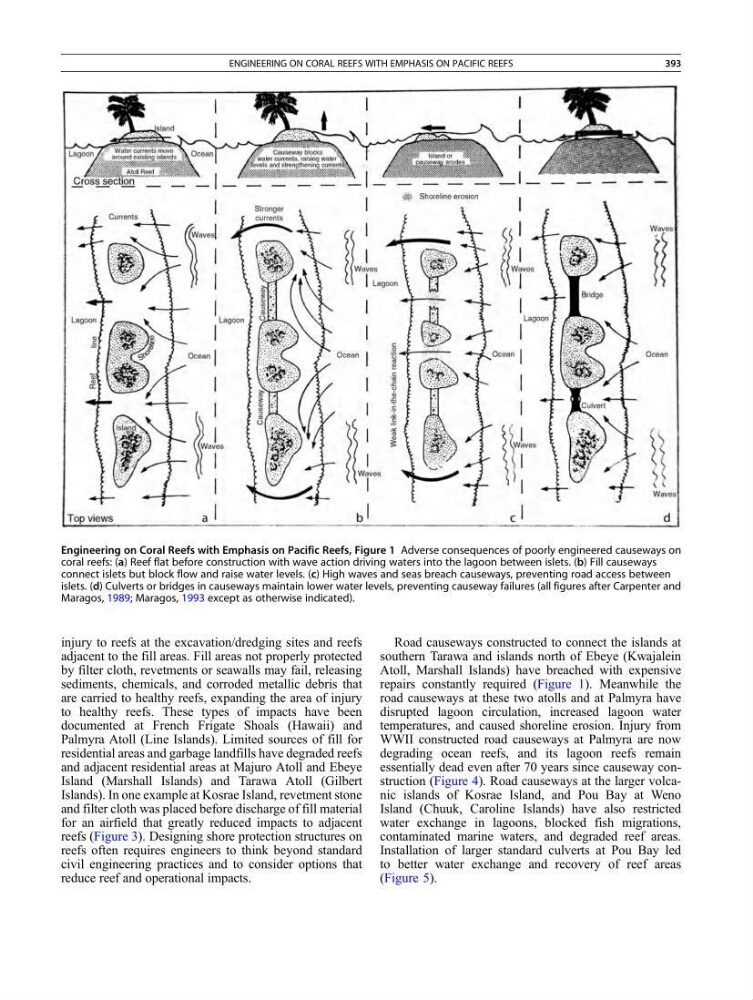
Road causeways constructed to connect the islands at
southern Tarawa and islands north of Ebeye (Kwajalein
Atoll, Marshall Islands) have breached with expensive
repairs constantly required (Figure 1). Meanwhile the
road causeways at these two atolls and at Palmyra have
disrupted lagoon circulation, increased lagoon water
temperatures, and caused shoreline erosion. Injury from
WWII constructed road causeways at Palmyra are now
degrading ocean reefs, and its lagoon reefs remain
essentially dead even after 70 years since causeway construction (Figure 4). Road causeways at the larger volcanic islands of Kosrae Island, and Pou Bay at Weno
Island (Chuuk, Caroline Islands) have also restricted
water exchange in lagoons, blocked fish migrations,
contaminated marine waters, and degraded reef areas.
Installation of larger standard culverts at Pou Bay led
to better water exchange and recovery of reef areas
(Figure 5).
Engineering on Coral Reefs with Emphasis on Pacific Reefs, Figure 1 Adverse consequences of poorly engineered causeways on
coral reefs: (a) Reef flat before construction with wave action driving waters into the lagoon between islets. (b) Fill causeways
connect islets but block flow and raise water levels. (c) High waves and seas breach causeways, preventing road access between
islets. (d) Culverts or bridges in causeways maintain lower water levels, preventing causeway failures (all figures after Carpenter and
Maragos, 1989; Maragos, 1993 except as otherwise indicated).
ENGINEERING ON CORAL REEFS WITH EMPHASIS ON PACIFIC REEFS
393
adjacent to the fill areas. Fill areas not properly protected
by filter cloth, revetments or seawalls may fail, releasing
sediments, chemicals, and corroded metallic debris that
are carried to healthy reefs, expanding the area of injury
to healthy reefs. These types of impacts have been
documented at French Frigate Shoals (Hawaii) and
Palmyra Atoll (Line Islands). Limited sources of fill for
residential areas and garbage landfills have degraded reefs
and adjacent residential areas at Majuro Atoll and Ebeye
Island (Marshall Islands) and Tarawa Atoll (Gilbert
Islands). In one example at Kosrae Island, revetment stone
and filter cloth was placed before discharge of fill material
for an airfield that greatly reduced impacts to adjacent
reefs (Figure 3). Designing shore protection structures on
reefs often requires engineers to think beyond standard
civil engineering practices and to consider options that
reduce reef and operational impacts.
Road causeways constructed to connect the islands at
southern Tarawa and islands north of Ebeye (Kwajalein
Atoll, Marshall Islands) have breached with expensive
repairs constantly required (Figure 1). Meanwhile the
road causeways at these two atolls and at Palmyra have
disrupted lagoon circulation, increased lagoon water
temperatures, and caused shoreline erosion. Injury from
WWII constructed road causeways at Palmyra are now
degrading ocean reefs, and its lagoon reefs remain
essentially dead even after 70 years since causeway construction (Figure 4). Road causeways at the larger volcanic islands of Kosrae Island, and Pou Bay at Weno
Island (Chuuk, Caroline Islands) have also restricted
water exchange in lagoons, blocked fish migrations,
contaminated marine waters, and degraded reef areas.
Installation of larger standard culverts at Pou Bay led
to better water exchange and recovery of reef areas
(Figure 5).
Engineering on Coral Reefs with Emphasis on Pacific Reefs, Figure 1 Adverse consequences of poorly engineered causeways on
coral reefs: (a) Reef flat before construction with wave action driving waters into the lagoon between islets. (b) Fill causeways
connect islets but block flow and raise water levels. (c) High waves and seas breach causeways, preventing road access between
islets. (d) Culverts or bridges in causeways maintain lower water levels, preventing causeway failures (all figures after Carpenter and
Maragos, 1989; Maragos, 1993 except as otherwise indicated).
ENGINEERING ON CORAL REEFS WITH EMPHASIS ON PACIFIC REEFS
393