

dosimetry such as thermoluminescence (TL), optically
stimulated luminescence (OSL), and radioluminescence
(RL). All these methods use the phenomenon of common
minerals acting as natural dosimeters. The radiation (natural radioactivity and cosmic rays) causes charge (electrons, free radicals) which is trapped at defects in the
crystal lattice of a wide range of minerals such as aragonite, calcite, and quartz. Here, we will focus on dating
aragonite coral samples. The trapped charges from paramagnetic centers can be detected by the rise of
a characteristic ESR signal. The amount of trapped charge
accumulation (paleodose, D E ) increases with time and can
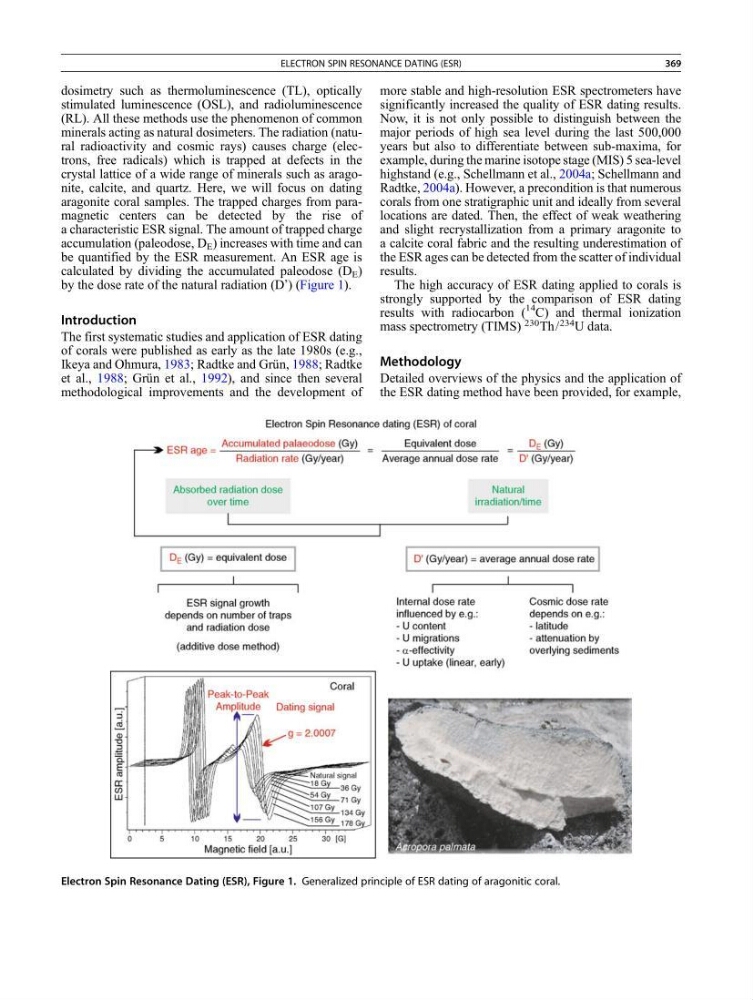
be quantified by the ESR measurement. An ESR age is
calculated by dividing the accumulated paleodose (D E )
by the dose rate of the natural radiation (D’) (Figure 1).
Introduction
The first systematic studies and application of ESR dating
of corals were published as early as the late 1980s (e.g.,
Ikeya and Ohmura, 1983; Radtke and Grün, 1988; Radtke
et al., 1988; Grün et al., 1992), and since then several
methodological improvements and the development of
more stable and high-resolution ESR spectrometers have
significantly increased the quality of ESR dating results.
Now, it is not only possible to distinguish between the
major periods of high sea level during the last 500,000
years but also to differentiate between sub-maxima, for
example, during the marine isotope stage (MIS) 5 sea-level
highstand (e.g., Schellmann et al., 2004a; Schellmann and
Radtke, 2004a). However, a precondition is that numerous
corals from one stratigraphic unit and ideally from several
locations are dated. Then, the effect of weak weathering
and slight recrystallization from a primary aragonite to
a calcite coral fabric and the resulting underestimation of
the ESR ages can be detected from the scatter of individual
results.
The high accuracy of ESR dating applied to corals is
strongly supported by the comparison of ESR dating
results with radiocarbon (
14
C) and thermal ionization
mass spectrometry (TIMS)
230 Th/
234
U data.
Methodology
Detailed overviews of the physics and the application of
the ESR dating method have been provided, for example,
Electron Spin Resonance Dating (ESR), Figure 1. Generalized principle of ESR dating of aragonitic coral.
ELECTRON SPIN RESONANCE DATING (ESR)
369
stimulated luminescence (OSL), and radioluminescence
(RL). All these methods use the phenomenon of common
minerals acting as natural dosimeters. The radiation (natural radioactivity and cosmic rays) causes charge (electrons, free radicals) which is trapped at defects in the
crystal lattice of a wide range of minerals such as aragonite, calcite, and quartz. Here, we will focus on dating
aragonite coral samples. The trapped charges from paramagnetic centers can be detected by the rise of
a characteristic ESR signal. The amount of trapped charge
accumulation (paleodose, D E ) increases with time and can
be quantified by the ESR measurement. An ESR age is
calculated by dividing the accumulated paleodose (D E )
by the dose rate of the natural radiation (D’) (Figure 1).
Introduction
The first systematic studies and application of ESR dating
of corals were published as early as the late 1980s (e.g.,
Ikeya and Ohmura, 1983; Radtke and Grün, 1988; Radtke
et al., 1988; Grün et al., 1992), and since then several
methodological improvements and the development of
more stable and high-resolution ESR spectrometers have
significantly increased the quality of ESR dating results.
Now, it is not only possible to distinguish between the
major periods of high sea level during the last 500,000
years but also to differentiate between sub-maxima, for
example, during the marine isotope stage (MIS) 5 sea-level
highstand (e.g., Schellmann et al., 2004a; Schellmann and
Radtke, 2004a). However, a precondition is that numerous
corals from one stratigraphic unit and ideally from several
locations are dated. Then, the effect of weak weathering
and slight recrystallization from a primary aragonite to
a calcite coral fabric and the resulting underestimation of
the ESR ages can be detected from the scatter of individual
results.
The high accuracy of ESR dating applied to corals is
strongly supported by the comparison of ESR dating
results with radiocarbon (
14
C) and thermal ionization
mass spectrometry (TIMS)
230 Th/
234
U data.
Methodology
Detailed overviews of the physics and the application of
the ESR dating method have been provided, for example,
Electron Spin Resonance Dating (ESR), Figure 1. Generalized principle of ESR dating of aragonitic coral.
ELECTRON SPIN RESONANCE DATING (ESR)
369