

ramose, branching and foliate corals are much better able
to cope with high sediment loads and are more common
where turbidity is high.
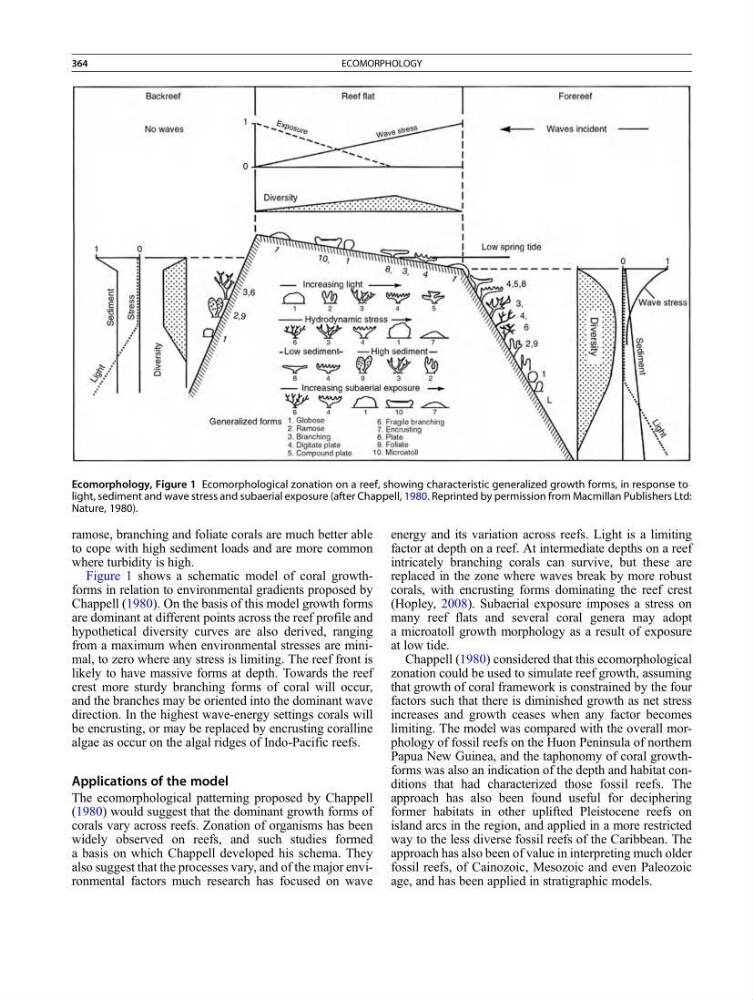
Figure 1 shows a schematic model of coral growthforms in relation to environmental gradients proposed by
Chappell (1980). On the basis of this model growth forms
are dominant at different points across the reef profile and
hypothetical diversity curves are also derived, ranging
from a maximum when environmental stresses are minimal, to zero where any stress is limiting. The reef front is
likely to have massive forms at depth. Towards the reef
crest more sturdy branching forms of coral will occur,
and the branches may be oriented into the dominant wave
direction. In the highest wave-energy settings corals will
be encrusting, or may be replaced by encrusting coralline
algae as occur on the algal ridges of Indo-Pacific reefs.
Applications of the model
The ecomorphological patterning proposed by Chappell
(1980) would suggest that the dominant growth forms of
corals vary across reefs. Zonation of organisms has been
widely observed on reefs, and such studies formed
a basis on which Chappell developed his schema. They
also suggest that the processes vary, and of the major environmental factors much research has focused on wave
energy and its variation across reefs. Light is a limiting
factor at depth on a reef. At intermediate depths on a reef
intricately branching corals can survive, but these are
replaced in the zone where waves break by more robust
corals, with encrusting forms dominating the reef crest
(Hopley, 2008). Subaerial exposure imposes a stress on
many reef flats and several coral genera may adopt
a microatoll growth morphology as a result of exposure
at low tide.
Chappell (1980) considered that this ecomorphological
zonation could be used to simulate reef growth, assuming
that growth of coral framework is constrained by the four
factors such that there is diminished growth as net stress
increases and growth ceases when any factor becomes
limiting. The model was compared with the overall morphology of fossil reefs on the Huon Peninsula of northern
Papua New Guinea, and the taphonomy of coral growthforms was also an indication of the depth and habitat conditions that had characterized those fossil reefs. The
approach has also been found useful for deciphering
former habitats in other uplifted Pleistocene reefs on
island arcs in the region, and applied in a more restricted
way to the less diverse fossil reefs of the Caribbean. The
approach has also been of value in interpreting much older
fossil reefs, of Cainozoic, Mesozoic and even Paleozoic
age, and has been applied in stratigraphic models.
Ecomorphology, Figure 1 Ecomorphological zonation on a reef, showing characteristic generalized growth forms, in response to
light, sediment and wave stress and subaerial exposure (after Chappell, 1980. Reprinted by permission from Macmillan Publishers Ltd:
Nature, 1980).
364
ECOMORPHOLOGY
to cope with high sediment loads and are more common
where turbidity is high.
Figure 1 shows a schematic model of coral growthforms in relation to environmental gradients proposed by
Chappell (1980). On the basis of this model growth forms
are dominant at different points across the reef profile and
hypothetical diversity curves are also derived, ranging
from a maximum when environmental stresses are minimal, to zero where any stress is limiting. The reef front is
likely to have massive forms at depth. Towards the reef
crest more sturdy branching forms of coral will occur,
and the branches may be oriented into the dominant wave
direction. In the highest wave-energy settings corals will
be encrusting, or may be replaced by encrusting coralline
algae as occur on the algal ridges of Indo-Pacific reefs.
Applications of the model
The ecomorphological patterning proposed by Chappell
(1980) would suggest that the dominant growth forms of
corals vary across reefs. Zonation of organisms has been
widely observed on reefs, and such studies formed
a basis on which Chappell developed his schema. They
also suggest that the processes vary, and of the major environmental factors much research has focused on wave
energy and its variation across reefs. Light is a limiting
factor at depth on a reef. At intermediate depths on a reef
intricately branching corals can survive, but these are
replaced in the zone where waves break by more robust
corals, with encrusting forms dominating the reef crest
(Hopley, 2008). Subaerial exposure imposes a stress on
many reef flats and several coral genera may adopt
a microatoll growth morphology as a result of exposure
at low tide.
Chappell (1980) considered that this ecomorphological
zonation could be used to simulate reef growth, assuming
that growth of coral framework is constrained by the four
factors such that there is diminished growth as net stress
increases and growth ceases when any factor becomes
limiting. The model was compared with the overall morphology of fossil reefs on the Huon Peninsula of northern
Papua New Guinea, and the taphonomy of coral growthforms was also an indication of the depth and habitat conditions that had characterized those fossil reefs. The
approach has also been found useful for deciphering
former habitats in other uplifted Pleistocene reefs on
island arcs in the region, and applied in a more restricted
way to the less diverse fossil reefs of the Caribbean. The
approach has also been of value in interpreting much older
fossil reefs, of Cainozoic, Mesozoic and even Paleozoic
age, and has been applied in stratigraphic models.
Ecomorphology, Figure 1 Ecomorphological zonation on a reef, showing characteristic generalized growth forms, in response to
light, sediment and wave stress and subaerial exposure (after Chappell, 1980. Reprinted by permission from Macmillan Publishers Ltd:
Nature, 1980).
364
ECOMORPHOLOGY