

variable and did exceed 7 m/ky on occasion. However,
these were almost always from short-lived intervals within
reefs that were building at much slower rates closer to the
regional average of 3–4 m/ky. Similar patterns have been
described by Gischler (2007) for Belize and Hopley et al.
(2007) for the Great Barrier Reef. Holocene reefs in the
western Dominican Republic verify an abrupt change
from transgression to regression as the rate of sea-level
rise dropped below 3–4 m/ky after 7,000 cal BP (Hubbard
et al., 2009).
Early reefs, like those off the southern Barbados shelf,
were left behind, despite showing at least brief accretion
rates that rivaled sea-level rise. The innermost reefs all
around the Caribbean formed around 8,000 years ago as
sea level was slowing. This has allowed them to either
“keep up” or “catch up” in the interim (Adey and Burke,
1976; Neumann and Macintyre, 1985). The eventual shift
in the shelf-edge reef community between 7,000 and
6,000 years ago is enigmatic inasmuch as it occurred at
a time when sea level had slowed to the point where it
should have been much easier to keep up. This was also
long after bank waters had cleared, and the reefs were still
in water depths capable of supporting active accretion.
Why A. palmata reefs quit throughout the Caribbean,
(Hubbard et al., 2005) and why they have shown no evidence of catching up for the past 6,000 years is unclear
and may bear on recent events involving this important
Caribbean reef building species.
The interaction between sea-level rise and local antecedent topography has been the dominant factor controlling the timing of reef development, subsequent reef
accretion patterns, and whether particular reefs are at sea
level today. Each episode of reef building followed
flooding of slope breaks that provided advantages for reef
building (e.g., a hard substrate that facilitated coral recruitment, access to open water for easy sediment removal).
Initial coral-dominated accretion lagged behind flooding,
owing to a combination of reduced water quality (that
retarded coral development) and increased bioerosion
(that favored sediment deposition over coral-mediated
accretion). Community structure varied from site to site,
but A. palmata appears to have been the most important
0
20
40
60
Depth below present sea level (m)
80
100
120
20
15
10
5–6m/ky
After fairbanks (1989)
and bard et al (1990)
Corrected from
Lighty et al (1982)
6–7m/ky
5–6m/ky
3.5m/ky
MWP-IA
MWP-IB
5
Thousands of years before present
Stylized caribbean reef history
b
a
ADD sed fill
Land bank/PR
TB/BI
LR
1
2
RGF-7
RGF-12
RGF-9
Stepping
stones
0
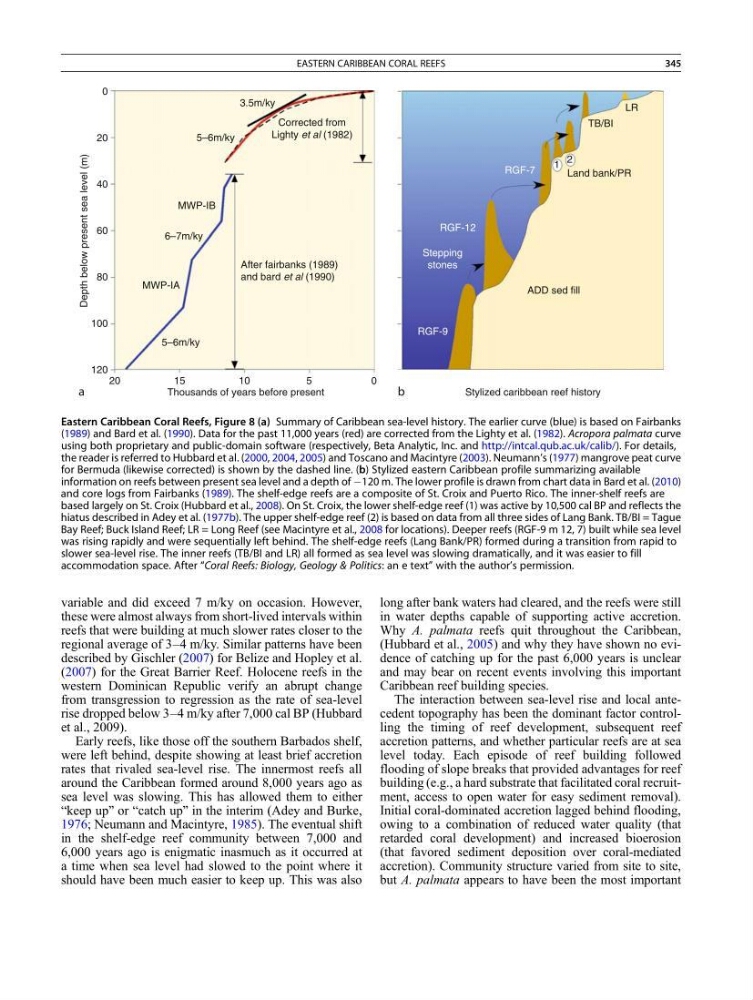
Eastern Caribbean Coral Reefs, Figure 8 (a) Summary of Caribbean sea-level history. The earlier curve (blue) is based on Fairbanks
(1989) and Bard et al. (1990). Data for the past 11,000 years (red) are corrected from the Lighty et al. (1982). Acropora palmata curve
using both proprietary and public-domain software (respectively, Beta Analytic, Inc. and http://intcal.qub.ac.uk/calib/). For details,
the reader is referred to Hubbard et al. (2000, 2004, 2005) and Toscano and Macintyre (2003). Neumann’s (1977) mangrove peat curve
for Bermuda (likewise corrected) is shown by the dashed line. (b) Stylized eastern Caribbean profile summarizing available
information on reefs between present sea level and a depth of À120 m. The lower profile is drawn from chart data in Bard et al. (2010)
and core logs from Fairbanks (1989). The shelf-edge reefs are a composite of St. Croix and Puerto Rico. The inner-shelf reefs are
based largely on St. Croix (Hubbard et al., 2008). On St. Croix, the lower shelf-edge reef (1) was active by 10,500 cal BP and reflects the
hiatus described in Adey et al. (1977b). The upper shelf-edge reef (2) is based on data from all three sides of Lang Bank. TB/BI = Tague
Bay Reef; Buck Island Reef; LR = Long Reef (see Macintyre et al., 2008 for locations). Deeper reefs (RGF-9 m 12, 7) built while sea level
was rising rapidly and were sequentially left behind. The shelf-edge reefs (Lang Bank/PR) formed during a transition from rapid to
slower sea-level rise. The inner reefs (TB/BI and LR) all formed as sea level was slowing dramatically, and it was easier to fill
accommodation space. After “Coral Reefs: Biology, Geology & Politics: an e text” with the author’s permission.
EASTERN CARIBBEAN CORAL REEFS
345
these were almost always from short-lived intervals within
reefs that were building at much slower rates closer to the
regional average of 3–4 m/ky. Similar patterns have been
described by Gischler (2007) for Belize and Hopley et al.
(2007) for the Great Barrier Reef. Holocene reefs in the
western Dominican Republic verify an abrupt change
from transgression to regression as the rate of sea-level
rise dropped below 3–4 m/ky after 7,000 cal BP (Hubbard
et al., 2009).
Early reefs, like those off the southern Barbados shelf,
were left behind, despite showing at least brief accretion
rates that rivaled sea-level rise. The innermost reefs all
around the Caribbean formed around 8,000 years ago as
sea level was slowing. This has allowed them to either
“keep up” or “catch up” in the interim (Adey and Burke,
1976; Neumann and Macintyre, 1985). The eventual shift
in the shelf-edge reef community between 7,000 and
6,000 years ago is enigmatic inasmuch as it occurred at
a time when sea level had slowed to the point where it
should have been much easier to keep up. This was also
long after bank waters had cleared, and the reefs were still
in water depths capable of supporting active accretion.
Why A. palmata reefs quit throughout the Caribbean,
(Hubbard et al., 2005) and why they have shown no evidence of catching up for the past 6,000 years is unclear
and may bear on recent events involving this important
Caribbean reef building species.
The interaction between sea-level rise and local antecedent topography has been the dominant factor controlling the timing of reef development, subsequent reef
accretion patterns, and whether particular reefs are at sea
level today. Each episode of reef building followed
flooding of slope breaks that provided advantages for reef
building (e.g., a hard substrate that facilitated coral recruitment, access to open water for easy sediment removal).
Initial coral-dominated accretion lagged behind flooding,
owing to a combination of reduced water quality (that
retarded coral development) and increased bioerosion
(that favored sediment deposition over coral-mediated
accretion). Community structure varied from site to site,
but A. palmata appears to have been the most important
0
20
40
60
Depth below present sea level (m)
80
100
120
20
15
10
5–6m/ky
After fairbanks (1989)
and bard et al (1990)
Corrected from
Lighty et al (1982)
6–7m/ky
5–6m/ky
3.5m/ky
MWP-IA
MWP-IB
5
Thousands of years before present
Stylized caribbean reef history
b
a
ADD sed fill
Land bank/PR
TB/BI
LR
1
2
RGF-7
RGF-12
RGF-9
Stepping
stones
0
Eastern Caribbean Coral Reefs, Figure 8 (a) Summary of Caribbean sea-level history. The earlier curve (blue) is based on Fairbanks
(1989) and Bard et al. (1990). Data for the past 11,000 years (red) are corrected from the Lighty et al. (1982). Acropora palmata curve
using both proprietary and public-domain software (respectively, Beta Analytic, Inc. and http://intcal.qub.ac.uk/calib/). For details,
the reader is referred to Hubbard et al. (2000, 2004, 2005) and Toscano and Macintyre (2003). Neumann’s (1977) mangrove peat curve
for Bermuda (likewise corrected) is shown by the dashed line. (b) Stylized eastern Caribbean profile summarizing available
information on reefs between present sea level and a depth of À120 m. The lower profile is drawn from chart data in Bard et al. (2010)
and core logs from Fairbanks (1989). The shelf-edge reefs are a composite of St. Croix and Puerto Rico. The inner-shelf reefs are
based largely on St. Croix (Hubbard et al., 2008). On St. Croix, the lower shelf-edge reef (1) was active by 10,500 cal BP and reflects the
hiatus described in Adey et al. (1977b). The upper shelf-edge reef (2) is based on data from all three sides of Lang Bank. TB/BI = Tague
Bay Reef; Buck Island Reef; LR = Long Reef (see Macintyre et al., 2008 for locations). Deeper reefs (RGF-9 m 12, 7) built while sea level
was rising rapidly and were sequentially left behind. The shelf-edge reefs (Lang Bank/PR) formed during a transition from rapid to
slower sea-level rise. The inner reefs (TB/BI and LR) all formed as sea level was slowing dramatically, and it was easier to fill
accommodation space. After “Coral Reefs: Biology, Geology & Politics: an e text” with the author’s permission.
EASTERN CARIBBEAN CORAL REEFS
345