

causes for the large changes in relative sea level implied
by their observations. Charles Darwin experienced an
earthquake that caused coseismic uplift along the coast
of Chile (Darwin, 1909, p. 314) and understood that
coseismic vertical motions could cause coral reef emergence and submergence as well. Darwin summarized
reports of emerged reefs, the likelihood that some uplift
was recent, and the probable relationship of uplift to earthquakes (Darwin, 1842). However, he cited no confirmed
evidence of coseismic reef uplift or subsidence. After visiting the Solomon Islands, Guppy (1887, p. 126) stated
that “The different stages in the upheaval of several of
the calcareous islands are clearly shown in the ledges or
terraces displayed in their profiles. Such ledges indicate
long intervals or pauses in the movement of elevation, during which the coral reefs by their outward extension
formed reef flats, which have ultimately been to some
degree preserved in the existing ledges, now raised to elevations often of some hundreds of feet above the sea.”
However, based on his observations of apparently very
young emerged reefs and bio-erosion notches in the Solomon Islands, Guppy (1887, p. 128) concluded that “. . .the
protracted elevatory movements of one or two hundred
feet and over have consisted in a succession of small
upheavals of perhaps not more than five or six feet at
a time.” To provide a basis for future measurements of
vertical change he emplaced “datum” marks at several
locations in the Solomon Islands. One of his marks on
Uki-ni-Masi Island was located 5 ft. above high-water
spring tide on 11 October 1882. During a visit on 29 July
1986, we found the mark at 5 ft 5 in. above high tide of that
day and thus of no discernible difference in elevation than
when installed by Guppy (Figure 2).
The earliest credible accounts of coseismic reef uplift
came from missionaries and administrators and generally
contain virtually no geological description or mention of
uplifted corals. An example is the reported $6 m
volcanogenic coseismic uplift of a reef near Yasur Volcano
on Tanna Island, New Hebrides (now Vanuatu) on 10 January 1878 followed by a few meters more uplift about
a month later (Lawrie, 1898). Another account indicates
that the second uplift occurred ten years after the first
(Mawson, 1905). Both reports were based on second-hand
accounts from missionaries. Another second-hand report
of coseismic reef vertical movements comes from San
Cristobal Island (Makira Island), Solomon Islands, associated with a large earthquake sequence in October 1931
(Gold, 1932; Grover, 1958). However, again these reports
provided no details regarding amounts of reef emergence
or subsidence and no more than a vague indication of its
geographic extent.
Scientific reports of coseismically displaced
coral reefs
Perhaps the earliest first-hand scientific report described
coral uplift on Malakula Island, Vanuatu, associated with
a M w $7.7 subduction zone earthquake on 11 August
1965 (Benoit and Dubois, 1971), but the authors visited
Earthquakes and Emergence or Submergence of Coral Reefs,
Figure 2 The mark pointed to by the seismological observer
Bobby Kelly was emplaced by H.B. Guppy on 11 October 1882 on
Uki-ni-Masi Island, Solomon Islands, to be used as a reference
mark in case of future vertical displacement (Guppy, 1887).
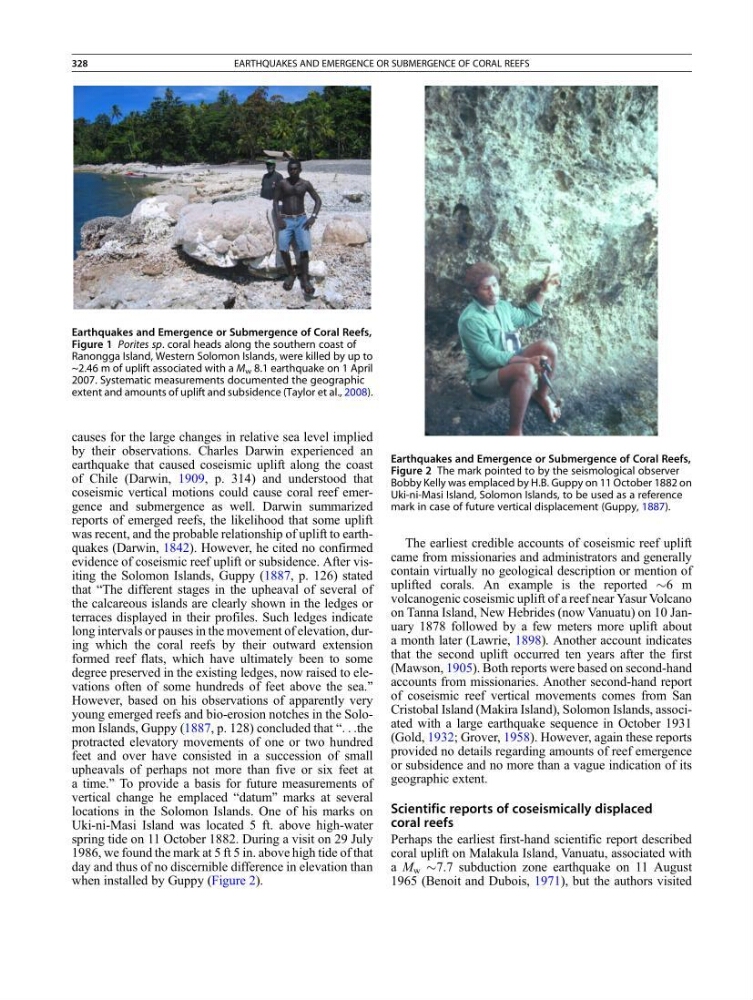
Earthquakes and Emergence or Submergence of Coral Reefs,
Figure 1 Porites sp. coral heads along the southern coast of
Ranongga Island, Western Solomon Islands, were killed by up to
~2.46 m of uplift associated with a M w 8.1 earthquake on 1 April
2007. Systematic measurements documented the geographic
extent and amounts of uplift and subsidence (Taylor et al., 2008).
328
EARTHQUAKES AND EMERGENCE OR SUBMERGENCE OF CORAL REEFS
by their observations. Charles Darwin experienced an
earthquake that caused coseismic uplift along the coast
of Chile (Darwin, 1909, p. 314) and understood that
coseismic vertical motions could cause coral reef emergence and submergence as well. Darwin summarized
reports of emerged reefs, the likelihood that some uplift
was recent, and the probable relationship of uplift to earthquakes (Darwin, 1842). However, he cited no confirmed
evidence of coseismic reef uplift or subsidence. After visiting the Solomon Islands, Guppy (1887, p. 126) stated
that “The different stages in the upheaval of several of
the calcareous islands are clearly shown in the ledges or
terraces displayed in their profiles. Such ledges indicate
long intervals or pauses in the movement of elevation, during which the coral reefs by their outward extension
formed reef flats, which have ultimately been to some
degree preserved in the existing ledges, now raised to elevations often of some hundreds of feet above the sea.”
However, based on his observations of apparently very
young emerged reefs and bio-erosion notches in the Solomon Islands, Guppy (1887, p. 128) concluded that “. . .the
protracted elevatory movements of one or two hundred
feet and over have consisted in a succession of small
upheavals of perhaps not more than five or six feet at
a time.” To provide a basis for future measurements of
vertical change he emplaced “datum” marks at several
locations in the Solomon Islands. One of his marks on
Uki-ni-Masi Island was located 5 ft. above high-water
spring tide on 11 October 1882. During a visit on 29 July
1986, we found the mark at 5 ft 5 in. above high tide of that
day and thus of no discernible difference in elevation than
when installed by Guppy (Figure 2).
The earliest credible accounts of coseismic reef uplift
came from missionaries and administrators and generally
contain virtually no geological description or mention of
uplifted corals. An example is the reported $6 m
volcanogenic coseismic uplift of a reef near Yasur Volcano
on Tanna Island, New Hebrides (now Vanuatu) on 10 January 1878 followed by a few meters more uplift about
a month later (Lawrie, 1898). Another account indicates
that the second uplift occurred ten years after the first
(Mawson, 1905). Both reports were based on second-hand
accounts from missionaries. Another second-hand report
of coseismic reef vertical movements comes from San
Cristobal Island (Makira Island), Solomon Islands, associated with a large earthquake sequence in October 1931
(Gold, 1932; Grover, 1958). However, again these reports
provided no details regarding amounts of reef emergence
or subsidence and no more than a vague indication of its
geographic extent.
Scientific reports of coseismically displaced
coral reefs
Perhaps the earliest first-hand scientific report described
coral uplift on Malakula Island, Vanuatu, associated with
a M w $7.7 subduction zone earthquake on 11 August
1965 (Benoit and Dubois, 1971), but the authors visited
Earthquakes and Emergence or Submergence of Coral Reefs,
Figure 2 The mark pointed to by the seismological observer
Bobby Kelly was emplaced by H.B. Guppy on 11 October 1882 on
Uki-ni-Masi Island, Solomon Islands, to be used as a reference
mark in case of future vertical displacement (Guppy, 1887).
Earthquakes and Emergence or Submergence of Coral Reefs,
Figure 1 Porites sp. coral heads along the southern coast of
Ranongga Island, Western Solomon Islands, were killed by up to
~2.46 m of uplift associated with a M w 8.1 earthquake on 1 April
2007. Systematic measurements documented the geographic
extent and amounts of uplift and subsidence (Taylor et al., 2008).
328
EARTHQUAKES AND EMERGENCE OR SUBMERGENCE OF CORAL REEFS