

the intervening lagoon is 20–25 m. One hole drilled into
the outer rim reached 30 m but did not penetrate the Pleistocene. However, seismic survey suggested that it was
25–30 m beneath the lagoon and second front and ca.
20 m beneath the main reef. Surprisingly, the double front
may not be a classic example as drilling showed that
below ca. 12 m it was mainly sand suggesting that the
foundations were provided by a sand barrier or spit across
the embayment, as also suggested by the morphology.
Gable Reef’s main reef flat has an age of 6–5 ka, while
the age of the secondary reef flat is <1.3 ka. However,
only 5 m below the surface it is >5.5 ka and appears to
have lagged behind the main rim by only 500–600 years.
Although more complex than double fronts growing
from reef terraces, the Gable Reef example does provide
insight into the growth rates and age relationships of
similar features elsewhere.
Bibliography
Battistini, R. et al. (24 authors), 1975. Elements de terminologie
récifale Indo Pacifique. Téthys, 7(1), I–III.
Chevalier, K. P., 1973. Coral reefs of New Caledonia. In Jones,
O. A., and Endean, R. (eds.), Biology and Geology of Coral
Reefs, 1, Geology, 1, 143–167.
Guilcher, A., 1965. Grand Récifs Sud. Récifs et lagon de Tuo.
Expéditon francaise sur les récifs coralliens de la NouvelleCalédonie. Edit. Fond. Singer. Polignac. 1, 137–225.
Hopley, D., Smithers, S. G., and Parnell, K. E., 2007. The Geomorphology of the Great Barrier Reef: Development, Diversity and
Change. Cambridge: Cambridge University Press, 532 pp.
Cross-references
Coral Cay Classification and Evolution
Fore Reef/Reef Front
Reef Classification, Response to Sea Level Rise
Submerged Reefs
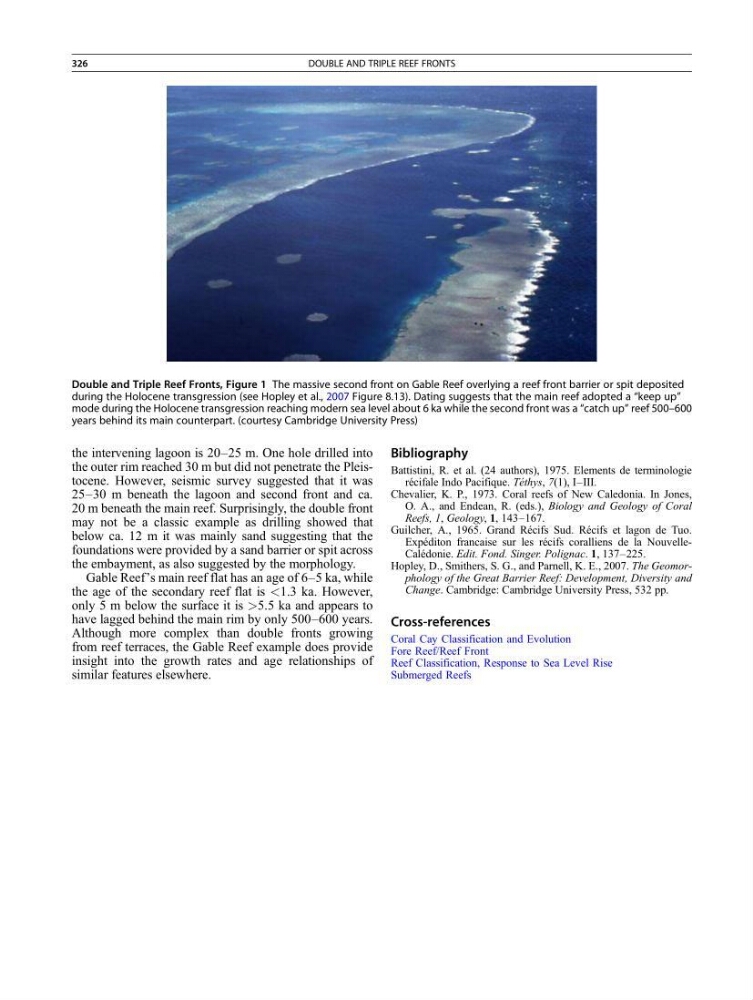
Double and Triple Reef Fronts, Figure 1 The massive second front on Gable Reef overlying a reef front barrier or spit deposited
during the Holocene transgression (see Hopley et al., 2007 Figure 8.13). Dating suggests that the main reef adopted a “keep up”
mode during the Holocene transgression reaching modern sea level about 6 ka while the second front was a “catch up” reef 500–600
years behind its main counterpart. (courtesy Cambridge University Press)
326
DOUBLE AND TRIPLE REEF FRONTS
the outer rim reached 30 m but did not penetrate the Pleistocene. However, seismic survey suggested that it was
25–30 m beneath the lagoon and second front and ca.
20 m beneath the main reef. Surprisingly, the double front
may not be a classic example as drilling showed that
below ca. 12 m it was mainly sand suggesting that the
foundations were provided by a sand barrier or spit across
the embayment, as also suggested by the morphology.
Gable Reef’s main reef flat has an age of 6–5 ka, while
the age of the secondary reef flat is <1.3 ka. However,
only 5 m below the surface it is >5.5 ka and appears to
have lagged behind the main rim by only 500–600 years.
Although more complex than double fronts growing
from reef terraces, the Gable Reef example does provide
insight into the growth rates and age relationships of
similar features elsewhere.
Bibliography
Battistini, R. et al. (24 authors), 1975. Elements de terminologie
récifale Indo Pacifique. Téthys, 7(1), I–III.
Chevalier, K. P., 1973. Coral reefs of New Caledonia. In Jones,
O. A., and Endean, R. (eds.), Biology and Geology of Coral
Reefs, 1, Geology, 1, 143–167.
Guilcher, A., 1965. Grand Récifs Sud. Récifs et lagon de Tuo.
Expéditon francaise sur les récifs coralliens de la NouvelleCalédonie. Edit. Fond. Singer. Polignac. 1, 137–225.
Hopley, D., Smithers, S. G., and Parnell, K. E., 2007. The Geomorphology of the Great Barrier Reef: Development, Diversity and
Change. Cambridge: Cambridge University Press, 532 pp.
Cross-references
Coral Cay Classification and Evolution
Fore Reef/Reef Front
Reef Classification, Response to Sea Level Rise
Submerged Reefs
Double and Triple Reef Fronts, Figure 1 The massive second front on Gable Reef overlying a reef front barrier or spit deposited
during the Holocene transgression (see Hopley et al., 2007 Figure 8.13). Dating suggests that the main reef adopted a “keep up”
mode during the Holocene transgression reaching modern sea level about 6 ka while the second front was a “catch up” reef 500–600
years behind its main counterpart. (courtesy Cambridge University Press)
326
DOUBLE AND TRIPLE REEF FRONTS