

necessary for permitting the sedimentary particles to be
introduced and moved within the rock frame. From this
point of view, the reefs with their good porosity and permeability, their high susceptibility of early cementation,
and their high-energy environmental conditions, are
excellent candidates for internal sedimentation.
Marine internal sediments
These represent the most frequent internal sediments in
modern and ancient reefs. They are generally characterized by their fine-grained bioclastic components and their
geopetal arrangement (Figure 1d).
Nonmarine internal sediments
These internal sediments are the products of subaerial diagenesis, either in the vadose zone or related to karstic processes during periods of sea-level low stands.
Consequently, they represent important discriminant
criteria in the reconstitution of reef history and its response
to sea-level changes.
Vadose internal sediments
Vadose silts consist of geopetal accumulations of tiny
crystalline debris, produced by the abrasion and mechanical erosion of previously lithified substrates in the meteoric vadose zone. They are frequently associated with
sparitic cements and intense dissolution features related
to meteoric diagenesis.
Centrifugal micrite is not a commonly observed feature
in Holocene and Pleistocene coral reefs (Carrière, 1987;
Perrin, 1989), certainly due to its narrow zone of occurrence restricted to the supratidal zone (Purser, 1973;
Aïssaoui and Purser, 1983).
Karstic internal sediments
These internal sediments are filling either primary voids or
dissolution cavities sometimes of large size. Their
nonmarine origin is attested by the general lack of marine
bioclasts, the presence of clays and laminated crusts of
pedogenetic origin, together with their typical orange-red
color. They may include rock fragments and breccia
infilling the largest cavities.
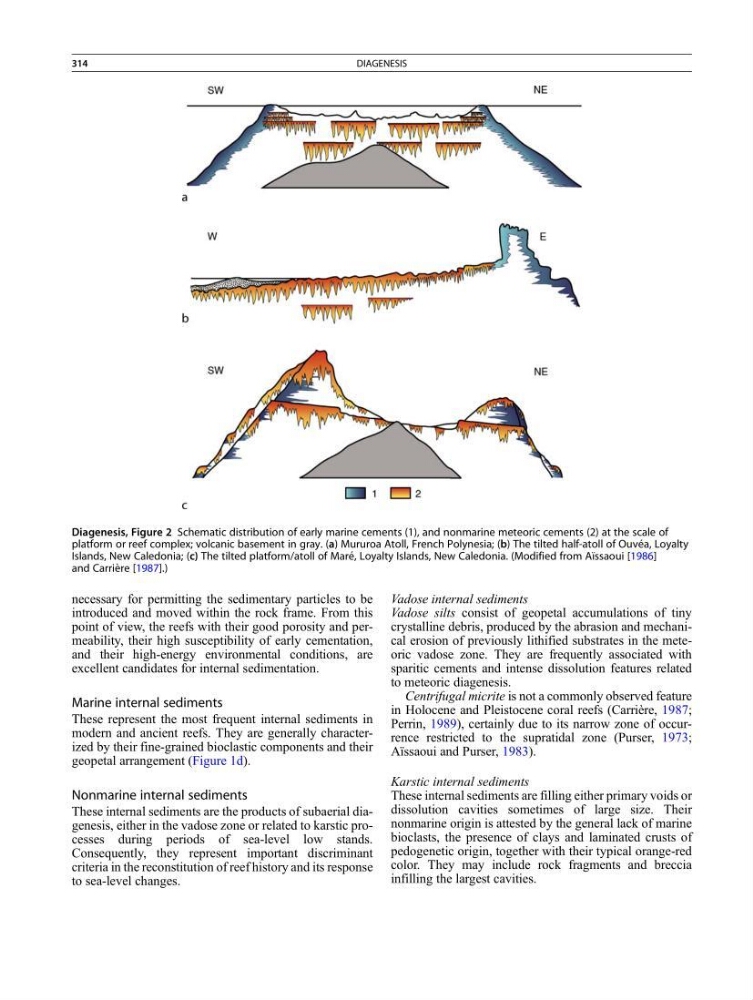
Diagenesis, Figure 2 Schematic distribution of early marine cements (1), and nonmarine meteoric cements (2) at the scale of
platform or reef complex; volcanic basement in gray. (a) Mururoa Atoll, French Polynesia; (b) The tilted half-atoll of Ouve ´a, Loyalty
Islands, New Caledonia; (c) The tilted platform/atoll of Mare ´, Loyalty Islands, New Caledonia. (Modified from Aı ¨ssaoui [1986]
and Carrie `re [1987].)
314
DIAGENESIS
introduced and moved within the rock frame. From this
point of view, the reefs with their good porosity and permeability, their high susceptibility of early cementation,
and their high-energy environmental conditions, are
excellent candidates for internal sedimentation.
Marine internal sediments
These represent the most frequent internal sediments in
modern and ancient reefs. They are generally characterized by their fine-grained bioclastic components and their
geopetal arrangement (Figure 1d).
Nonmarine internal sediments
These internal sediments are the products of subaerial diagenesis, either in the vadose zone or related to karstic processes during periods of sea-level low stands.
Consequently, they represent important discriminant
criteria in the reconstitution of reef history and its response
to sea-level changes.
Vadose internal sediments
Vadose silts consist of geopetal accumulations of tiny
crystalline debris, produced by the abrasion and mechanical erosion of previously lithified substrates in the meteoric vadose zone. They are frequently associated with
sparitic cements and intense dissolution features related
to meteoric diagenesis.
Centrifugal micrite is not a commonly observed feature
in Holocene and Pleistocene coral reefs (Carrière, 1987;
Perrin, 1989), certainly due to its narrow zone of occurrence restricted to the supratidal zone (Purser, 1973;
Aïssaoui and Purser, 1983).
Karstic internal sediments
These internal sediments are filling either primary voids or
dissolution cavities sometimes of large size. Their
nonmarine origin is attested by the general lack of marine
bioclasts, the presence of clays and laminated crusts of
pedogenetic origin, together with their typical orange-red
color. They may include rock fragments and breccia
infilling the largest cavities.
Diagenesis, Figure 2 Schematic distribution of early marine cements (1), and nonmarine meteoric cements (2) at the scale of
platform or reef complex; volcanic basement in gray. (a) Mururoa Atoll, French Polynesia; (b) The tilted half-atoll of Ouve ´a, Loyalty
Islands, New Caledonia; (c) The tilted platform/atoll of Mare ´, Loyalty Islands, New Caledonia. (Modified from Aı ¨ssaoui [1986]
and Carrie `re [1987].)
314
DIAGENESIS