

B.A. in 1881 (M.A. 1926). He returned to Australia in
1882 on the steamship Potosi arriving at Sydney on the
27th November to join the New South Wales Government
as assistant geological surveyor. He married Caroline
Martha (Cara) Mallett on the 30th July 1885 at St Paul’s
Church of England, Canterbury, having met her earlier
on the voyage to Sydney in 1882. Edgeworth David joined
the University of Sydney as Professor of Geology and
William Hovell Lecturer in Physical Geography in 1891
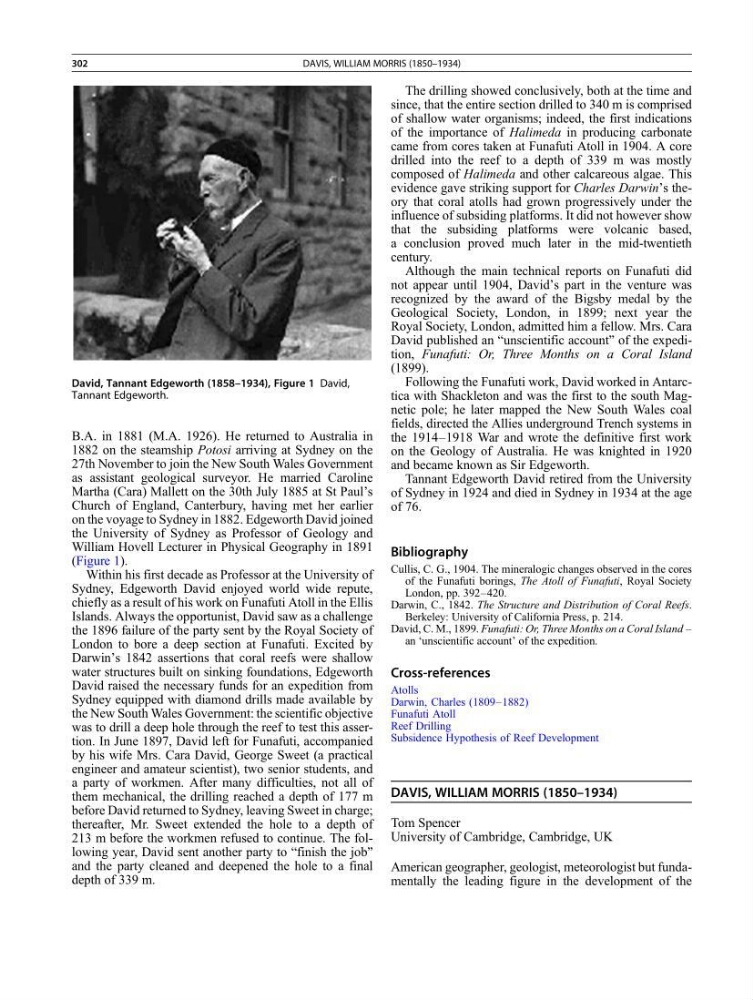
(Figure 1).
Within his first decade as Professor at the University of
Sydney, Edgeworth David enjoyed world wide repute,
chiefly as a result of his work on Funafuti Atoll in the Ellis
Islands. Always the opportunist, David saw as a challenge
the 1896 failure of the party sent by the Royal Society of
London to bore a deep section at Funafuti. Excited by
Darwin’s 1842 assertions that coral reefs were shallow
water structures built on sinking foundations, Edgeworth
David raised the necessary funds for an expedition from
Sydney equipped with diamond drills made available by
the New South Wales Government: the scientific objective
was to drill a deep hole through the reef to test this assertion. In June 1897, David left for Funafuti, accompanied
by his wife Mrs. Cara David, George Sweet (a practical
engineer and amateur scientist), two senior students, and
a party of workmen. After many difficulties, not all of
them mechanical, the drilling reached a depth of 177 m
before David returned to Sydney, leaving Sweet in charge;
thereafter, Mr. Sweet extended the hole to a depth of
213 m before the workmen refused to continue. The following year, David sent another party to “finish the job”
and the party cleaned and deepened the hole to a final
depth of 339 m.
The drilling showed conclusively, both at the time and
since, that the entire section drilled to 340 m is comprised
of shallow water organisms; indeed, the first indications
of the importance of Halimeda in producing carbonate
came from cores taken at Funafuti Atoll in 1904. A core
drilled into the reef to a depth of 339 m was mostly
composed of Halimeda and other calcareous algae. This
evidence gave striking support for Charles Darwin’s theory that coral atolls had grown progressively under the
influence of subsiding platforms. It did not however show
that the subsiding platforms were volcanic based,
a conclusion proved much later in the mid-twentieth
century.
Although the main technical reports on Funafuti did
not appear until 1904, David’s part in the venture was
recognized by the award of the Bigsby medal by the
Geological Society, London, in 1899; next year the
Royal Society, London, admitted him a fellow. Mrs. Cara
David published an “unscientific account” of the expedition, Funafuti: Or, Three Months on a Coral Island
(1899).
Following the Funafuti work, David worked in Antarctica with Shackleton and was the first to the south Magnetic pole; he later mapped the New South Wales coal
fields, directed the Allies underground Trench systems in
the 1914–1918 War and wrote the definitive first work
on the Geology of Australia. He was knighted in 1920
and became known as Sir Edgeworth.
Tannant Edgeworth David retired from the University
of Sydney in 1924 and died in Sydney in 1934 at the age
of 76.
Bibliography
Cullis, C. G., 1904. The mineralogic changes observed in the cores
of the Funafuti borings, The Atoll of Funafuti, Royal Society
London, pp. 392–420.
Darwin, C., 1842. The Structure and Distribution of Coral Reefs.
Berkeley: University of California Press, p. 214.
David, C. M., 1899. Funafuti: Or, Three Months on a Coral Island –
an ‘unscientific account’ of the expedition.
Cross-references
Atolls
Darwin, Charles (1809–1882)
Funafuti Atoll
Reef Drilling
Subsidence Hypothesis of Reef Development
DAVIS, WILLIAM MORRIS (1850–1934)
Tom Spencer
University of Cambridge, Cambridge, UK
American geographer, geologist, meteorologist but fundamentally the leading figure in the development of the
David, Tannant Edgeworth (1858–1934), Figure 1 David,
Tannant Edgeworth.
302
DAVIS, WILLIAM MORRIS (1850–1934)
1882 on the steamship Potosi arriving at Sydney on the
27th November to join the New South Wales Government
as assistant geological surveyor. He married Caroline
Martha (Cara) Mallett on the 30th July 1885 at St Paul’s
Church of England, Canterbury, having met her earlier
on the voyage to Sydney in 1882. Edgeworth David joined
the University of Sydney as Professor of Geology and
William Hovell Lecturer in Physical Geography in 1891
(Figure 1).
Within his first decade as Professor at the University of
Sydney, Edgeworth David enjoyed world wide repute,
chiefly as a result of his work on Funafuti Atoll in the Ellis
Islands. Always the opportunist, David saw as a challenge
the 1896 failure of the party sent by the Royal Society of
London to bore a deep section at Funafuti. Excited by
Darwin’s 1842 assertions that coral reefs were shallow
water structures built on sinking foundations, Edgeworth
David raised the necessary funds for an expedition from
Sydney equipped with diamond drills made available by
the New South Wales Government: the scientific objective
was to drill a deep hole through the reef to test this assertion. In June 1897, David left for Funafuti, accompanied
by his wife Mrs. Cara David, George Sweet (a practical
engineer and amateur scientist), two senior students, and
a party of workmen. After many difficulties, not all of
them mechanical, the drilling reached a depth of 177 m
before David returned to Sydney, leaving Sweet in charge;
thereafter, Mr. Sweet extended the hole to a depth of
213 m before the workmen refused to continue. The following year, David sent another party to “finish the job”
and the party cleaned and deepened the hole to a final
depth of 339 m.
The drilling showed conclusively, both at the time and
since, that the entire section drilled to 340 m is comprised
of shallow water organisms; indeed, the first indications
of the importance of Halimeda in producing carbonate
came from cores taken at Funafuti Atoll in 1904. A core
drilled into the reef to a depth of 339 m was mostly
composed of Halimeda and other calcareous algae. This
evidence gave striking support for Charles Darwin’s theory that coral atolls had grown progressively under the
influence of subsiding platforms. It did not however show
that the subsiding platforms were volcanic based,
a conclusion proved much later in the mid-twentieth
century.
Although the main technical reports on Funafuti did
not appear until 1904, David’s part in the venture was
recognized by the award of the Bigsby medal by the
Geological Society, London, in 1899; next year the
Royal Society, London, admitted him a fellow. Mrs. Cara
David published an “unscientific account” of the expedition, Funafuti: Or, Three Months on a Coral Island
(1899).
Following the Funafuti work, David worked in Antarctica with Shackleton and was the first to the south Magnetic pole; he later mapped the New South Wales coal
fields, directed the Allies underground Trench systems in
the 1914–1918 War and wrote the definitive first work
on the Geology of Australia. He was knighted in 1920
and became known as Sir Edgeworth.
Tannant Edgeworth David retired from the University
of Sydney in 1924 and died in Sydney in 1934 at the age
of 76.
Bibliography
Cullis, C. G., 1904. The mineralogic changes observed in the cores
of the Funafuti borings, The Atoll of Funafuti, Royal Society
London, pp. 392–420.
Darwin, C., 1842. The Structure and Distribution of Coral Reefs.
Berkeley: University of California Press, p. 214.
David, C. M., 1899. Funafuti: Or, Three Months on a Coral Island –
an ‘unscientific account’ of the expedition.
Cross-references
Atolls
Darwin, Charles (1809–1882)
Funafuti Atoll
Reef Drilling
Subsidence Hypothesis of Reef Development
DAVIS, WILLIAM MORRIS (1850–1934)
Tom Spencer
University of Cambridge, Cambridge, UK
American geographer, geologist, meteorologist but fundamentally the leading figure in the development of the
David, Tannant Edgeworth (1858–1934), Figure 1 David,
Tannant Edgeworth.
302
DAVIS, WILLIAM MORRIS (1850–1934)