

of Global Climate Change, it also seems plausible that
many more coral reefs may fail in the not too distant geological future (Mackenzie, 2003).
Bibliography
Chave, K., Smith, S., Roy, K., 1972. Carbonate production by coral
reefs. Marine Geology, 12, 123–140.
Flood, P., 1999. Development of northwest Pacific guyots: General
Results from Ocean Drilling Program legs 143 and 144. The
Island Arc, 8, 92–98.
Grigg, R. W., 1982. Darwin Point: A threshold for atoll formation.
Coral Reefs, 1, 29–34.
Grigg, R. W., 2006. Depth limit for reef building corals in the Au’au
Channel, S.E. Hawaii. Coral Reefs, 25(1), 77–84.
Grigg, R. W., 2008. The Darwin Point: A conceptual and historical
review. Proceedings. 11th International Coral Reef Symposium,
Fort Lauderdale, Florida, 2008.
Grigg, R. W., and Epp, D., 1989. Critical depth for the survival of
coral islands: affects on the Hawaiian Archipelago. Science,
243, 638–641.
Hopley, D., 1982. The Geomorphology of the Great Barrier Reef,
Quaternary Development of Coral Reefs. New York: Wiley,
453 pp.
Mackenzie, F. T., 2003. Our Changing Planet. Upper Saddle River,
NJ: Prentice-Hall, 580 pp.
Cross-references
Darwin, Charles (1809–1882)
General Evolution of Carbonate Reefs
Hawaiian Emperor Volcanic Chain and Coral Reef History
Sea Level Change and Its Effect on Reef Growth
Submerged Reefs
Subsidence Hypothesis of Reef Development
DARWIN, CHARLES (1809–1882)
Nick Harvey
The University of Adelaide, Adelaide, SA, Australia
Charles Darwin. British naturalist, 1809–1882, developed subsidence hypothesis for reef development.
Introduction
Charles Darwin had a profound effect on the theories of
coral reef evolution and the subsequent pattern of reef
research. In 1842, after some delay due to his ill health,
the first edition of Darwin’s The Structure and Distribution of Coral Reefs was published. In the introduction of
the book, Darwin describes its objectives as “to describe
from my own observation and the works of others; the
principal kinds of coral reefs, more especially those occurring in the open ocean, and to explain the origin of their
peculiar forms” (Darwin, 1842, p. 1).
Darwin provides the reader with an explanation for
different types of reefs; “lagoon islands” or “atolls,” “barrier,” or “encircling reefs,” and “fringing,” or “shore reefs”
(see Subsidence Hypothesis of Reef Development), for
each of which he dedicates a separate chapter (Darwin,
1842). In the introduction to the book, he also provides
a brief overview of his theory of coral reefs, including
barrier reefs for which at that time, according to him, there
was “scarcely one” (Darwin, 1842, p. 4). Thus, according
to Darwin “. . .in both atolls and barrier-reefs, the foundation on which the coral was primarily attached, has subsided; and that during this downward movement, the
reefs have grown upwards. This conclusion, it will be
further seen, explains most satisfactorily the outline and
general form of atolls and barrier – reefs, and likewise
certain peculiarities in their structure” (Darwin, 1842,
p. 4). (see Chapter Subsidence Hypothesis of Reef
Development).
This work was not the first time Darwin’s ideas on
coral reefs had been published. In the introduction to the
book, Darwin writes that “A brief account” of his ideas
on corals was read to the Geological Society of London
in May 1837 and subsequently published in the Proceedings (Darwin, 1838). His ideas were also published in
the third volume of Fitzroy (1839).
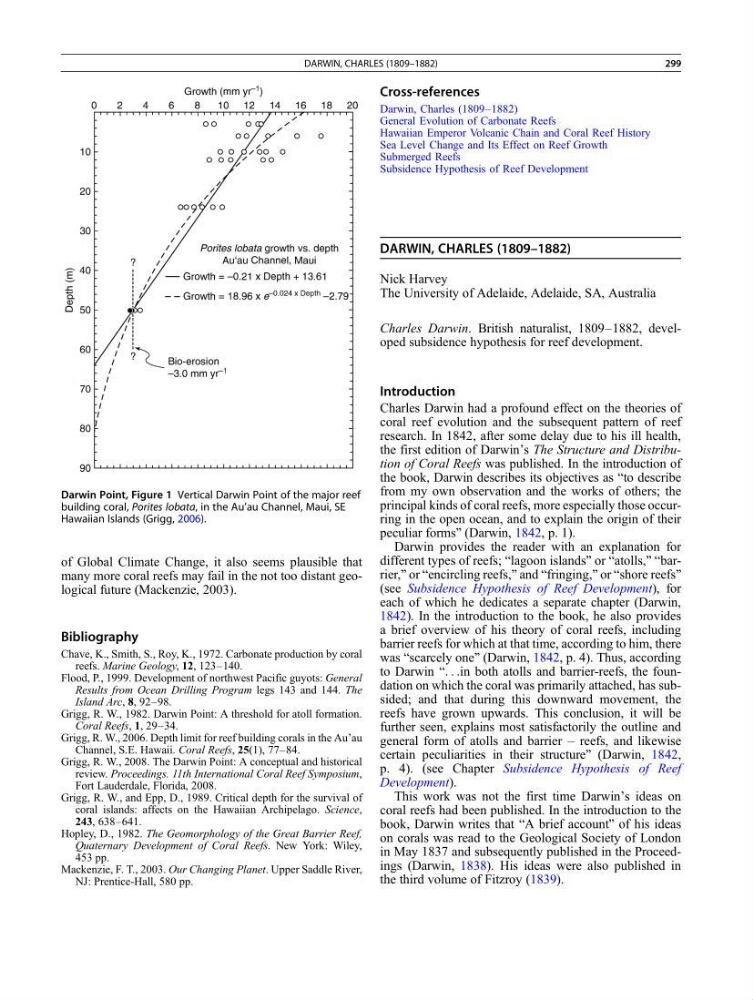
Darwin Point, Figure 1 Vertical Darwin Point of the major reef
building coral, Porites lobata, in the Au’au Channel, Maui, SE
Hawaiian Islands (Grigg, 2006).
DARWIN, CHARLES (1809–1882)
299
many more coral reefs may fail in the not too distant geological future (Mackenzie, 2003).
Bibliography
Chave, K., Smith, S., Roy, K., 1972. Carbonate production by coral
reefs. Marine Geology, 12, 123–140.
Flood, P., 1999. Development of northwest Pacific guyots: General
Results from Ocean Drilling Program legs 143 and 144. The
Island Arc, 8, 92–98.
Grigg, R. W., 1982. Darwin Point: A threshold for atoll formation.
Coral Reefs, 1, 29–34.
Grigg, R. W., 2006. Depth limit for reef building corals in the Au’au
Channel, S.E. Hawaii. Coral Reefs, 25(1), 77–84.
Grigg, R. W., 2008. The Darwin Point: A conceptual and historical
review. Proceedings. 11th International Coral Reef Symposium,
Fort Lauderdale, Florida, 2008.
Grigg, R. W., and Epp, D., 1989. Critical depth for the survival of
coral islands: affects on the Hawaiian Archipelago. Science,
243, 638–641.
Hopley, D., 1982. The Geomorphology of the Great Barrier Reef,
Quaternary Development of Coral Reefs. New York: Wiley,
453 pp.
Mackenzie, F. T., 2003. Our Changing Planet. Upper Saddle River,
NJ: Prentice-Hall, 580 pp.
Cross-references
Darwin, Charles (1809–1882)
General Evolution of Carbonate Reefs
Hawaiian Emperor Volcanic Chain and Coral Reef History
Sea Level Change and Its Effect on Reef Growth
Submerged Reefs
Subsidence Hypothesis of Reef Development
DARWIN, CHARLES (1809–1882)
Nick Harvey
The University of Adelaide, Adelaide, SA, Australia
Charles Darwin. British naturalist, 1809–1882, developed subsidence hypothesis for reef development.
Introduction
Charles Darwin had a profound effect on the theories of
coral reef evolution and the subsequent pattern of reef
research. In 1842, after some delay due to his ill health,
the first edition of Darwin’s The Structure and Distribution of Coral Reefs was published. In the introduction of
the book, Darwin describes its objectives as “to describe
from my own observation and the works of others; the
principal kinds of coral reefs, more especially those occurring in the open ocean, and to explain the origin of their
peculiar forms” (Darwin, 1842, p. 1).
Darwin provides the reader with an explanation for
different types of reefs; “lagoon islands” or “atolls,” “barrier,” or “encircling reefs,” and “fringing,” or “shore reefs”
(see Subsidence Hypothesis of Reef Development), for
each of which he dedicates a separate chapter (Darwin,
1842). In the introduction to the book, he also provides
a brief overview of his theory of coral reefs, including
barrier reefs for which at that time, according to him, there
was “scarcely one” (Darwin, 1842, p. 4). Thus, according
to Darwin “. . .in both atolls and barrier-reefs, the foundation on which the coral was primarily attached, has subsided; and that during this downward movement, the
reefs have grown upwards. This conclusion, it will be
further seen, explains most satisfactorily the outline and
general form of atolls and barrier – reefs, and likewise
certain peculiarities in their structure” (Darwin, 1842,
p. 4). (see Chapter Subsidence Hypothesis of Reef
Development).
This work was not the first time Darwin’s ideas on
coral reefs had been published. In the introduction to the
book, Darwin writes that “A brief account” of his ideas
on corals was read to the Geological Society of London
in May 1837 and subsequently published in the Proceedings (Darwin, 1838). His ideas were also published in
the third volume of Fitzroy (1839).
Darwin Point, Figure 1 Vertical Darwin Point of the major reef
building coral, Porites lobata, in the Au’au Channel, Maui, SE
Hawaiian Islands (Grigg, 2006).
DARWIN, CHARLES (1809–1882)
299