

for a number of reasons (Hallock, 2001; Fabricius, 2005):
they can limit PAR reaching corals by promoting phytoplankton blooms that reduce water transparency; they
can promote the growth of the algal competitors of corals
(especially when grazing organisms are scarce); they can
promote bioerosion and excessive phosphate can inhibit
formation of CaCO 3 crystals. Excessive N also promotes
the proliferation of zooxanthellae within corals (Dubinsky
and Jokiel, 1994), which appears to detrimentally affect
growth (Lesser et al., 1994) and to increase the coral’s sensitivity to elevated temperatures, and thus the likelihood of
lethal bleaching (Wooldridge, 2009).
There are four sources of nutrients to coastal waters:
rivers, terrestrial dust, rainfall, and upwelled ocean waters.
Dissolved concentrations of key nutrient elements
required by corals and their zooxanthellae are usually
extremely low on coral reefs due to low input rates, huge
dilutions, and uptake by phytoplankton and pelagic bacteria (Furnas et al., 2004). Much of the terrigenous nutrient
that flows into coastal waters is rapidly incorporated in
phytoplankton–zooplankton-fish food webs (Furnas
et al., 2004), to the potential benefit of coastal shrimp
and fin-fish fisheries. However, the food web itself can
deliver excess nutrients into the waters bathing corals:
the feeding detritus and fecal pellets generated by this food
web are fed on by microbes, which in turn release
dissolved nutrients, with the potential to affect corals detrimentally as described above.
Microenvironment controls on coral growth
A coral’s microenvironment consists of (1) resources (that
it must receive at adequate rates and continuity of supply);
(2) sublethal stresses (sometimes called “press disturbances” – Connell, 1997), which reduce its capacity to
use resources efficiently (e.g., suboptimal temperatures
or salinities; low-level pollutants); and (3) extreme events
(sometimes called “pulse disturbances” – Connell op.
cit.), which may kill, injure, or dislodge it during events
of short duration (hours to weeks). Extreme natural events,
which have characteristic return intervals generally
measured in years to decades, include anomalies (high
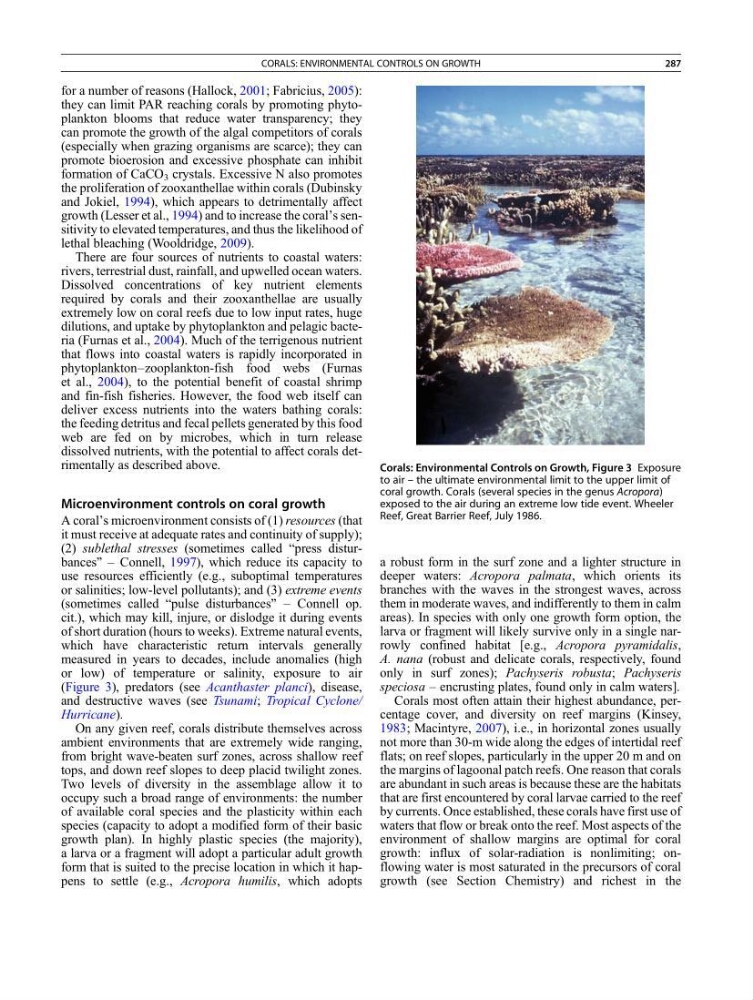
or low) of temperature or salinity, exposure to air
(Figure 3), predators (see Acanthaster planci), disease,
and destructive waves (see Tsunami; Tropical Cyclone/
Hurricane).
On any given reef, corals distribute themselves across
ambient environments that are extremely wide ranging,
from bright wave-beaten surf zones, across shallow reef
tops, and down reef slopes to deep placid twilight zones.
Two levels of diversity in the assemblage allow it to
occupy such a broad range of environments: the number
of available coral species and the plasticity within each
species (capacity to adopt a modified form of their basic
growth plan). In highly plastic species (the majority),
a larva or a fragment will adopt a particular adult growth
form that is suited to the precise location in which it happens to settle (e.g., Acropora humilis, which adopts
a robust form in the surf zone and a lighter structure in
deeper waters: Acropora palmata, which orients its
branches with the waves in the strongest waves, across
them in moderate waves, and indifferently to them in calm
areas). In species with only one growth form option, the
larva or fragment will likely survive only in a single narrowly confined habitat [e.g., Acropora pyramidalis,
A. nana (robust and delicate corals, respectively, found
only in surf zones); Pachyseris robusta; Pachyseris
speciosa – encrusting plates, found only in calm waters].
Corals most often attain their highest abundance, percentage cover, and diversity on reef margins (Kinsey,
1983; Macintyre, 2007), i.e., in horizontal zones usually
not more than 30-m wide along the edges of intertidal reef
flats; on reef slopes, particularly in the upper 20 m and on
the margins of lagoonal patch reefs. One reason that corals
are abundant in such areas is because these are the habitats
that are first encountered by coral larvae carried to the reef
by currents. Once established, these corals have first use of
waters that flow or break onto the reef. Most aspects of the
environment of shallow margins are optimal for coral
growth: influx of solar-radiation is nonlimiting; onflowing water is most saturated in the precursors of coral
growth (see Section Chemistry) and richest in the
Corals: Environmental Controls on Growth, Figure 3 Exposure
to air – the ultimate environmental limit to the upper limit of
coral growth. Corals (several species in the genus Acropora)
exposed to the air during an extreme low tide event. Wheeler
Reef, Great Barrier Reef, July 1986.
CORALS: ENVIRONMENTAL CONTROLS ON GROWTH
287
they can limit PAR reaching corals by promoting phytoplankton blooms that reduce water transparency; they
can promote the growth of the algal competitors of corals
(especially when grazing organisms are scarce); they can
promote bioerosion and excessive phosphate can inhibit
formation of CaCO 3 crystals. Excessive N also promotes
the proliferation of zooxanthellae within corals (Dubinsky
and Jokiel, 1994), which appears to detrimentally affect
growth (Lesser et al., 1994) and to increase the coral’s sensitivity to elevated temperatures, and thus the likelihood of
lethal bleaching (Wooldridge, 2009).
There are four sources of nutrients to coastal waters:
rivers, terrestrial dust, rainfall, and upwelled ocean waters.
Dissolved concentrations of key nutrient elements
required by corals and their zooxanthellae are usually
extremely low on coral reefs due to low input rates, huge
dilutions, and uptake by phytoplankton and pelagic bacteria (Furnas et al., 2004). Much of the terrigenous nutrient
that flows into coastal waters is rapidly incorporated in
phytoplankton–zooplankton-fish food webs (Furnas
et al., 2004), to the potential benefit of coastal shrimp
and fin-fish fisheries. However, the food web itself can
deliver excess nutrients into the waters bathing corals:
the feeding detritus and fecal pellets generated by this food
web are fed on by microbes, which in turn release
dissolved nutrients, with the potential to affect corals detrimentally as described above.
Microenvironment controls on coral growth
A coral’s microenvironment consists of (1) resources (that
it must receive at adequate rates and continuity of supply);
(2) sublethal stresses (sometimes called “press disturbances” – Connell, 1997), which reduce its capacity to
use resources efficiently (e.g., suboptimal temperatures
or salinities; low-level pollutants); and (3) extreme events
(sometimes called “pulse disturbances” – Connell op.
cit.), which may kill, injure, or dislodge it during events
of short duration (hours to weeks). Extreme natural events,
which have characteristic return intervals generally
measured in years to decades, include anomalies (high
or low) of temperature or salinity, exposure to air
(Figure 3), predators (see Acanthaster planci), disease,
and destructive waves (see Tsunami; Tropical Cyclone/
Hurricane).
On any given reef, corals distribute themselves across
ambient environments that are extremely wide ranging,
from bright wave-beaten surf zones, across shallow reef
tops, and down reef slopes to deep placid twilight zones.
Two levels of diversity in the assemblage allow it to
occupy such a broad range of environments: the number
of available coral species and the plasticity within each
species (capacity to adopt a modified form of their basic
growth plan). In highly plastic species (the majority),
a larva or a fragment will adopt a particular adult growth
form that is suited to the precise location in which it happens to settle (e.g., Acropora humilis, which adopts
a robust form in the surf zone and a lighter structure in
deeper waters: Acropora palmata, which orients its
branches with the waves in the strongest waves, across
them in moderate waves, and indifferently to them in calm
areas). In species with only one growth form option, the
larva or fragment will likely survive only in a single narrowly confined habitat [e.g., Acropora pyramidalis,
A. nana (robust and delicate corals, respectively, found
only in surf zones); Pachyseris robusta; Pachyseris
speciosa – encrusting plates, found only in calm waters].
Corals most often attain their highest abundance, percentage cover, and diversity on reef margins (Kinsey,
1983; Macintyre, 2007), i.e., in horizontal zones usually
not more than 30-m wide along the edges of intertidal reef
flats; on reef slopes, particularly in the upper 20 m and on
the margins of lagoonal patch reefs. One reason that corals
are abundant in such areas is because these are the habitats
that are first encountered by coral larvae carried to the reef
by currents. Once established, these corals have first use of
waters that flow or break onto the reef. Most aspects of the
environment of shallow margins are optimal for coral
growth: influx of solar-radiation is nonlimiting; onflowing water is most saturated in the precursors of coral
growth (see Section Chemistry) and richest in the
Corals: Environmental Controls on Growth, Figure 3 Exposure
to air – the ultimate environmental limit to the upper limit of
coral growth. Corals (several species in the genus Acropora)
exposed to the air during an extreme low tide event. Wheeler
Reef, Great Barrier Reef, July 1986.
CORALS: ENVIRONMENTAL CONTROLS ON GROWTH
287