

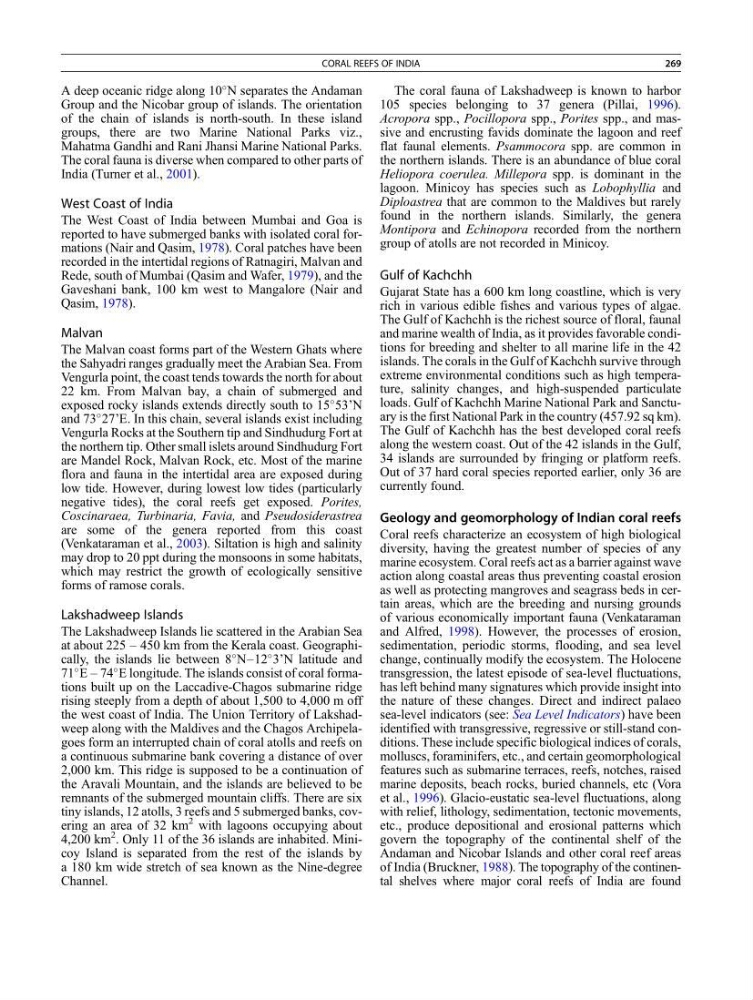
A deep oceanic ridge along 10
N separates the Andaman
Group and the Nicobar group of islands. The orientation
of the chain of islands is north-south. In these island
groups, there are two Marine National Parks viz.,
Mahatma Gandhi and Rani Jhansi Marine National Parks.
The coral fauna is diverse when compared to other parts of
India (Turner et al., 2001).
West Coast of India
The West Coast of India between Mumbai and Goa is
reported to have submerged banks with isolated coral formations (Nair and Qasim, 1978). Coral patches have been
recorded in the intertidal regions of Ratnagiri, Malvan and
Rede, south of Mumbai (Qasim and Wafer, 1979), and the
Gaveshani bank, 100 km west to Mangalore (Nair and
Qasim, 1978).
Malvan
The Malvan coast forms part of the Western Ghats where
the Sahyadri ranges gradually meet the Arabian Sea. From
Vengurla point, the coast tends towards the north for about
22 km. From Malvan bay, a chain of submerged and
exposed rocky islands extends directly south to 15
53’N
and 73
27’E. In this chain, several islands exist including
Vengurla Rocks at the Southern tip and Sindhudurg Fort at
the northern tip. Other small islets around Sindhudurg Fort
are Mandel Rock, Malvan Rock, etc. Most of the marine
flora and fauna in the intertidal area are exposed during
low tide. However, during lowest low tides (particularly
negative tides), the coral reefs get exposed. Porites,
Coscinaraea, Turbinaria, Favia, and Pseudosiderastrea
are some of the genera reported from this coast
(Venkataraman et al., 2003). Siltation is high and salinity
may drop to 20 ppt during the monsoons in some habitats,
which may restrict the growth of ecologically sensitive
forms of ramose corals.
Lakshadweep Islands
The Lakshadweep Islands lie scattered in the Arabian Sea
at about 225 – 450 km from the Kerala coast. Geographically, the islands lie between 8
N–12
3’N latitude and
71
E – 74
E longitude. The islands consist of coral formations built up on the Laccadive-Chagos submarine ridge
rising steeply from a depth of about 1,500 to 4,000 m off
the west coast of India. The Union Territory of Lakshadweep along with the Maldives and the Chagos Archipelagoes form an interrupted chain of coral atolls and reefs on
a continuous submarine bank covering a distance of over
2,000 km. This ridge is supposed to be a continuation of
the Aravali Mountain, and the islands are believed to be
remnants of the submerged mountain cliffs. There are six
tiny islands, 12 atolls, 3 reefs and 5 submerged banks, covering an area of 32 km
2 with lagoons occupying about
4,200 km
2
. Only 11 of the 36 islands are inhabited. Minicoy Island is separated from the rest of the islands by
a 180 km wide stretch of sea known as the Nine-degree
Channel.
The coral fauna of Lakshadweep is known to harbor
105 species belonging to 37 genera (Pillai, 1996).
Acropora spp., Pocillopora spp., Porites spp., and massive and encrusting favids dominate the lagoon and reef
flat faunal elements. Psammocora spp. are common in
the northern islands. There is an abundance of blue coral
Heliopora coerulea. Millepora spp. is dominant in the
lagoon. Minicoy has species such as Lobophyllia and
Diploastrea that are common to the Maldives but rarely
found in the northern islands. Similarly, the genera
Montipora and Echinopora recorded from the northern
group of atolls are not recorded in Minicoy.
Gulf of Kachchh
Gujarat State has a 600 km long coastline, which is very
rich in various edible fishes and various types of algae.
The Gulf of Kachchh is the richest source of floral, faunal
and marine wealth of India, as it provides favorable conditions for breeding and shelter to all marine life in the 42
islands. The corals in the Gulf of Kachchh survive through
extreme environmental conditions such as high temperature, salinity changes, and high-suspended particulate
loads. Gulf of Kachchh Marine National Park and Sanctuary is the first National Park in the country (457.92 sq km).
The Gulf of Kachchh has the best developed coral reefs
along the western coast. Out of the 42 islands in the Gulf,
34 islands are surrounded by fringing or platform reefs.
Out of 37 hard coral species reported earlier, only 36 are
currently found.
Geology and geomorphology of Indian coral reefs
Coral reefs characterize an ecosystem of high biological
diversity, having the greatest number of species of any
marine ecosystem. Coral reefs act as a barrier against wave
action along coastal areas thus preventing coastal erosion
as well as protecting mangroves and seagrass beds in certain areas, which are the breeding and nursing grounds
of various economically important fauna (Venkataraman
and Alfred, 1998). However, the processes of erosion,
sedimentation, periodic storms, flooding, and sea level
change, continually modify the ecosystem. The Holocene
transgression, the latest episode of sea-level fluctuations,
has left behind many signatures which provide insight into
the nature of these changes. Direct and indirect palaeo
sea-level indicators (see: Sea Level Indicators) have been
identified with transgressive, regressive or still-stand conditions. These include specific biological indices of corals,
molluscs, foraminifers, etc., and certain geomorphological
features such as submarine terraces, reefs, notches, raised
marine deposits, beach rocks, buried channels, etc (Vora
et al., 1996). Glacio-eustatic sea-level fluctuations, along
with relief, lithology, sedimentation, tectonic movements,
etc., produce depositional and erosional patterns which
govern the topography of the continental shelf of the
Andaman and Nicobar Islands and other coral reef areas
of India (Bruckner, 1988). The topography of the continental shelves where major coral reefs of India are found
CORAL REEFS OF INDIA
269
N separates the Andaman
Group and the Nicobar group of islands. The orientation
of the chain of islands is north-south. In these island
groups, there are two Marine National Parks viz.,
Mahatma Gandhi and Rani Jhansi Marine National Parks.
The coral fauna is diverse when compared to other parts of
India (Turner et al., 2001).
West Coast of India
The West Coast of India between Mumbai and Goa is
reported to have submerged banks with isolated coral formations (Nair and Qasim, 1978). Coral patches have been
recorded in the intertidal regions of Ratnagiri, Malvan and
Rede, south of Mumbai (Qasim and Wafer, 1979), and the
Gaveshani bank, 100 km west to Mangalore (Nair and
Qasim, 1978).
Malvan
The Malvan coast forms part of the Western Ghats where
the Sahyadri ranges gradually meet the Arabian Sea. From
Vengurla point, the coast tends towards the north for about
22 km. From Malvan bay, a chain of submerged and
exposed rocky islands extends directly south to 15
53’N
and 73
27’E. In this chain, several islands exist including
Vengurla Rocks at the Southern tip and Sindhudurg Fort at
the northern tip. Other small islets around Sindhudurg Fort
are Mandel Rock, Malvan Rock, etc. Most of the marine
flora and fauna in the intertidal area are exposed during
low tide. However, during lowest low tides (particularly
negative tides), the coral reefs get exposed. Porites,
Coscinaraea, Turbinaria, Favia, and Pseudosiderastrea
are some of the genera reported from this coast
(Venkataraman et al., 2003). Siltation is high and salinity
may drop to 20 ppt during the monsoons in some habitats,
which may restrict the growth of ecologically sensitive
forms of ramose corals.
Lakshadweep Islands
The Lakshadweep Islands lie scattered in the Arabian Sea
at about 225 – 450 km from the Kerala coast. Geographically, the islands lie between 8
N–12
3’N latitude and
71
E – 74
E longitude. The islands consist of coral formations built up on the Laccadive-Chagos submarine ridge
rising steeply from a depth of about 1,500 to 4,000 m off
the west coast of India. The Union Territory of Lakshadweep along with the Maldives and the Chagos Archipelagoes form an interrupted chain of coral atolls and reefs on
a continuous submarine bank covering a distance of over
2,000 km. This ridge is supposed to be a continuation of
the Aravali Mountain, and the islands are believed to be
remnants of the submerged mountain cliffs. There are six
tiny islands, 12 atolls, 3 reefs and 5 submerged banks, covering an area of 32 km
2 with lagoons occupying about
4,200 km
2
. Only 11 of the 36 islands are inhabited. Minicoy Island is separated from the rest of the islands by
a 180 km wide stretch of sea known as the Nine-degree
Channel.
The coral fauna of Lakshadweep is known to harbor
105 species belonging to 37 genera (Pillai, 1996).
Acropora spp., Pocillopora spp., Porites spp., and massive and encrusting favids dominate the lagoon and reef
flat faunal elements. Psammocora spp. are common in
the northern islands. There is an abundance of blue coral
Heliopora coerulea. Millepora spp. is dominant in the
lagoon. Minicoy has species such as Lobophyllia and
Diploastrea that are common to the Maldives but rarely
found in the northern islands. Similarly, the genera
Montipora and Echinopora recorded from the northern
group of atolls are not recorded in Minicoy.
Gulf of Kachchh
Gujarat State has a 600 km long coastline, which is very
rich in various edible fishes and various types of algae.
The Gulf of Kachchh is the richest source of floral, faunal
and marine wealth of India, as it provides favorable conditions for breeding and shelter to all marine life in the 42
islands. The corals in the Gulf of Kachchh survive through
extreme environmental conditions such as high temperature, salinity changes, and high-suspended particulate
loads. Gulf of Kachchh Marine National Park and Sanctuary is the first National Park in the country (457.92 sq km).
The Gulf of Kachchh has the best developed coral reefs
along the western coast. Out of the 42 islands in the Gulf,
34 islands are surrounded by fringing or platform reefs.
Out of 37 hard coral species reported earlier, only 36 are
currently found.
Geology and geomorphology of Indian coral reefs
Coral reefs characterize an ecosystem of high biological
diversity, having the greatest number of species of any
marine ecosystem. Coral reefs act as a barrier against wave
action along coastal areas thus preventing coastal erosion
as well as protecting mangroves and seagrass beds in certain areas, which are the breeding and nursing grounds
of various economically important fauna (Venkataraman
and Alfred, 1998). However, the processes of erosion,
sedimentation, periodic storms, flooding, and sea level
change, continually modify the ecosystem. The Holocene
transgression, the latest episode of sea-level fluctuations,
has left behind many signatures which provide insight into
the nature of these changes. Direct and indirect palaeo
sea-level indicators (see: Sea Level Indicators) have been
identified with transgressive, regressive or still-stand conditions. These include specific biological indices of corals,
molluscs, foraminifers, etc., and certain geomorphological
features such as submarine terraces, reefs, notches, raised
marine deposits, beach rocks, buried channels, etc (Vora
et al., 1996). Glacio-eustatic sea-level fluctuations, along
with relief, lithology, sedimentation, tectonic movements,
etc., produce depositional and erosional patterns which
govern the topography of the continental shelf of the
Andaman and Nicobar Islands and other coral reef areas
of India (Bruckner, 1988). The topography of the continental shelves where major coral reefs of India are found
CORAL REEFS OF INDIA
269