

leads to a significant overestimation of freshwater resources
on almost all coral cays (Oberdorfer et al., 1990). Bailey
et al. (2009) highlight the importance of cemented layers
confining the freshwater in the Holecene aquifer. These
occur at the reef flat surface, forcing freshwater to discharge
in fractures in the cemented layer, or elsewhere on the
reef. Hard layers at depth can direct flow, or otherwise
confine flow.
Lens thickness and freshwater resources
The thickness of the freshwater lens is typically in the
order of 10–20 m on small coral islands (Falkland,
1993), although thinner lenses clearly exist on small
islands, and thicknesses of up to 30 m have been measured. The shape of the lens may be asymmetric, typically
deeper on the lagoon side of atoll islands (Falkland, 1993),
probably due to the preferential accumulation of lower
permeability sediments on the lagoon side (Anthony
et al., 1989). Anthony (1997) notes that the position of
the island on the reef flat, specifically with respect to the
prevailing wind is an important determinant of the thickness of the freshwater lens, due to leeward reefs typically
having finer subsurface deposits than those on the windward side of the reef platforms. The lower permeability
deposits on the leeward island support thicker freshwater
lenses than those on windward islands (Bailey et al.,
2009). It is suggested by Bailey et al. (2009) that whereas
the freshwater lens on leeward islands is truncated at the
Pleistocene unconformity, the lens on the (typically
smaller) windward islands may not extend to that level.
From a number of examples drawn from the literature,
windward island lens thickness is in the order of 2–11 m,
compared to 12–20 m for leeward islands.
Numerical simulations using the dispersion (as opposed
to sharp interface) model SUTRA (Voss and Provost,
2003) presented by Bailey et al. (2009), show clear relationships between recharge, hydraulic conductivity, depth
to the Pleistocene inconformity and island width, and the
thickness of the freshwater lens.
The lens thickness and consequent water availability
(White et al., 2007) can be significantly affected by climatic events, particularly drought. Bailey et al. (2009)
simulate El Nino conditions showing that a 6-month
drought required a 1.5-year recovery period for the aquifer
for islands in the western Pacific.
Modeling presented by Oberdorfer and Buddemeier
(1988) show that the dual aquifer may have a significant
influence on freshwater resources during times of climate
change and rising sea levels. Counter-intuitively, because
the depth of the freshwater layer is frequently truncated
at the Pleistocene unconformity, a higher sea level may
increase total freshwater resources, by opening up more
lower permeability sediments for freshwater storage, as
long as there is not a coincident loss of island area.
Summary
The Ghyben–Herzberg model is generally inappropriate
for the examination of the geohydrology of most coral
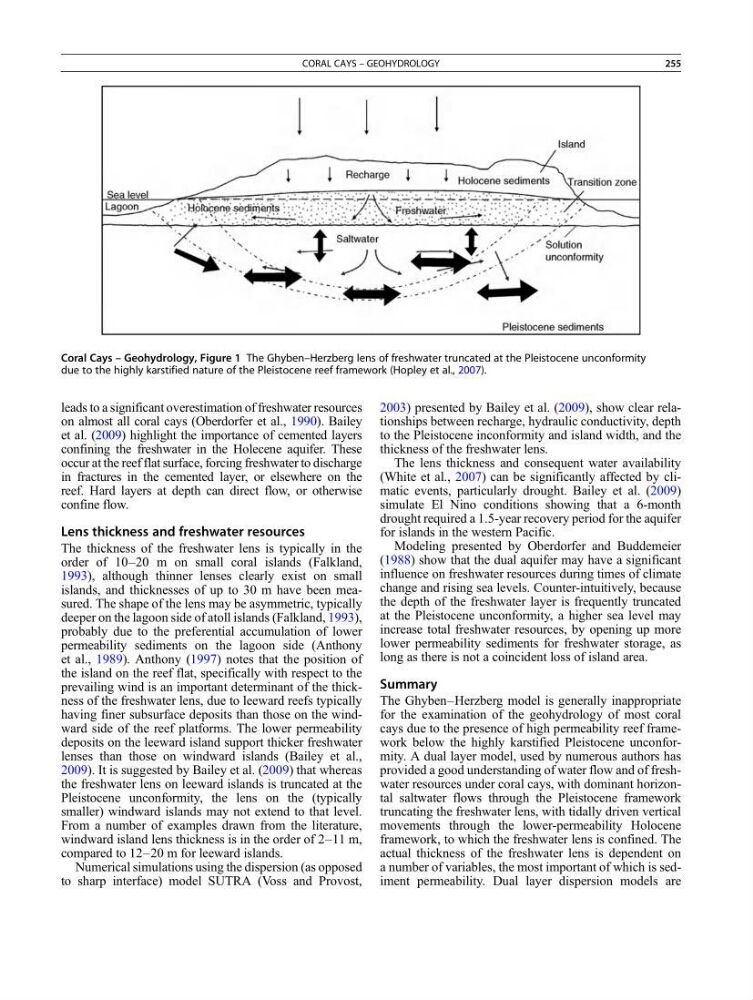
cays due to the presence of high permeability reef framework below the highly karstified Pleistocene unconformity. A dual layer model, used by numerous authors has
provided a good understanding of water flow and of freshwater resources under coral cays, with dominant horizontal saltwater flows through the Pleistocene framework
truncating the freshwater lens, with tidally driven vertical
movements through the lower-permeability Holocene
framework, to which the freshwater lens is confined. The
actual thickness of the freshwater lens is dependent on
a number of variables, the most important of which is sediment permeability. Dual layer dispersion models are
Coral Cays – Geohydrology, Figure 1 The Ghyben–Herzberg lens of freshwater truncated at the Pleistocene unconformity
due to the highly karstified nature of the Pleistocene reef framework (Hopley et al., 2007).
CORAL CAYS – GEOHYDROLOGY
255
on almost all coral cays (Oberdorfer et al., 1990). Bailey
et al. (2009) highlight the importance of cemented layers
confining the freshwater in the Holecene aquifer. These
occur at the reef flat surface, forcing freshwater to discharge
in fractures in the cemented layer, or elsewhere on the
reef. Hard layers at depth can direct flow, or otherwise
confine flow.
Lens thickness and freshwater resources
The thickness of the freshwater lens is typically in the
order of 10–20 m on small coral islands (Falkland,
1993), although thinner lenses clearly exist on small
islands, and thicknesses of up to 30 m have been measured. The shape of the lens may be asymmetric, typically
deeper on the lagoon side of atoll islands (Falkland, 1993),
probably due to the preferential accumulation of lower
permeability sediments on the lagoon side (Anthony
et al., 1989). Anthony (1997) notes that the position of
the island on the reef flat, specifically with respect to the
prevailing wind is an important determinant of the thickness of the freshwater lens, due to leeward reefs typically
having finer subsurface deposits than those on the windward side of the reef platforms. The lower permeability
deposits on the leeward island support thicker freshwater
lenses than those on windward islands (Bailey et al.,
2009). It is suggested by Bailey et al. (2009) that whereas
the freshwater lens on leeward islands is truncated at the
Pleistocene unconformity, the lens on the (typically
smaller) windward islands may not extend to that level.
From a number of examples drawn from the literature,
windward island lens thickness is in the order of 2–11 m,
compared to 12–20 m for leeward islands.
Numerical simulations using the dispersion (as opposed
to sharp interface) model SUTRA (Voss and Provost,
2003) presented by Bailey et al. (2009), show clear relationships between recharge, hydraulic conductivity, depth
to the Pleistocene inconformity and island width, and the
thickness of the freshwater lens.
The lens thickness and consequent water availability
(White et al., 2007) can be significantly affected by climatic events, particularly drought. Bailey et al. (2009)
simulate El Nino conditions showing that a 6-month
drought required a 1.5-year recovery period for the aquifer
for islands in the western Pacific.
Modeling presented by Oberdorfer and Buddemeier
(1988) show that the dual aquifer may have a significant
influence on freshwater resources during times of climate
change and rising sea levels. Counter-intuitively, because
the depth of the freshwater layer is frequently truncated
at the Pleistocene unconformity, a higher sea level may
increase total freshwater resources, by opening up more
lower permeability sediments for freshwater storage, as
long as there is not a coincident loss of island area.
Summary
The Ghyben–Herzberg model is generally inappropriate
for the examination of the geohydrology of most coral
cays due to the presence of high permeability reef framework below the highly karstified Pleistocene unconformity. A dual layer model, used by numerous authors has
provided a good understanding of water flow and of freshwater resources under coral cays, with dominant horizontal saltwater flows through the Pleistocene framework
truncating the freshwater lens, with tidally driven vertical
movements through the lower-permeability Holocene
framework, to which the freshwater lens is confined. The
actual thickness of the freshwater lens is dependent on
a number of variables, the most important of which is sediment permeability. Dual layer dispersion models are
Coral Cays – Geohydrology, Figure 1 The Ghyben–Herzberg lens of freshwater truncated at the Pleistocene unconformity
due to the highly karstified nature of the Pleistocene reef framework (Hopley et al., 2007).
CORAL CAYS – GEOHYDROLOGY
255