

the reef edge and long subaerial isolation at low tides are
the reasons for their being insufficient energy for sediment
movement. The Warraber reef flat is inactive for long
periods, with waves above 0.05 m on the outer reef flat
<30% of the time and 0.1 m only 19% of the time on each
Spring to Neap cycle. “Energy windows”, when waves
can perform geomorphic work, are determined by critical
water depths which are exceeded between 16.2 and 38%
of the time at the GBR sites. However, on Cocos-Keeling
because it is open to oceanic swells and has a low tidal
range, this time period can be up to 76% of the time, thus
accommodating greater sediment movement.
Reef flat response to sea level rise
Analyses of different scenarios of rates of sea level rise on
the typical zones of reef flats and reef islands have been
made by Hopley and Kinsey (1988); Hopley (1993);
Hopley (1997); Hopley et al. (2007). Projections for
2100 by Hopley and Kinsey (1988) were up to 1.8 m,
but by 1993, they were a more modest 30 cm to 1.0 m
(average 60 cm), by 1997 23–96 cm and currently
13–68 cm (all figures from IPCC reports). Although the
rate of annual sea level rise ranges from only 5 to
15 mm/year, this is important for reef flat ecology because
it approximates the vertical growth rates of some of the
slower growing corals. The realized value of sea-level rise
will determine how much and how quickly vertical
accommodation space is added, the places and heights that
corals may grow, and the wave energy, currents and hence
sediment transport on the reef flat (see Accommodation
Space). Response in the form of vertical accretion can also
be calculated. Estimates using alkalinity anomaly measurements (Kinsey, 1985), closely match those from the
geological record (Davies and Hopley, 1983). For the
major ecological zones these vertical accretion rates are:
100% coral on hard substrates – modal rate of 7–8 mm/
year but up to 15 mm/year for highly porous branching
corals on a hard substrate.
Algal pavement – 3–4 mm/year
Reef flat sand and rubble – 0.4 mm/year
Using these figures Hopley and Kinsey (1988) suggested
that reef flats would be completely rejuvenated in
100–150 years accreting initially at 4 mm/year then accelerating to 7 mm/year. Reef growth rates from dated cores
indicate that all reefs would be drowned by a sea level rise
>8–9 mm/year. For many inshore reefs of the GBR, rejuvenation would be aided by inundation of 1–1.5 m raised
reef substrate dating from higher sea level stands of the
mid-Holocene times.
By the mid-1990s sea level rise projections were more
conservative (0.3–1.0 m, average 60 cm). Hopley (1997)
modeled the impact of both the earlier rise of 1.8 m and
a more modest 0.5 m on a typical atoll reef flat (from
Bikini, Emery et al., 1954) (Figure 2). The higher rise
resulted in the inundation of the entire reef flat by about
2070, the outer flat becoming entirely coral covered, producing sediment for the deepening lagoon and inner sand/
rubble flat as wave transport became more efficient. In
contrast the response to the slower rate of rise was a reef
flat that more or less retained its original zonation. The
inner flat may become shallowly submerged but even here
transport of sediment from the windward margin may
maintain its level at about LWM. Calculating the calcium
carbonate production for a 1 m wide transect across the
entire 70 m wide atoll reef flat produced a figure of
2,020 kg/year for the present time, and a similar
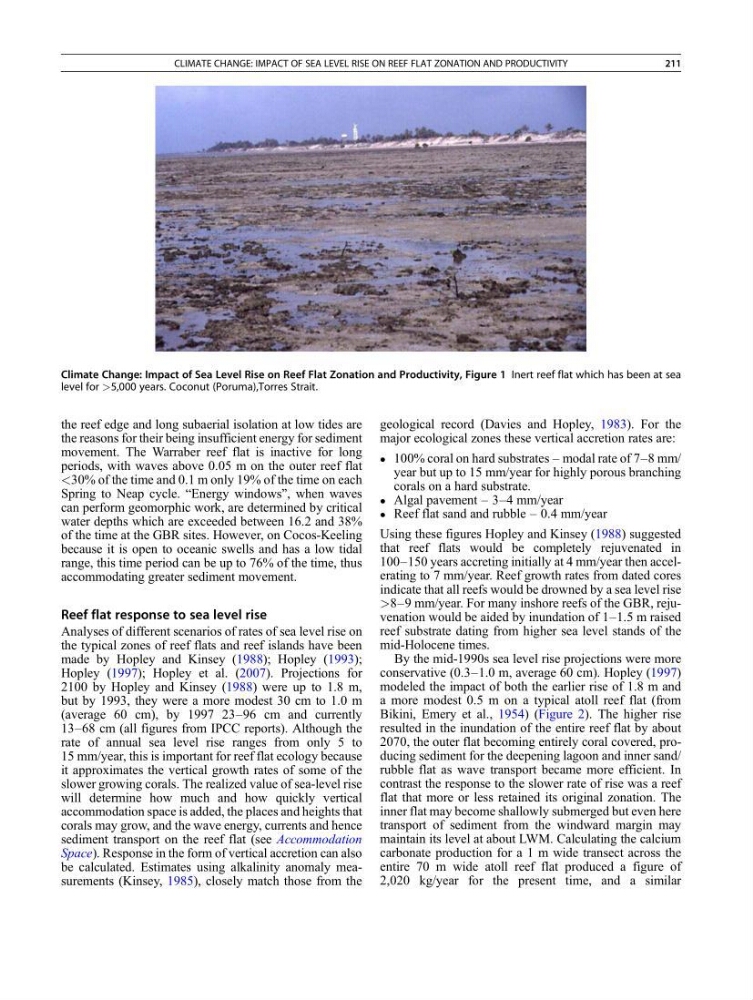
Climate Change: Impact of Sea Level Rise on Reef Flat Zonation and Productivity, Figure 1 Inert reef flat which has been at sea
level for >5,000 years. Coconut (Poruma),Torres Strait.
CLIMATE CHANGE: IMPACT OF SEA LEVEL RISE ON REEF FLAT ZONATION AND PRODUCTIVITY
211
the reasons for their being insufficient energy for sediment
movement. The Warraber reef flat is inactive for long
periods, with waves above 0.05 m on the outer reef flat
<30% of the time and 0.1 m only 19% of the time on each
Spring to Neap cycle. “Energy windows”, when waves
can perform geomorphic work, are determined by critical
water depths which are exceeded between 16.2 and 38%
of the time at the GBR sites. However, on Cocos-Keeling
because it is open to oceanic swells and has a low tidal
range, this time period can be up to 76% of the time, thus
accommodating greater sediment movement.
Reef flat response to sea level rise
Analyses of different scenarios of rates of sea level rise on
the typical zones of reef flats and reef islands have been
made by Hopley and Kinsey (1988); Hopley (1993);
Hopley (1997); Hopley et al. (2007). Projections for
2100 by Hopley and Kinsey (1988) were up to 1.8 m,
but by 1993, they were a more modest 30 cm to 1.0 m
(average 60 cm), by 1997 23–96 cm and currently
13–68 cm (all figures from IPCC reports). Although the
rate of annual sea level rise ranges from only 5 to
15 mm/year, this is important for reef flat ecology because
it approximates the vertical growth rates of some of the
slower growing corals. The realized value of sea-level rise
will determine how much and how quickly vertical
accommodation space is added, the places and heights that
corals may grow, and the wave energy, currents and hence
sediment transport on the reef flat (see Accommodation
Space). Response in the form of vertical accretion can also
be calculated. Estimates using alkalinity anomaly measurements (Kinsey, 1985), closely match those from the
geological record (Davies and Hopley, 1983). For the
major ecological zones these vertical accretion rates are:
100% coral on hard substrates – modal rate of 7–8 mm/
year but up to 15 mm/year for highly porous branching
corals on a hard substrate.
Algal pavement – 3–4 mm/year
Reef flat sand and rubble – 0.4 mm/year
Using these figures Hopley and Kinsey (1988) suggested
that reef flats would be completely rejuvenated in
100–150 years accreting initially at 4 mm/year then accelerating to 7 mm/year. Reef growth rates from dated cores
indicate that all reefs would be drowned by a sea level rise
>8–9 mm/year. For many inshore reefs of the GBR, rejuvenation would be aided by inundation of 1–1.5 m raised
reef substrate dating from higher sea level stands of the
mid-Holocene times.
By the mid-1990s sea level rise projections were more
conservative (0.3–1.0 m, average 60 cm). Hopley (1997)
modeled the impact of both the earlier rise of 1.8 m and
a more modest 0.5 m on a typical atoll reef flat (from
Bikini, Emery et al., 1954) (Figure 2). The higher rise
resulted in the inundation of the entire reef flat by about
2070, the outer flat becoming entirely coral covered, producing sediment for the deepening lagoon and inner sand/
rubble flat as wave transport became more efficient. In
contrast the response to the slower rate of rise was a reef
flat that more or less retained its original zonation. The
inner flat may become shallowly submerged but even here
transport of sediment from the windward margin may
maintain its level at about LWM. Calculating the calcium
carbonate production for a 1 m wide transect across the
entire 70 m wide atoll reef flat produced a figure of
2,020 kg/year for the present time, and a similar
Climate Change: Impact of Sea Level Rise on Reef Flat Zonation and Productivity, Figure 1 Inert reef flat which has been at sea
level for >5,000 years. Coconut (Poruma),Torres Strait.
CLIMATE CHANGE: IMPACT OF SEA LEVEL RISE ON REEF FLAT ZONATION AND PRODUCTIVITY
211