

the evolution (typically over 12–18 months) of an El Niño
event, as happened in 1982–1983 and 1997–1998. Both
phases are also associated with changes in tropical rainfall
amount and intensity (in particular floods and consequent
increases in freshwater flows to nearshore reefs) and in
preferred locations of tropical cyclone activity.
Impacts of climate change on coral reefs
Warmer waters and coral bleaching
At the heart of tropical coral reefs is a mutually beneficial
relationship between the coral animal and single-celled
photosynthetic plants. In return for protection and essential nutrients, the algae play a role in light-enhanced calcification and provide sufficient cheap energy to the coral
host to allow rapid calcification and thus form the massive
and complex carbonate structures of coral reefs (Barnes
and Chalker, 1990; Veron, 2000). Coral bleaching describes the loss by the coral animal of all or some of these
algae and their photosynthetic pigments so that the white
calcium carbonate skeleton becomes visible through the
translucent coral tissue. Coral bleaching is a response
of the coral to an environmental stress such as unusually
cold or warm temperatures, low salinity, or pollution.
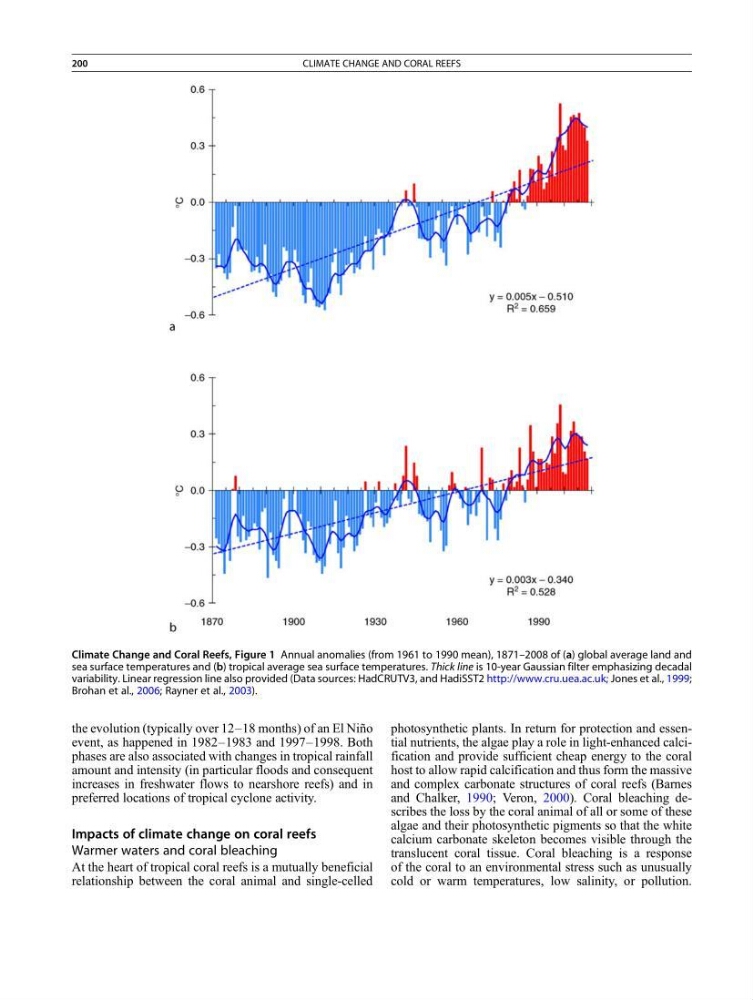
Climate Change and Coral Reefs, Figure 1 Annual anomalies (from 1961 to 1990 mean), 1871–2008 of (a) global average land and
sea surface temperatures and (b) tropical average sea surface temperatures. Thick line is 10-year Gaussian filter emphasizing decadal
variability. Linear regression line also provided (Data sources: HadCRUTV3, and HadiSST2 http://www.cru.uea.ac.uk; Jones et al., 1999;
Brohan et al., 2006; Rayner et al., 2003).
200
CLIMATE CHANGE AND CORAL REEFS
event, as happened in 1982–1983 and 1997–1998. Both
phases are also associated with changes in tropical rainfall
amount and intensity (in particular floods and consequent
increases in freshwater flows to nearshore reefs) and in
preferred locations of tropical cyclone activity.
Impacts of climate change on coral reefs
Warmer waters and coral bleaching
At the heart of tropical coral reefs is a mutually beneficial
relationship between the coral animal and single-celled
photosynthetic plants. In return for protection and essential nutrients, the algae play a role in light-enhanced calcification and provide sufficient cheap energy to the coral
host to allow rapid calcification and thus form the massive
and complex carbonate structures of coral reefs (Barnes
and Chalker, 1990; Veron, 2000). Coral bleaching describes the loss by the coral animal of all or some of these
algae and their photosynthetic pigments so that the white
calcium carbonate skeleton becomes visible through the
translucent coral tissue. Coral bleaching is a response
of the coral to an environmental stress such as unusually
cold or warm temperatures, low salinity, or pollution.
Climate Change and Coral Reefs, Figure 1 Annual anomalies (from 1961 to 1990 mean), 1871–2008 of (a) global average land and
sea surface temperatures and (b) tropical average sea surface temperatures. Thick line is 10-year Gaussian filter emphasizing decadal
variability. Linear regression line also provided (Data sources: HadCRUTV3, and HadiSST2 http://www.cru.uea.ac.uk; Jones et al., 1999;
Brohan et al., 2006; Rayner et al., 2003).
200
CLIMATE CHANGE AND CORAL REEFS