

CALCRETE/CALICHE
Barbara H. Lidz
U.S. Geological Survey, St. Petersburg, FL, USA
Synonyms
Breccias; Calcium-carbonate cement; Hardpan; Impermeable crust of soluble calcium salts; Laminated crust; Pedogenic calcareous soil; Secondarily deposited calcareous
material on native-limestone surface; Soilstone crust;
Strongly indurated wafer-thin calcareous layers; Subaerial
CaCO 3 crust; Subaerial-exposure surface; Unconformity
Definition
Laminated subaerial-soilstone crusts (calcrete/caliche) are
found in diverse carbonate environments throughout geological history (e.g., Swett, 1974; Harrison and Steinen,
1978; Kahle, 1978). Florida crusts accrete vertically in
a series of wafer-thin layers, through capillary interaction
of wet/dry processes on exposed limestone (Multer and
Hoffmeister, 1968). The limestone underlies a thin mantle
of organic-rich soil that contains cryptocrystalline calcite,
derived from periodic dissolution of in situ carbonate particles. Drill cores show Florida crusts cap five Pleistocene
chronostratigraphic marine sequences, as unconformities
(Enos and Perkins, 1977). Extensive subsurface persistence renders the crusts significant stratigraphic markers
for regional sequence correlation. Radiometric dates that
correlate with Pleistocene glacial cycles indicate times
when subsurface crust-source sites were dry land (Robbin,
1981). In the Florida Keys, crust accretion rates are
uniform within, but inconsistent between, northeast
(1 cm/2 ka) and southwest (1 cm/4 ka) sites (Robbin and
Stipp, 1979). Inconsistency results from different local
ambient conditions during crust formation (e.g., variability of limestone porosity, soil, humus, detrital carbonate,
and erosion). Inconsistent accretion rates result in different
thicknesses of calcrete (see Figure 1a and b in entry entitled, Porosity Variability in Limestone Sequences).
Calcrete textures
Calcretes have various textures depending upon the type
of material present at the site of formation and/or the processes involved in formation. Rhizoliths or rhizoconcretions are small cylindrical or conical root-cast
structures, usually branching or forked, that form in
a sedimentary rock. Rhizoliths may consist of calcrete or
chert and resemble in shape the plant roots they have
replaced. Calcretes that consist of aggregated, clustered,
or flocculated grains are said to be clotted. Patches of dark,
dense, fine-grained areas ultimately surrounded by sparry
calcite can characterize clotted rocks. The squashing of
soft micrite pellets usually produces clotting. Calcretes
that have different colors, commonly resulting from oxidation of iron components, are said to be mottled, but
multicoloration is not the only characteristic. Mottled
calcretes also can contain small irregular pieces of material in a sedimentary matrix of a different texture.
Breccias are coarse-grained clastic rocks composed of
angular fragments of any kind of preexisting native rock.
Mineral cement binds the fragments together in a finegrained matrix of sand, clay, or calcrete. Breccias may
result from talus accumulation (sedimentary breccia),
igneous processes (volcanic and explosive breccias), tectonic processes (fault breccia), disturbance during
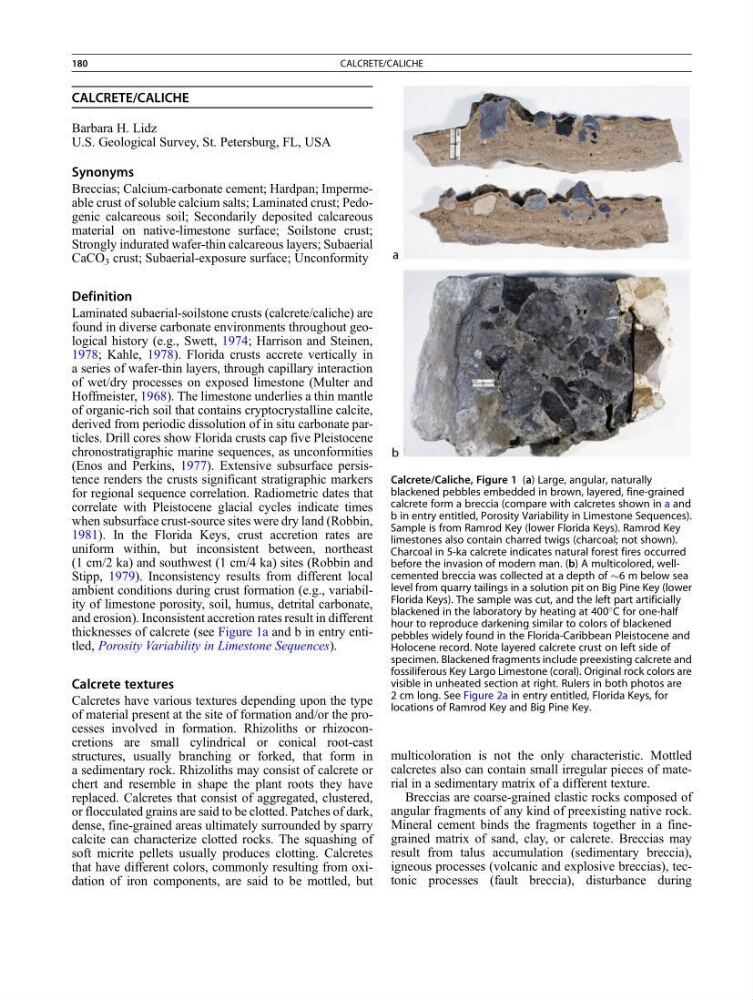
Calcrete/Caliche, Figure 1 (a) Large, angular, naturally
blackened pebbles embedded in brown, layered, fine-grained
calcrete form a breccia (compare with calcretes shown in a and
b in entry entitled, Porosity Variability in Limestone Sequences).
Sample is from Ramrod Key (lower Florida Keys). Ramrod Key
limestones also contain charred twigs (charcoal; not shown).
Charcoal in 5-ka calcrete indicates natural forest fires occurred
before the invasion of modern man. (b) A multicolored, wellcemented breccia was collected at a depth of $6 m below sea
level from quarry tailings in a solution pit on Big Pine Key (lower
Florida Keys). The sample was cut, and the left part artificially
blackened in the laboratory by heating at 400
C for one-half
hour to reproduce darkening similar to colors of blackened
pebbles widely found in the Florida-Caribbean Pleistocene and
Holocene record. Note layered calcrete crust on left side of
specimen. Blackened fragments include preexisting calcrete and
fossiliferous Key Largo Limestone (coral). Original rock colors are
visible in unheated section at right. Rulers in both photos are
2 cm long. See Figure 2a in entry entitled, Florida Keys, for
locations of Ramrod Key and Big Pine Key.
180
CALCRETE/CALICHE
Barbara H. Lidz
U.S. Geological Survey, St. Petersburg, FL, USA
Synonyms
Breccias; Calcium-carbonate cement; Hardpan; Impermeable crust of soluble calcium salts; Laminated crust; Pedogenic calcareous soil; Secondarily deposited calcareous
material on native-limestone surface; Soilstone crust;
Strongly indurated wafer-thin calcareous layers; Subaerial
CaCO 3 crust; Subaerial-exposure surface; Unconformity
Definition
Laminated subaerial-soilstone crusts (calcrete/caliche) are
found in diverse carbonate environments throughout geological history (e.g., Swett, 1974; Harrison and Steinen,
1978; Kahle, 1978). Florida crusts accrete vertically in
a series of wafer-thin layers, through capillary interaction
of wet/dry processes on exposed limestone (Multer and
Hoffmeister, 1968). The limestone underlies a thin mantle
of organic-rich soil that contains cryptocrystalline calcite,
derived from periodic dissolution of in situ carbonate particles. Drill cores show Florida crusts cap five Pleistocene
chronostratigraphic marine sequences, as unconformities
(Enos and Perkins, 1977). Extensive subsurface persistence renders the crusts significant stratigraphic markers
for regional sequence correlation. Radiometric dates that
correlate with Pleistocene glacial cycles indicate times
when subsurface crust-source sites were dry land (Robbin,
1981). In the Florida Keys, crust accretion rates are
uniform within, but inconsistent between, northeast
(1 cm/2 ka) and southwest (1 cm/4 ka) sites (Robbin and
Stipp, 1979). Inconsistency results from different local
ambient conditions during crust formation (e.g., variability of limestone porosity, soil, humus, detrital carbonate,
and erosion). Inconsistent accretion rates result in different
thicknesses of calcrete (see Figure 1a and b in entry entitled, Porosity Variability in Limestone Sequences).
Calcrete textures
Calcretes have various textures depending upon the type
of material present at the site of formation and/or the processes involved in formation. Rhizoliths or rhizoconcretions are small cylindrical or conical root-cast
structures, usually branching or forked, that form in
a sedimentary rock. Rhizoliths may consist of calcrete or
chert and resemble in shape the plant roots they have
replaced. Calcretes that consist of aggregated, clustered,
or flocculated grains are said to be clotted. Patches of dark,
dense, fine-grained areas ultimately surrounded by sparry
calcite can characterize clotted rocks. The squashing of
soft micrite pellets usually produces clotting. Calcretes
that have different colors, commonly resulting from oxidation of iron components, are said to be mottled, but
multicoloration is not the only characteristic. Mottled
calcretes also can contain small irregular pieces of material in a sedimentary matrix of a different texture.
Breccias are coarse-grained clastic rocks composed of
angular fragments of any kind of preexisting native rock.
Mineral cement binds the fragments together in a finegrained matrix of sand, clay, or calcrete. Breccias may
result from talus accumulation (sedimentary breccia),
igneous processes (volcanic and explosive breccias), tectonic processes (fault breccia), disturbance during
Calcrete/Caliche, Figure 1 (a) Large, angular, naturally
blackened pebbles embedded in brown, layered, fine-grained
calcrete form a breccia (compare with calcretes shown in a and
b in entry entitled, Porosity Variability in Limestone Sequences).
Sample is from Ramrod Key (lower Florida Keys). Ramrod Key
limestones also contain charred twigs (charcoal; not shown).
Charcoal in 5-ka calcrete indicates natural forest fires occurred
before the invasion of modern man. (b) A multicolored, wellcemented breccia was collected at a depth of $6 m below sea
level from quarry tailings in a solution pit on Big Pine Key (lower
Florida Keys). The sample was cut, and the left part artificially
blackened in the laboratory by heating at 400
C for one-half
hour to reproduce darkening similar to colors of blackened
pebbles widely found in the Florida-Caribbean Pleistocene and
Holocene record. Note layered calcrete crust on left side of
specimen. Blackened fragments include preexisting calcrete and
fossiliferous Key Largo Limestone (coral). Original rock colors are
visible in unheated section at right. Rulers in both photos are
2 cm long. See Figure 2a in entry entitled, Florida Keys, for
locations of Ramrod Key and Big Pine Key.
180
CALCRETE/CALICHE