

exhibited differences in preferred coral species depending
upon habitat, with M. annularis being preferred in shallow
habitats, whereas M. franksi was consumed more at depth
and Siderastrea siderea was preferentially grazed only in
the spur and groove habitats. Given that numbers of
Sparisoma viride and Sp. aurofrenatum increased between
1982 and 2004 on the Belize barrier reef, there would have
also been a corresponding increase in grazing on live coral
and the impacts of this on coral survival needs to be evaluated (Rotjan and Lewis, 2006).
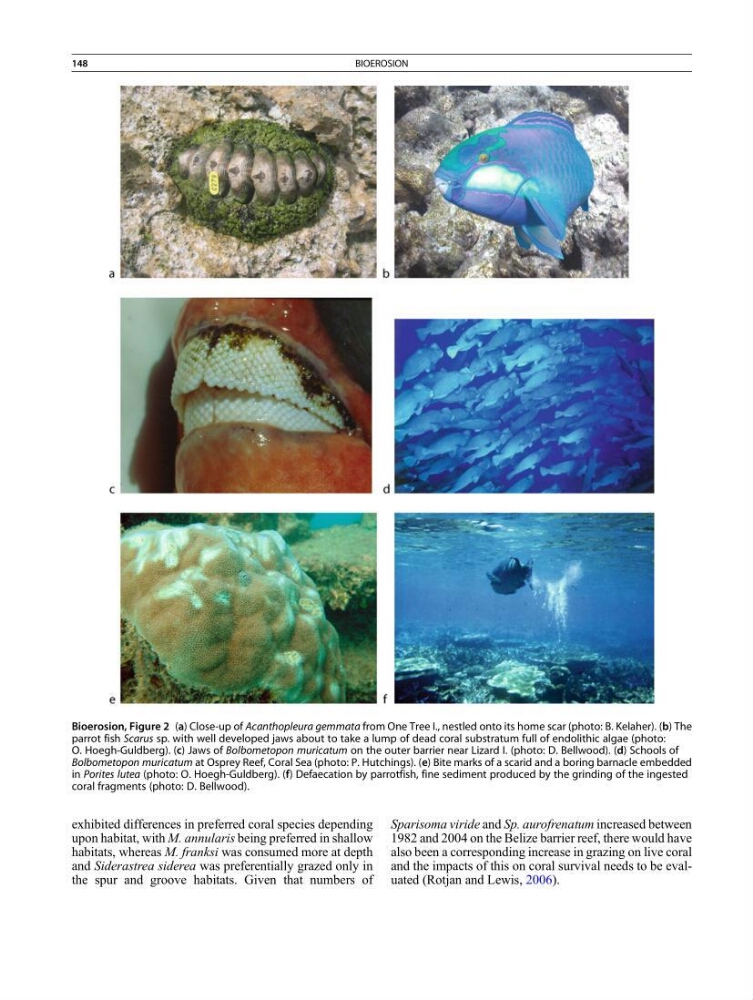
Bioerosion, Figure 2 (a) Close-up of Acanthopleura gemmata from One Tree I., nestled onto its home scar (photo: B. Kelaher). (b) The
parrot fish Scarus sp. with well developed jaws about to take a lump of dead coral substratum full of endolithic algae (photo:
O. Hoegh-Guldberg). (c) Jaws of Bolbometopon muricatum on the outer barrier near Lizard I. (photo: D. Bellwood). (d) Schools of
Bolbometopon muricatum at Osprey Reef, Coral Sea (photo: P. Hutchings). (e) Bite marks of a scarid and a boring barnacle embedded
in Porites lutea (photo: O. Hoegh-Guldberg). (f) Defaecation by parrotfish, fine sediment produced by the grinding of the ingested
coral fragments (photo: D. Bellwood).
148
BIOEROSION
upon habitat, with M. annularis being preferred in shallow
habitats, whereas M. franksi was consumed more at depth
and Siderastrea siderea was preferentially grazed only in
the spur and groove habitats. Given that numbers of
Sparisoma viride and Sp. aurofrenatum increased between
1982 and 2004 on the Belize barrier reef, there would have
also been a corresponding increase in grazing on live coral
and the impacts of this on coral survival needs to be evaluated (Rotjan and Lewis, 2006).
Bioerosion, Figure 2 (a) Close-up of Acanthopleura gemmata from One Tree I., nestled onto its home scar (photo: B. Kelaher). (b) The
parrot fish Scarus sp. with well developed jaws about to take a lump of dead coral substratum full of endolithic algae (photo:
O. Hoegh-Guldberg). (c) Jaws of Bolbometopon muricatum on the outer barrier near Lizard I. (photo: D. Bellwood). (d) Schools of
Bolbometopon muricatum at Osprey Reef, Coral Sea (photo: P. Hutchings). (e) Bite marks of a scarid and a boring barnacle embedded
in Porites lutea (photo: O. Hoegh-Guldberg). (f) Defaecation by parrotfish, fine sediment produced by the grinding of the ingested
coral fragments (photo: D. Bellwood).
148
BIOEROSION