

However, the wind fetch 20 km or more to the west generates steep wind waves of up to 2 m in height in the central
and west lagoon during normal wind conditions, rendering
small boat navigation hazardous during the heavy winds
and seas.
Scientific surveys at Bikini Atoll
The geological structure, composition, and morphology of
Bikini Atoll were thoroughly studied before and after the
initial Operation Crossroads atomic bomb tests at Bikini
in 1946. Samples were collected at many sites via shallow
hookah diving, free-diving, and by hand on shallow patch
reefs in the lagoon and on both sides of the perimeter reef
and reef crests in 1946–1947. Extensive collections were
also made of corals and geological samples via dozens
of deep dredge hauls of the lagoon floor and seaward fore
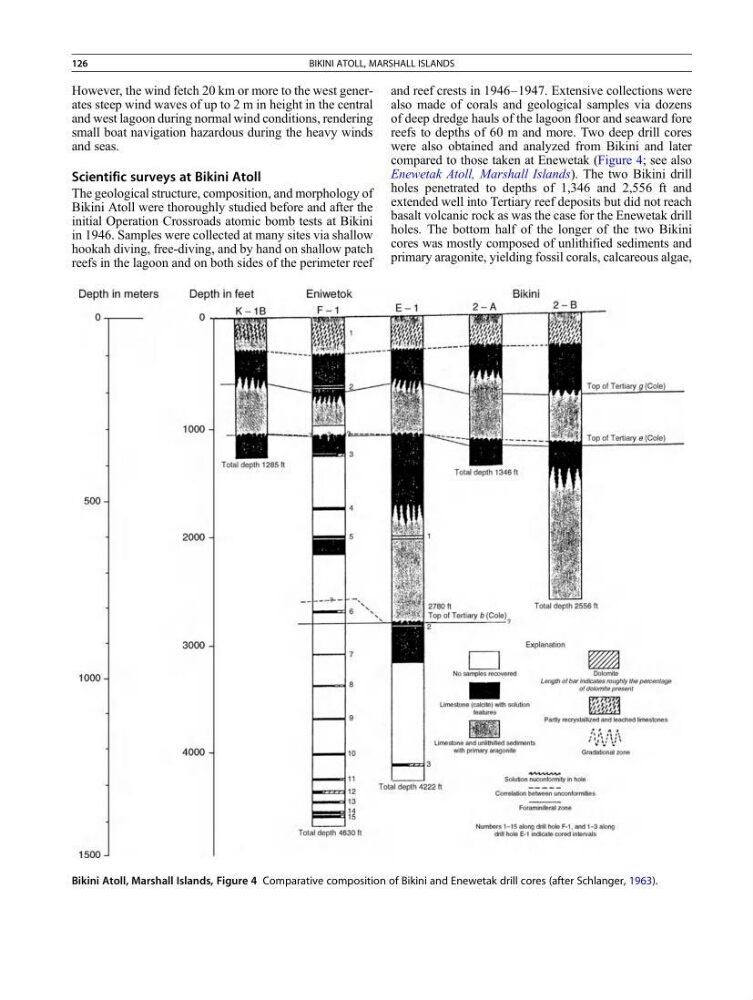
reefs to depths of 60 m and more. Two deep drill cores
were also obtained and analyzed from Bikini and later
compared to those taken at Enewetak (Figure 4; see also
Enewetak Atoll, Marshall Islands). The two Bikini drill
holes penetrated to depths of 1,346 and 2,556 ft and
extended well into Tertiary reef deposits but did not reach
basalt volcanic rock as was the case for the Enewetak drill
holes. The bottom half of the longer of the two Bikini
cores was mostly composed of unlithified sediments and
primary aragonite, yielding fossil corals, calcareous algae,
Bikini Atoll, Marshall Islands, Figure 4 Comparative composition of Bikini and Enewetak drill cores (after Schlanger, 1963).
126
BIKINI ATOLL, MARSHALL ISLANDS
and west lagoon during normal wind conditions, rendering
small boat navigation hazardous during the heavy winds
and seas.
Scientific surveys at Bikini Atoll
The geological structure, composition, and morphology of
Bikini Atoll were thoroughly studied before and after the
initial Operation Crossroads atomic bomb tests at Bikini
in 1946. Samples were collected at many sites via shallow
hookah diving, free-diving, and by hand on shallow patch
reefs in the lagoon and on both sides of the perimeter reef
and reef crests in 1946–1947. Extensive collections were
also made of corals and geological samples via dozens
of deep dredge hauls of the lagoon floor and seaward fore
reefs to depths of 60 m and more. Two deep drill cores
were also obtained and analyzed from Bikini and later
compared to those taken at Enewetak (Figure 4; see also
Enewetak Atoll, Marshall Islands). The two Bikini drill
holes penetrated to depths of 1,346 and 2,556 ft and
extended well into Tertiary reef deposits but did not reach
basalt volcanic rock as was the case for the Enewetak drill
holes. The bottom half of the longer of the two Bikini
cores was mostly composed of unlithified sediments and
primary aragonite, yielding fossil corals, calcareous algae,
Bikini Atoll, Marshall Islands, Figure 4 Comparative composition of Bikini and Enewetak drill cores (after Schlanger, 1963).
126
BIKINI ATOLL, MARSHALL ISLANDS