

stromatoporoids grew in upright bushes, usually on fine
lime mud substrates that indicate sheltered environments.
The Banks reef tabulate and rugose corals were more
diverse than the stromatoporoids, but volumetrically
<30% of the reef mass, though some patch reefs were
monospecific thamnoporid corals. The calcitic microstructure of Banks corals is commonly better preserved than modern day scleractinian corals. Solitary cup corals were very
rare on Banks Island. In overall construction strategy, rugose
corals were dendroid, phaceloid, cerioid, thamnasterioid,
and aphroid forms, but lacked the meandroid ‘brain coral’
morphology of modern taxa. For the tabulate corals, dominant were the alveolitids (flat- to dish-shaped to cup-shaped,
like the living lettuce coral Agaricia), coenitids (flat or
branching), and thamnoporids (branching, almost identical
to living Porites porites). The corals were more abundant
as thickets, usually reef-flanking or biostromal, or as
a lesser component within the fore-reef or reef flat. Unique
for the Devonian, some corals and stromatoporoids grew on
foundered tree trunks, the oldest known in the fossil record.
Except for rare armored fragments and teeth, fishes were
scarce in the Banks reef setting, as were shelly brachiopods,
calcareous green and red algae.
Patch reefs ranged from a few meters in height and diameter to massive rounded to elongate mounds to a kilometer
or more long and 30–50 m in composite height
(Thorsteinsson and Tozer, 1962; Copper and Edinger,
2009) (Figure 4), found throughout the 220 m thick carbonate succession of the Mercy Bay Formation. Platform reefs,
with a reef flat and slope up to ca. 30
, developed only at one
Frasnian sea level highstand, and these were irregular in plan
view, with scalloped edges possibly fringing delta lobes
(Figure 3). Reefs generally initiated growth on coral debris.
Bibliography
Copper, P., 2002. Reef development at the Frasnian-Famennian
(Late Devonian) mass extinction boundary. Palaeogeography,
Palaeoclimatology, Palaeoecology, 157, 1–20.
Copper, P., and Edinger, E., 2009. Distribution, geometry and
palaeogeography of the Frasnian (Late Devonian) reef complexes of Banks Island, NWT, western arctic, Canada. In
Königshof, P. (ed.), Devonian Change: Case Studies in
Palaeogeography and Palaeoecology. London: The Geological
Society, Special Publications, Vol. 314, pp. 107–122.
Thorsteinsson, R., and Tozer, T. E., 1962. Banks, Victoria and Stefansson islands, arctic archipelago. Geological Survey of Canada, Memoir, 22, 1–85.
BANKS, JOSEPH (1743–1820)
Norman C. Duke
University of Queensland, Brisbane, QLD, Australia
Banks, a founding father of natural science and co-founder
of Australia, was born in London, Great Britain, on
February 13, 1743, the only son of a wealthy landowner.
He married Dorothea Hugesson on March 23, 1779. He
died in Isleworth, London, on June 19, 1820, aged 77.
Banks devoted his entire adult life toward the advancement of science.
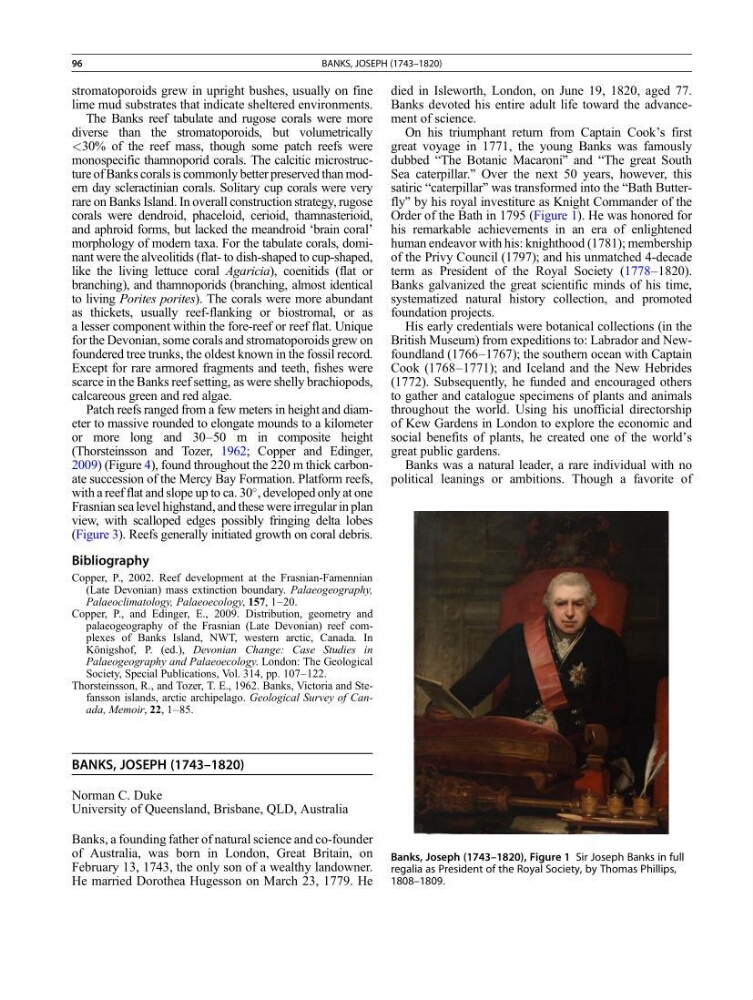
On his triumphant return from Captain Cook’s first
great voyage in 1771, the young Banks was famously
dubbed “The Botanic Macaroni” and “The great South
Sea caterpillar.” Over the next 50 years, however, this
satiric “caterpillar” was transformed into the “Bath Butterfly” by his royal investiture as Knight Commander of the
Order of the Bath in 1795 (Figure 1). He was honored for
his remarkable achievements in an era of enlightened
human endeavor with his: knighthood (1781); membership
of the Privy Council (1797); and his unmatched 4-decade
term as President of the Royal Society (1778–1820).
Banks galvanized the great scientific minds of his time,
systematized natural history collection, and promoted
foundation projects.
His early credentials were botanical collections (in the
British Museum) from expeditions to: Labrador and Newfoundland (1766–1767); the southern ocean with Captain
Cook (1768–1771); and Iceland and the New Hebrides
(1772). Subsequently, he funded and encouraged others
to gather and catalogue specimens of plants and animals
throughout the world. Using his unofficial directorship
of Kew Gardens in London to explore the economic and
social benefits of plants, he created one of the world’s
great public gardens.
Banks was a natural leader, a rare individual with no
political leanings or ambitions. Though a favorite of
Banks, Joseph (1743–1820), Figure 1 Sir Joseph Banks in full
regalia as President of the Royal Society, by Thomas Phillips,
1808–1809.
96
BANKS, JOSEPH (1743–1820)
lime mud substrates that indicate sheltered environments.
The Banks reef tabulate and rugose corals were more
diverse than the stromatoporoids, but volumetrically
<30% of the reef mass, though some patch reefs were
monospecific thamnoporid corals. The calcitic microstructure of Banks corals is commonly better preserved than modern day scleractinian corals. Solitary cup corals were very
rare on Banks Island. In overall construction strategy, rugose
corals were dendroid, phaceloid, cerioid, thamnasterioid,
and aphroid forms, but lacked the meandroid ‘brain coral’
morphology of modern taxa. For the tabulate corals, dominant were the alveolitids (flat- to dish-shaped to cup-shaped,
like the living lettuce coral Agaricia), coenitids (flat or
branching), and thamnoporids (branching, almost identical
to living Porites porites). The corals were more abundant
as thickets, usually reef-flanking or biostromal, or as
a lesser component within the fore-reef or reef flat. Unique
for the Devonian, some corals and stromatoporoids grew on
foundered tree trunks, the oldest known in the fossil record.
Except for rare armored fragments and teeth, fishes were
scarce in the Banks reef setting, as were shelly brachiopods,
calcareous green and red algae.
Patch reefs ranged from a few meters in height and diameter to massive rounded to elongate mounds to a kilometer
or more long and 30–50 m in composite height
(Thorsteinsson and Tozer, 1962; Copper and Edinger,
2009) (Figure 4), found throughout the 220 m thick carbonate succession of the Mercy Bay Formation. Platform reefs,
with a reef flat and slope up to ca. 30
, developed only at one
Frasnian sea level highstand, and these were irregular in plan
view, with scalloped edges possibly fringing delta lobes
(Figure 3). Reefs generally initiated growth on coral debris.
Bibliography
Copper, P., 2002. Reef development at the Frasnian-Famennian
(Late Devonian) mass extinction boundary. Palaeogeography,
Palaeoclimatology, Palaeoecology, 157, 1–20.
Copper, P., and Edinger, E., 2009. Distribution, geometry and
palaeogeography of the Frasnian (Late Devonian) reef complexes of Banks Island, NWT, western arctic, Canada. In
Königshof, P. (ed.), Devonian Change: Case Studies in
Palaeogeography and Palaeoecology. London: The Geological
Society, Special Publications, Vol. 314, pp. 107–122.
Thorsteinsson, R., and Tozer, T. E., 1962. Banks, Victoria and Stefansson islands, arctic archipelago. Geological Survey of Canada, Memoir, 22, 1–85.
BANKS, JOSEPH (1743–1820)
Norman C. Duke
University of Queensland, Brisbane, QLD, Australia
Banks, a founding father of natural science and co-founder
of Australia, was born in London, Great Britain, on
February 13, 1743, the only son of a wealthy landowner.
He married Dorothea Hugesson on March 23, 1779. He
died in Isleworth, London, on June 19, 1820, aged 77.
Banks devoted his entire adult life toward the advancement of science.
On his triumphant return from Captain Cook’s first
great voyage in 1771, the young Banks was famously
dubbed “The Botanic Macaroni” and “The great South
Sea caterpillar.” Over the next 50 years, however, this
satiric “caterpillar” was transformed into the “Bath Butterfly” by his royal investiture as Knight Commander of the
Order of the Bath in 1795 (Figure 1). He was honored for
his remarkable achievements in an era of enlightened
human endeavor with his: knighthood (1781); membership
of the Privy Council (1797); and his unmatched 4-decade
term as President of the Royal Society (1778–1820).
Banks galvanized the great scientific minds of his time,
systematized natural history collection, and promoted
foundation projects.
His early credentials were botanical collections (in the
British Museum) from expeditions to: Labrador and Newfoundland (1766–1767); the southern ocean with Captain
Cook (1768–1771); and Iceland and the New Hebrides
(1772). Subsequently, he funded and encouraged others
to gather and catalogue specimens of plants and animals
throughout the world. Using his unofficial directorship
of Kew Gardens in London to explore the economic and
social benefits of plants, he created one of the world’s
great public gardens.
Banks was a natural leader, a rare individual with no
political leanings or ambitions. Though a favorite of
Banks, Joseph (1743–1820), Figure 1 Sir Joseph Banks in full
regalia as President of the Royal Society, by Thomas Phillips,
1808–1809.
96
BANKS, JOSEPH (1743–1820)