

BANKS ISLAND: FRASNIAN (LATE DEVONIAN)
REEFS IN NORTHWESTERN ARCTIC CANADA
Paul Copper
Laurentian University, Sudbury, ON, Canada
During the Frasnian (385.3–374.5 my), stromatoporoid
sponge and coral reefs were restricted to about 5,000 km
2
of Banks Island (Thorsteinsson and Tozer, 1962). The
more than 2,000 km long preceding Middle Devonian barrier reef platform, extending westward from Greenland, lay
buried in thick sands, silts, and muds. Banks Island reefs
are remarkable for several reasons: (a) they were built up
on the margins of an equatorial super delta, fringed by
one of the oldest coastal lowland forests, whose margins
harbored primitive-jawed placoderm fishes, and some of
the first amphibians; (b) they flourished in the early and
mid-Frasnian, prior to the Frasnian–Famennian global
mass extinction events; (c) the reefs grew in four cycles,
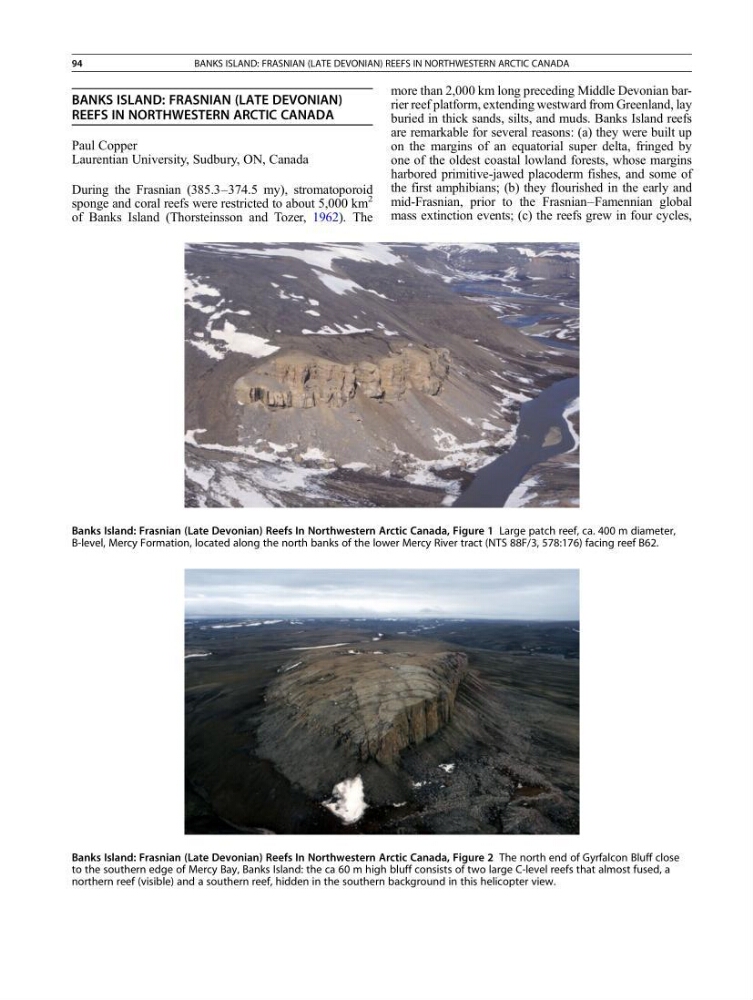
Banks Island: Frasnian (Late Devonian) Reefs In Northwestern Arctic Canada, Figure 1 Large patch reef, ca. 400 m diameter,
B-level, Mercy Formation, located along the north banks of the lower Mercy River tract (NTS 88F/3, 578:176) facing reef B62.
Banks Island: Frasnian (Late Devonian) Reefs In Northwestern Arctic Canada, Figure 2 The north end of Gyrfalcon Bluff close
to the southern edge of Mercy Bay, Banks Island: the ca 60 m high bluff consists of two large C-level reefs that almost fused, a
northern reef (visible) and a southern reef, hidden in the southern background in this helicopter view.
94
BANKS ISLAND: FRASNIAN (LATE DEVONIAN) REEFS IN NORTHWESTERN ARCTIC CANADA
REEFS IN NORTHWESTERN ARCTIC CANADA
Paul Copper
Laurentian University, Sudbury, ON, Canada
During the Frasnian (385.3–374.5 my), stromatoporoid
sponge and coral reefs were restricted to about 5,000 km
2
of Banks Island (Thorsteinsson and Tozer, 1962). The
more than 2,000 km long preceding Middle Devonian barrier reef platform, extending westward from Greenland, lay
buried in thick sands, silts, and muds. Banks Island reefs
are remarkable for several reasons: (a) they were built up
on the margins of an equatorial super delta, fringed by
one of the oldest coastal lowland forests, whose margins
harbored primitive-jawed placoderm fishes, and some of
the first amphibians; (b) they flourished in the early and
mid-Frasnian, prior to the Frasnian–Famennian global
mass extinction events; (c) the reefs grew in four cycles,
Banks Island: Frasnian (Late Devonian) Reefs In Northwestern Arctic Canada, Figure 1 Large patch reef, ca. 400 m diameter,
B-level, Mercy Formation, located along the north banks of the lower Mercy River tract (NTS 88F/3, 578:176) facing reef B62.
Banks Island: Frasnian (Late Devonian) Reefs In Northwestern Arctic Canada, Figure 2 The north end of Gyrfalcon Bluff close
to the southern edge of Mercy Bay, Banks Island: the ca 60 m high bluff consists of two large C-level reefs that almost fused, a
northern reef (visible) and a southern reef, hidden in the southern background in this helicopter view.
94
BANKS ISLAND: FRASNIAN (LATE DEVONIAN) REEFS IN NORTHWESTERN ARCTIC CANADA