

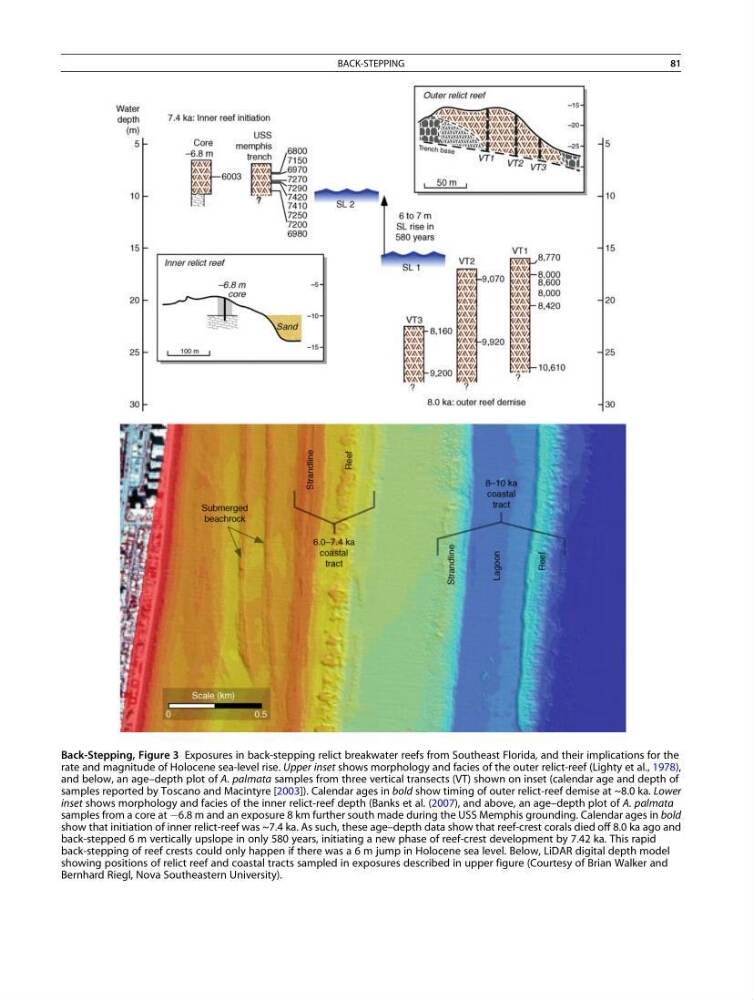
Back-Stepping, Figure 3 Exposures in back-stepping relict breakwater reefs from Southeast Florida, and their implications for the
rate and magnitude of Holocene sea-level rise. Upper inset shows morphology and facies of the outer relict-reef (Lighty et al., 1978),
and below, an age–depth plot of A. palmata samples from three vertical transects (VT) shown on inset (calendar age and depth of
samples reported by Toscano and Macintyre [2003]). Calendar ages in bold show timing of outer relict-reef demise at ~8.0 ka. Lower
inset shows morphology and facies of the inner relict-reef depth (Banks et al. (2007), and above, an age–depth plot of A. palmata
samples from a core at À6.8 m and an exposure 8 km further south made during the USS Memphis grounding. Calendar ages in bold
show that initiation of inner relict-reef was ~7.4 ka. As such, these age–depth data show that reef-crest corals died off 8.0 ka ago and
back-stepped 6 m vertically upslope in only 580 years, initiating a new phase of reef-crest development by 7.42 ka. This rapid
back-stepping of reef crests could only happen if there was a 6 m jump in Holocene sea level. Below, LiDAR digital depth model
showing positions of relict reef and coastal tracts sampled in exposures described in upper figure (Courtesy of Brian Walker and
Bernhard Riegl, Nova Southeastern University).
BACK-STEPPING
81
rate and magnitude of Holocene sea-level rise. Upper inset shows morphology and facies of the outer relict-reef (Lighty et al., 1978),
and below, an age–depth plot of A. palmata samples from three vertical transects (VT) shown on inset (calendar age and depth of
samples reported by Toscano and Macintyre [2003]). Calendar ages in bold show timing of outer relict-reef demise at ~8.0 ka. Lower
inset shows morphology and facies of the inner relict-reef depth (Banks et al. (2007), and above, an age–depth plot of A. palmata
samples from a core at À6.8 m and an exposure 8 km further south made during the USS Memphis grounding. Calendar ages in bold
show that initiation of inner relict-reef was ~7.4 ka. As such, these age–depth data show that reef-crest corals died off 8.0 ka ago and
back-stepped 6 m vertically upslope in only 580 years, initiating a new phase of reef-crest development by 7.42 ka. This rapid
back-stepping of reef crests could only happen if there was a 6 m jump in Holocene sea level. Below, LiDAR digital depth model
showing positions of relict reef and coastal tracts sampled in exposures described in upper figure (Courtesy of Brian Walker and
Bernhard Riegl, Nova Southeastern University).
BACK-STEPPING
81