

Arabian Sea Upwelling
47
upwelling as extending in a belt close to the coast southward to Cape Warscheik
(02
0
30' N). Certainly, within the Somali Current the tilting of the isotherms up towards
the coast inevitably leads to a general lowering of temperature as the coast is approached,
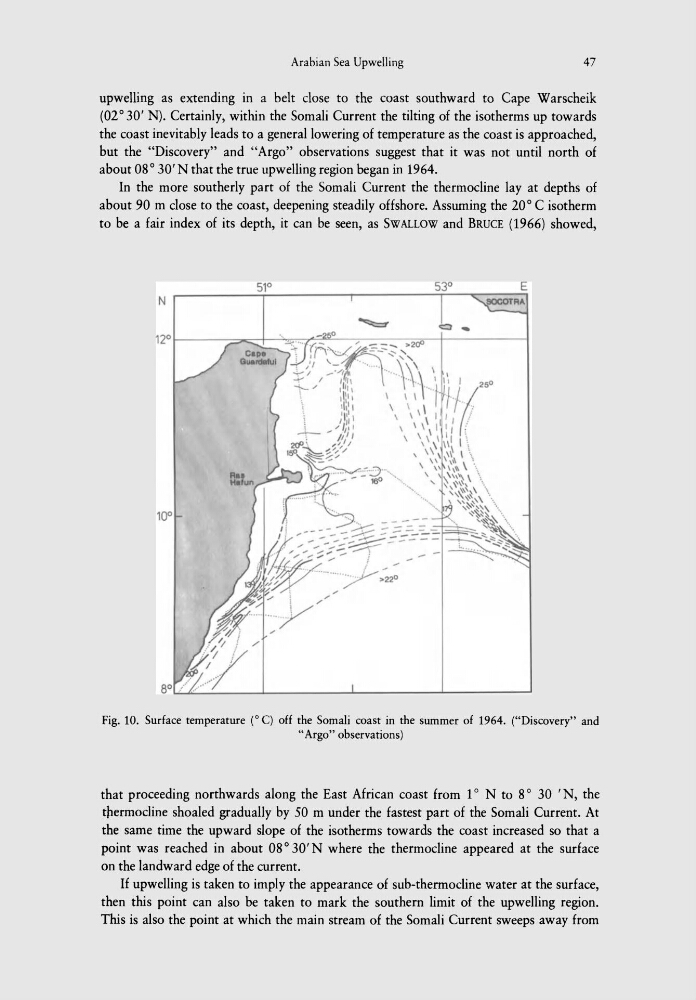
but the "Discovery" and "Argo" observations suggest that it was not until north of
about 08 0 30' N that the true upwelling region began in 1964.
In the more southerly part of the Somali Current the thermocline lay at depths of
about 90 m close to the coast, deepening steadily offshore. Assuming the 20 0 C isotherm
to be a fair index of its depth, it can be seen, as SWALLOW and BRUCE (1966) showed,
N
Fig. 10. Surface temperature (" C) off the Somali coast in the summer of 1964. ("Discovery" and
"Argo" observations)
that proceeding northwards along the East African coast from 1
0
N to 8 0 30 'N, the
t/lermocline shoaled gradually by 50 m under the fastest part of the Somali Current. At
the same time the upward slope of the isotherms towards the coast increased so that a
point was reached in about 08" 30'N where the thermocline appeared at the surface
on the landward edge of the current.
If upwelling is taken to imply the appearance of sub-thermocline water at the surface,
then this point can also be taken to mark the southern limit of the upwelling region.
This is also the point at which the main stream of the Somali Current sweeps away from
47
upwelling as extending in a belt close to the coast southward to Cape Warscheik
(02
0
30' N). Certainly, within the Somali Current the tilting of the isotherms up towards
the coast inevitably leads to a general lowering of temperature as the coast is approached,
but the "Discovery" and "Argo" observations suggest that it was not until north of
about 08 0 30' N that the true upwelling region began in 1964.
In the more southerly part of the Somali Current the thermocline lay at depths of
about 90 m close to the coast, deepening steadily offshore. Assuming the 20 0 C isotherm
to be a fair index of its depth, it can be seen, as SWALLOW and BRUCE (1966) showed,
N
Fig. 10. Surface temperature (" C) off the Somali coast in the summer of 1964. ("Discovery" and
"Argo" observations)
that proceeding northwards along the East African coast from 1
0
N to 8 0 30 'N, the
t/lermocline shoaled gradually by 50 m under the fastest part of the Somali Current. At
the same time the upward slope of the isotherms towards the coast increased so that a
point was reached in about 08" 30'N where the thermocline appeared at the surface
on the landward edge of the current.
If upwelling is taken to imply the appearance of sub-thermocline water at the surface,
then this point can also be taken to mark the southern limit of the upwelling region.
This is also the point at which the main stream of the Somali Current sweeps away from