

Seasonal Studies of a Pelagic Ecosystem (Meridian 110 ° E)
513
where N is the number of species in the count and Pi is the proportion of the total
number of individuals, in the i th species. Units are measured in bits or nits depending
on whether logs are taken to the base 2 or the base e. Log"N measures the diversity of N
equally common species.
I have taken 46 species of copepods (Appendix) as a basis for comparisons of species
diversity between zones and seasons (Figs. 15 a, b). These belong to the families
Eucalanidae (herbivores) and Euchaetidae, Sapphirinidae, and Copiliidae (carnivores).
The figure shows that diversities were usually high and sometimes approached the
upper limits usually found in nature (MARGALEF, 1968 ). They were generally higher in
winter than in summer, with a zon al maximum between the tropics and subtropics. In
spring, night diversities were occasionally high at the extreme north and south of the
Table 10. Correlation between species diversity of selected copepods (HT), copepod concentration (C),
zooplankton biomass (2), chlorophyll a (P), productivity (p), and species diversity of copepods taken
by midwater trawl (He)
Zone
Period
HT:C
HT:Z
HT:P
HT:p
HT:Hc
Tropical
Aug. 62- Feb. 63
+.22
-.11
+.13
M ar. 63 - Aug. 63
+.22
+.16
-.04
Whole Year
+.17
0
+.02
+.25
+.30
Subtropical
Aug. 62 - Feb. 63
+.39**
+ .34*
+.20
Mar. 63 - Aug. 63
+ .29*
+.41 **
-.05
Whole Year
+.32**
+.37**
+.05
+.11
-.03
Whole Section
Aug.-Feb.
+.23
+ .06
+.13
Whole Section
Mar.-Aug.
+.27**
+.34**
-.04
Whole Section
Whole Year
+.24':'"
+.19
+.03
+.15
+.20
Significance (%):
** 99 * 95
section. There were rare instances of low species diversity: one in summer in the region of
the South Equatorial Current and one in autumn in the southern part of the study area.
The first was the result of conspicuous dominance by the carnivore Euchaeta russelli
which reached absolute concentrations approaching 200 m- 3 ; the second was the result of
dominance by the herbivore Eucalanus subtenuis. These are instances of transient
instabilities, a trend that was soon reversed in favour of more complex ecosystems.
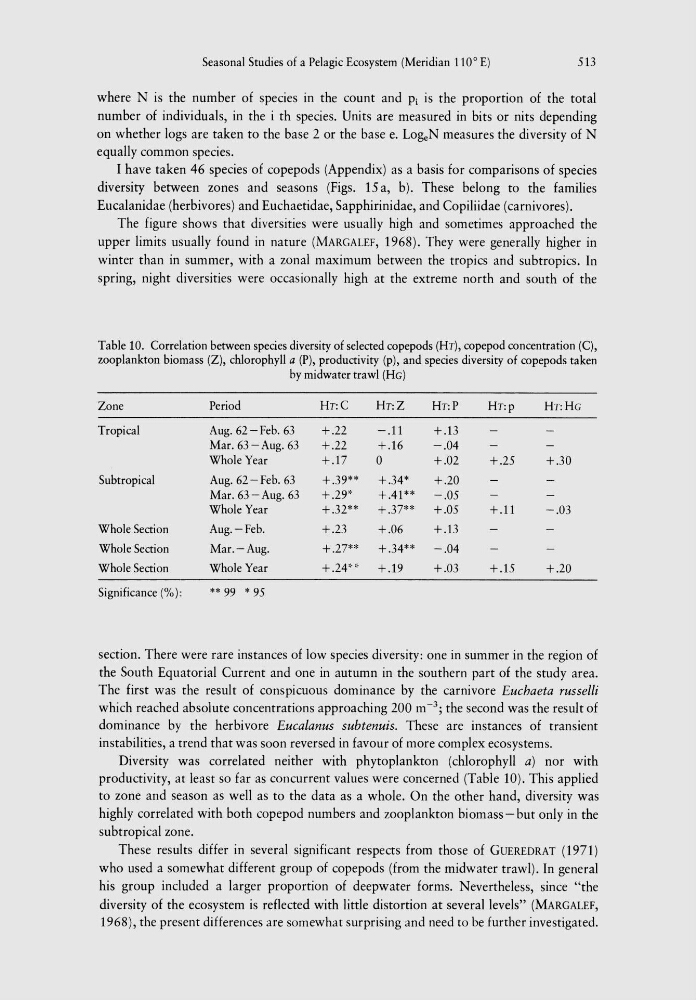
Diversity was correlated neither with phytoplankton (chlorophyll a) nor with
productivity, at least so far as concurrent values were concerned (Table 10). This applied
to zone and season as well as to the data as a whole. On the other hand, diversity was
highly correlated with both copepod numbers and zooplankton biomass - but only in the
subtropical zone.
These results differ in several significant respects from those of GUEREDRAT (1971)
who used a somewhat different group of copepods (from the midwater trawl). In general
his group included a larger proportion of deepwater forms. Nevertheless, since "the
diversity of the ecosystem is reflected with little distortion at several levels" (MARGALEF,
1968 ), the present differences are somewhat surprising and need to be further investigated.
513
where N is the number of species in the count and Pi is the proportion of the total
number of individuals, in the i th species. Units are measured in bits or nits depending
on whether logs are taken to the base 2 or the base e. Log"N measures the diversity of N
equally common species.
I have taken 46 species of copepods (Appendix) as a basis for comparisons of species
diversity between zones and seasons (Figs. 15 a, b). These belong to the families
Eucalanidae (herbivores) and Euchaetidae, Sapphirinidae, and Copiliidae (carnivores).
The figure shows that diversities were usually high and sometimes approached the
upper limits usually found in nature (MARGALEF, 1968 ). They were generally higher in
winter than in summer, with a zon al maximum between the tropics and subtropics. In
spring, night diversities were occasionally high at the extreme north and south of the
Table 10. Correlation between species diversity of selected copepods (HT), copepod concentration (C),
zooplankton biomass (2), chlorophyll a (P), productivity (p), and species diversity of copepods taken
by midwater trawl (He)
Zone
Period
HT:C
HT:Z
HT:P
HT:p
HT:Hc
Tropical
Aug. 62- Feb. 63
+.22
-.11
+.13
M ar. 63 - Aug. 63
+.22
+.16
-.04
Whole Year
+.17
0
+.02
+.25
+.30
Subtropical
Aug. 62 - Feb. 63
+.39**
+ .34*
+.20
Mar. 63 - Aug. 63
+ .29*
+.41 **
-.05
Whole Year
+.32**
+.37**
+.05
+.11
-.03
Whole Section
Aug.-Feb.
+.23
+ .06
+.13
Whole Section
Mar.-Aug.
+.27**
+.34**
-.04
Whole Section
Whole Year
+.24':'"
+.19
+.03
+.15
+.20
Significance (%):
** 99 * 95
section. There were rare instances of low species diversity: one in summer in the region of
the South Equatorial Current and one in autumn in the southern part of the study area.
The first was the result of conspicuous dominance by the carnivore Euchaeta russelli
which reached absolute concentrations approaching 200 m- 3 ; the second was the result of
dominance by the herbivore Eucalanus subtenuis. These are instances of transient
instabilities, a trend that was soon reversed in favour of more complex ecosystems.
Diversity was correlated neither with phytoplankton (chlorophyll a) nor with
productivity, at least so far as concurrent values were concerned (Table 10). This applied
to zone and season as well as to the data as a whole. On the other hand, diversity was
highly correlated with both copepod numbers and zooplankton biomass - but only in the
subtropical zone.
These results differ in several significant respects from those of GUEREDRAT (1971)
who used a somewhat different group of copepods (from the midwater trawl). In general
his group included a larger proportion of deepwater forms. Nevertheless, since "the
diversity of the ecosystem is reflected with little distortion at several levels" (MARGALEF,
1968 ), the present differences are somewhat surprising and need to be further investigated.