

504
D. J. TRANTER:
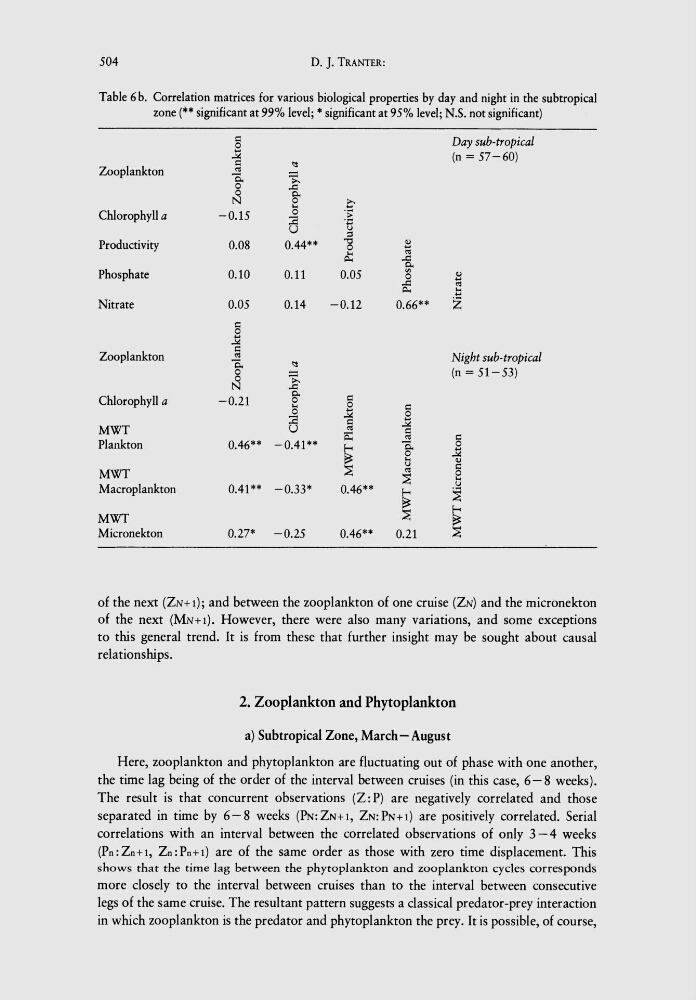
Table 6b. Correlation matrices for various biological properties by day and night in the subtropical
zone (** significant at 99% level; * significant at 95% level; N.S. not significant)
t::
Day sub-tropical
0
J;i
(n = 57-60)
t::
<:!
Zooplankton
' "
P..
>0
..c:
0
8N
...
C
Chlorophyll a
-0.15
0
.:;
:2
'0
u
u
::l
Productivity
0.08
0.44**
"0
...
...
' "
~
..c:
~
Phosphate
0.10
0.11
0.05
'"
...
..c:
' "
~
...
...
Nitrate
0.05
0.14
-0.12
0.66**
Z
t::
0
...
~
Zooplankton
t::
Night sub-tropical
' "
P..
<:!
0
>(n = 51-53)
0
N
..c:
Chlorophyll a
-0.21
8t::
...
0
t::
0
...
0
~
:2
t::
J;i
MWT
u
' "
t::
is::
' "
c:
Plankton
0.46** -0.41**
f-<
P..
0
~
0
J;i
...
c:
MWT
'"
0
::;s
....
Macroplankton
u
0.41 *- -0.33*
0.46**
f-<
~
~
f-<
MWT
::;s
~
Micronekton
0.27*
-0.25
0.46*0.21
::;s
of the next (ZN+l); and between the zooplankton of one cruise (ZN) and the micronekton
of the next (MN+1). However, there were also many variations, and some exceptions
to this general trend. It is from these that further insight may be sought about causal
relationships.
2. Zooplankton and Phytoplankton
a) Subtropical Zone, March - August
Here, zooplankton and phytoplankton are fluctuating out of phase with one another,
the time lag being of the order of the interval between cruises (in this case, 6 - 8 weeks).
The result is that concurrent observations (Z: P) are negatively correlated and those
separated in time by 6-8 weeks (PN:ZN+l, ZN:PN+l) are positively correlated. Serial
correlations with an interval between the correlated observations of only 3 - 4 weeks
(Pn: Zn+1, Zn :Pn+l) are of the same order as those with zero time displacement. This
shows that the time lag between the phytoplankton and zooplankton cycles corresponds
more closely to the interval between cruises than to the interval between consecutive
legs of the same cruise. The resultant pattern suggests a classical predator-prey interaction
in which zooplankton is the predator and phytoplankton the prey. It is possible, of course,
D. J. TRANTER:
Table 6b. Correlation matrices for various biological properties by day and night in the subtropical
zone (** significant at 99% level; * significant at 95% level; N.S. not significant)
t::
Day sub-tropical
0
J;i
(n = 57-60)
t::
<:!
Zooplankton
' "
P..
>0
..c:
0
8N
...
C
Chlorophyll a
-0.15
0
.:;
:2
'0
u
u
::l
Productivity
0.08
0.44**
"0
...
...
' "
~
..c:
~
Phosphate
0.10
0.11
0.05
'"
...
..c:
' "
~
...
...
Nitrate
0.05
0.14
-0.12
0.66**
Z
t::
0
...
~
Zooplankton
t::
Night sub-tropical
' "
P..
<:!
0
>(n = 51-53)
0
N
..c:
Chlorophyll a
-0.21
8t::
...
0
t::
0
...
0
~
:2
t::
J;i
MWT
u
' "
t::
is::
' "
c:
Plankton
0.46** -0.41**
f-<
P..
0
~
0
J;i
...
c:
MWT
'"
0
::;s
....
Macroplankton
u
0.41 *- -0.33*
0.46**
f-<
~
~
f-<
MWT
::;s
~
Micronekton
0.27*
-0.25
0.46*0.21
::;s
of the next (ZN+l); and between the zooplankton of one cruise (ZN) and the micronekton
of the next (MN+1). However, there were also many variations, and some exceptions
to this general trend. It is from these that further insight may be sought about causal
relationships.
2. Zooplankton and Phytoplankton
a) Subtropical Zone, March - August
Here, zooplankton and phytoplankton are fluctuating out of phase with one another,
the time lag being of the order of the interval between cruises (in this case, 6 - 8 weeks).
The result is that concurrent observations (Z: P) are negatively correlated and those
separated in time by 6-8 weeks (PN:ZN+l, ZN:PN+l) are positively correlated. Serial
correlations with an interval between the correlated observations of only 3 - 4 weeks
(Pn: Zn+1, Zn :Pn+l) are of the same order as those with zero time displacement. This
shows that the time lag between the phytoplankton and zooplankton cycles corresponds
more closely to the interval between cruises than to the interval between consecutive
legs of the same cruise. The resultant pattern suggests a classical predator-prey interaction
in which zooplankton is the predator and phytoplankton the prey. It is possible, of course,