

Production in the Indian Ocean and the Transfer from the Primary to the Secondary Level 485
gonad has to create so much excess material in order to produce a second gonad one
generation later. For Calanus finmarchicus, the ratio of gonad to body weight is 0.15
(from data given in MARSHALL and ORR, 1952) and this tends to increase for smaller
copepods. Perhaps the highest transfer coefficients of just over 20% represent a mean
ratio of gonad to body weight.
The fact that the observed mean value of 10% is close to that expected implies either
that the primary and secondary productions are well estimated or that they are both
biased in the same way. Therefore, if the primary production is considered to be correct,
so is the secondary production. If true secondary production were 50% greater than the
estimate given, the mean transfer coefficient would be 15 %.
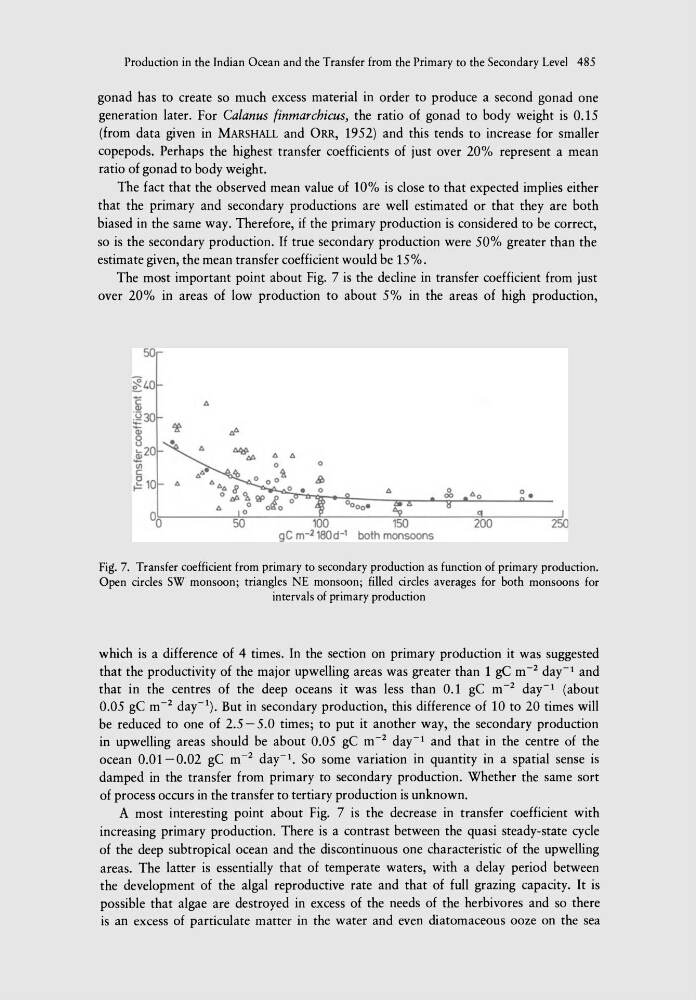
The most important point about Fig. 7 is the decline in transfer coefficient from just
over 20% in areas of low production to about 5% in the areas of high production,
50
~40
~
~30
~
~20
III
c
~ 10
Fig. 7. Transfer coefficient from primary to secondary production as function of primary production.
Open circles SW monsoon; triangles NE monsoon; filled circles averages for both monsoons for
intervals of primary production
which is a difference of 4 times. In the section on primary production it was suggested
that the productivity of the major upwelling areas was greater than 1 gC m- 2 day-I and
that in the centres of the deep oceans it was less than 0.1 gC m -2 day-I (about
0.05 gC m- 2 day-I). But in secondary production, this difference of 10 to 20 times will
be reduced to one of 2.5 - 5.0 times; to put it another way, the secondary production
in upwelling areas should be about 0.05 gC m- 2 day-I and that in the centre of the
ocean 0.01- 0.02 gC m -2 day-I. So some variation in quantity in a spatial sense is
damped in the transfer from primary to secondary production. Whether the same sort
of process occurs in the transfer to tertiary production is unknown.
A most interesting point about Fig. 7 is the decrease in transfer coefficient with
increasing primary production. There is a contrast between the quasi steady-state cycle
of the deep subtropical ocean and the discontinuous one characteristic of the upwelling
areas. The latter is essentially that of temperate waters, with a delay period between
the development of the algal reproductive rate and that of full grazing capacity. It is
possible that algae are destroyed in excess of the needs of the herbivores and so there
is an excess of particulate matter in the water and even diatomaceous ooze on the sea
gonad has to create so much excess material in order to produce a second gonad one
generation later. For Calanus finmarchicus, the ratio of gonad to body weight is 0.15
(from data given in MARSHALL and ORR, 1952) and this tends to increase for smaller
copepods. Perhaps the highest transfer coefficients of just over 20% represent a mean
ratio of gonad to body weight.
The fact that the observed mean value of 10% is close to that expected implies either
that the primary and secondary productions are well estimated or that they are both
biased in the same way. Therefore, if the primary production is considered to be correct,
so is the secondary production. If true secondary production were 50% greater than the
estimate given, the mean transfer coefficient would be 15 %.
The most important point about Fig. 7 is the decline in transfer coefficient from just
over 20% in areas of low production to about 5% in the areas of high production,
50
~40
~
~30
~
~20
III
c
~ 10
Fig. 7. Transfer coefficient from primary to secondary production as function of primary production.
Open circles SW monsoon; triangles NE monsoon; filled circles averages for both monsoons for
intervals of primary production
which is a difference of 4 times. In the section on primary production it was suggested
that the productivity of the major upwelling areas was greater than 1 gC m- 2 day-I and
that in the centres of the deep oceans it was less than 0.1 gC m -2 day-I (about
0.05 gC m- 2 day-I). But in secondary production, this difference of 10 to 20 times will
be reduced to one of 2.5 - 5.0 times; to put it another way, the secondary production
in upwelling areas should be about 0.05 gC m- 2 day-I and that in the centre of the
ocean 0.01- 0.02 gC m -2 day-I. So some variation in quantity in a spatial sense is
damped in the transfer from primary to secondary production. Whether the same sort
of process occurs in the transfer to tertiary production is unknown.
A most interesting point about Fig. 7 is the decrease in transfer coefficient with
increasing primary production. There is a contrast between the quasi steady-state cycle
of the deep subtropical ocean and the discontinuous one characteristic of the upwelling
areas. The latter is essentially that of temperate waters, with a delay period between
the development of the algal reproductive rate and that of full grazing capacity. It is
possible that algae are destroyed in excess of the needs of the herbivores and so there
is an excess of particulate matter in the water and even diatomaceous ooze on the sea